Violence, intimidation and fear: 10 years on from the ‘Jungle’, life in Calais migrant camps is harsher than ever

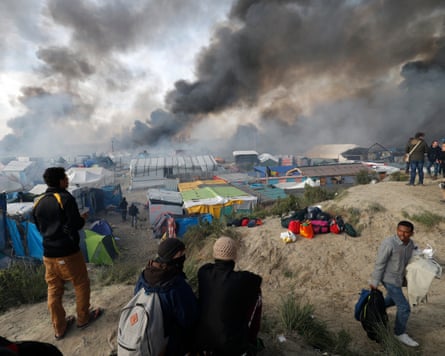
In the decade since the demolition of the “Jungle”, an area of Calais where thousands of asylum seekers set up makeshift shelters before embarking on Channel crossings to the UK, everything and nothing has changed.
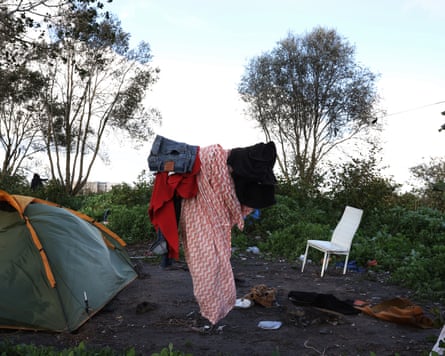
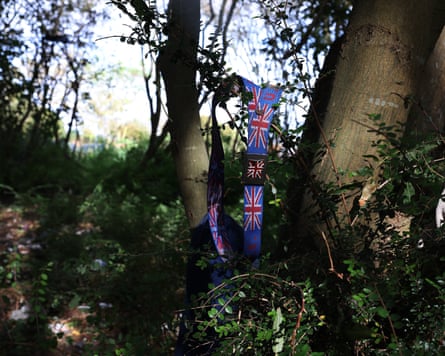
This week, in a woodland clearing not far from one of Calais’s busy main roads, several brightly coloured tents are pitched. A jacket hanging from a tree branch blows in the brisk autumnal breeze alongside a belt decorated with union flags. It is only October but the wind makes the temperature feel several degrees chillier.
“I live in a tent,” says Adam*, at a nearby charity-run phone charging session. He is an electrical engineering student from Sudan who fled his country when the war started. “We have been evicted so many times. It is not worth having any possessions because the police take everything. I only have the clothes you can see me wearing now.”
Successive UK governments have spent hundreds of millions of pounds on numerous initiatives to curb illegal migration via northern France, including paying the French for police enforcement along the coast. On Wednesday Rob Jones, the director general of operations at the National Crime Agency, told MPs that thanks to UK-France efforts the business model of the people smugglers enabling small boat crossings was “starting to shake”.
Nonetheless more than 200,000 asylum seekers have made the journey from Calais to the UK since the “Jungle” – one of the largest of its kind in Europe – ceased to exist. On the 10th anniversary of it being torn down, about 4,000 people remain in smaller camps in Calais, Dunkirk and Boulogne, waiting to cross the sea.
The predominant nationalities hoping to reach the UK are almost the same as they were in 2016 – Eritreans, Sudanese, Somalis, Iranians and Afghans. Their resolve to reach the UK, where they believe they will be safe, has not weakened. Living conditions continue to be harsh and basic.
While the number of people arriving in the UK illegally on small boats has been steadily dropping, from more than 41,000 in 2025 to about 21,000 so far this year, this can in part be attributed to an overall reduction of irregular migration to Europe, as well as a large number of windy days – making Channel crossings more difficult.
In 2016 almost nobody crossed the Channel in small boats. But from 2018 onwards, small boat crossings began to rise. A policy of “zero point de fixation” was introduced in France to prevent the establishment of another large encampment. As a result, small living sites in wooded areas – particularly in Calais – are evicted on average once every 48 hours, with asylum seekers having tents, clothing and other possessions destroyed or confiscated by police in the process. Most will set up a new camp nearby, often with donations of tents from charities.
Human Rights Observers, an organisation set up to document the treatment of asylum seekers in northern France by authorities, described this cycle as the “border spectacle”.
Far-right agitators have travelled from the UK to harass people in the makeshift camps, leading French authorities to ban 10 people from entering the country. But more continue to arrive. Recently two agitators from Belgium and a third from Poland also travelled to northern France to harass and intimidate the asylum seekers.
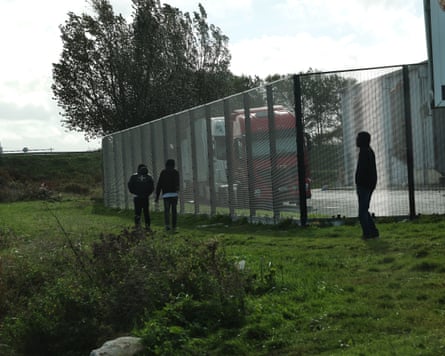
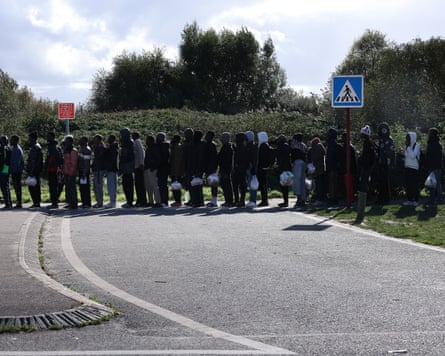
Many at the phone charging session have attempted to cross the Channel to the UK several times. This week’s home affairs committee heard evidence that the average number of crossing attempts a person has increased from three to seven.
Treatment by police is a much-discussed topic among those charging their phones. The French charity Utopia 56, which supports displaced and homeless people, says it has documented a 40% increase in violence by police towards asylum seekers between April and August 2026 compared with the same period last year.
after newsletter promotion
“I understand that the police are doing their work but why do they have to be so aggressive?” says one boy at the session, who does not wish to be named. “They stop me so often in Calais even when I am not trying to cross. Life in Calais is too difficult, everyone wants to leave as quickly as possible. I’m 16, I’m too young for this life but I don’t have a choice.”
Human Rights Observers counted 539 evictions of 3,792 people in Calais last year. They say firewood used for warmth and cooking is seized during evictions.
Project Play, which supports displaced children and families in northern France, also says they have observed an increase in aggressive behaviour by police.
“In recent years, we have seen an escalation in violence against everyone at the border – including children and families,” Katie Hall, advocacy lead at Project Play, said. “This year, we have also seen the police forcibly separating families, including by preventing parents from reaching children already on boats by taking hold of their other children.
“This is catastrophic for human rights, and reflects a politics devoid of empathy and humanity.”
With his phone fully charged, Adam leaves the session with a cheerful wave, carrying several takeaway containers of food provided by the charity to share with friends in neighbouring tents.
“I don’t know if I will ever find a way of continuing my degree but for now I am just trying to find somewhere I won’t be evicted from every two days,” he says. “I would like to reach the UK because I can speak English. But I am scared of the water so don’t want to get into a dinghy. I am trying to claim asylum in France. There is no straight road to safety.”
KioskNews shows a cleaned-up reading view extracted from the publisher’s page — the original always lives on their site, not ours.