Taipower head wants power sector at the table in tech decisions
The electricity industry should be brought into technology-sector decision-making as soon as possible, Taiwan Power Co (Taipower, 台電) chairman Tseng Wen-sheng (曾文生) said yesterday.
Energy would become increasingly important to the technology industry because computing power depends on electricity, Tseng said at a news conference ahead of the Net-Zero Taiwan and Energy Taiwan exhibitions, which open tomorrow.
Electricity will also become a critical part of the supply chains of the semiconductor and technology industries, he said.
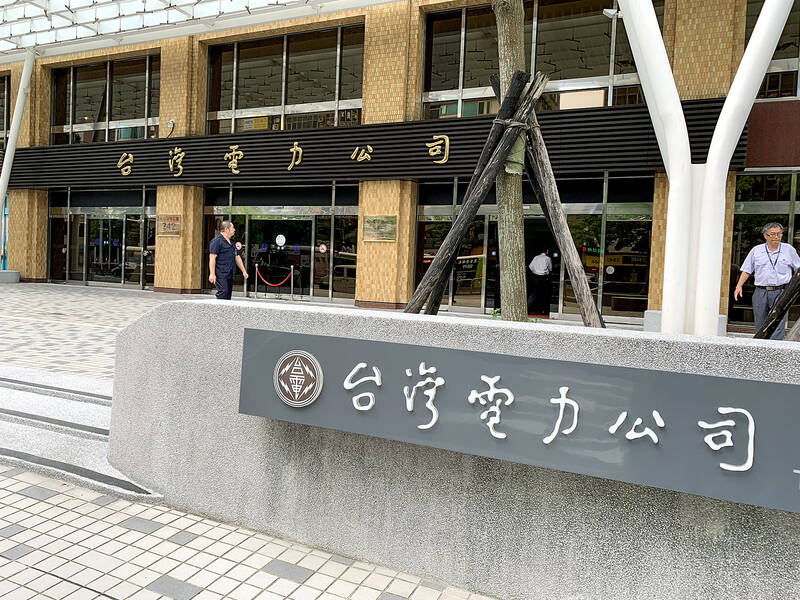
The signage of Taiwan Power Co is pictured at the company’s building in Taipei on Dec. 30 last year.
Photo: Lin Jing-hua, Taipei Times
As industrial power supply and demand patterns evolve, Taipower should play a greater role in industrial decision-making rather than simply providing electricity, Tseng said.
He said parts of Taipower’s operations should take a more industry-oriented approach, enabling the company to better understand the technology sector’s operating models, business challenges, financial arrangements and supply chain partnerships.
As businesses’ demand for renewable energy grows, electricity suppliers and consumers should jointly discuss energy procurement, the acquisition of renewable energy certificates and energy storage, he said.
Tseng noted that because the industry sector changes rapidly, the time frame for electricity investment decisions has shortened from about 10 years to five years, or even three.
He hopes to hold more talks with the technology, renewable energy and other industries to discuss electricity market rules and ways to cooperate, the Taipower chairman said.
Taiwan’s current electricity supply is sufficient and Tapower could meet the country’s industrial development needs, Tseng said.
He cited Taiwan’s global ranking in investment in natural gas-fired power generation, third in 2024 and sixth last year, as evidence of the rapid pace of investment in power generation.
However, he warned that electricity demand from artificial intelligence applications could grow exponentially. If companies build their own data centers or keep computing operations on-site to protect trade secrets, demand for computing power in Taiwan could also become more difficult to predict, he said.
Taipower is closely monitoring electricity distribution and the growth in demand for high-voltage power, Tseng said.
Meeting the rapidly growing demand for computing power will require not only enough electricity generation but also a grid that can deliver power where and when it is needed, while coordinating with renewable energy sources and energy storage systems, he said.
KioskNews shows a cleaned-up reading view extracted from the publisher’s page — the original always lives on their site, not ours.