Notes from Central Taiwan: The real vector of PRC influence in Taiwan
The activities of legislator May Chin and her staff may show a campaign operating at a low level over many years, involving flows of resources and deep personal relationships
By Michael A. Turton / Contributing reporter


One of the most important corruption cases of the year faded from the public eye for a while this summer, only to resurface last week as prosecutors brought in “independent” indigenous legislator May Chin (高金素梅) for questioning and the Coast Guard seized two fishing boats in connection with the sprawling set of cases around her.
The first set of cases involves one of the most common forms of legislative corruption in Taiwan: embezzling funds intended to pay assistants. In June, the Taipei District Prosecutors’ Office indicted Chin and 23 others linked to her office on charges including alleged embezzlement, forgery, money laundering and illegal imports of COVID-19 rapid test kits from China. Prosecutors alleged that Chin directed her staffers to create records of non-existent aides so that Chin could collect the money. She was accused of embezzling more than NT$7.87 million.
Among the staffers caught up in the probe was Chang Chun-chieh (張俊傑), Chin’s former chief of staff. Chang was accused of being involved in the embezzlement of assistant salaries, and of using an Indigenous cultural association to fraudulently obtain over NT$9.33 million from government agencies and state-owned enterprises. Chang was held incommunicado for four months and then released on NT$10 million bail in June due to his advanced age (70) and the fact that he was suffering from lung cancer.

Legislator May Chin leaves the Taipei District Court on Oct. 27.
Photo: CNA
In early September, Chang cut the electronic bracelet used to monitor his movements and disappeared.
PRC SPY?
Prosecutors believe that Chang was working for the People’s Republic of China (PRC) and had established an espionage ring in Taiwan. They also suspected that Chang made lists of Indigenous leaders and pro-independence religious figures. He is alleged to have received NT$100 million to support his activities.
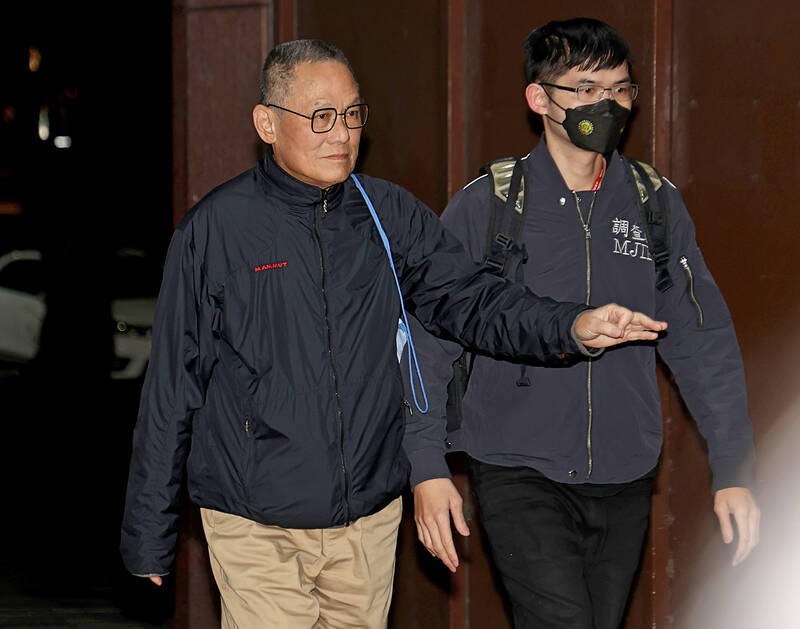
The Investigation Bureau transfers Chang Chun-chieh, left, to the Taipei District Prosecutors Office on Feb. 11.
Photo: CNA
During his bold run across Taiwan, according to a Mirror Media report, police and prosecutors twice located his hideout, but Chang’s constant changes of location enabled him to elude capture.
He frequently changed cars and phones during his escape, in which police have so far apprehended more than 50 people suspected of helping him. These include active-duty military personnel, organized crime figures, temple members and fishing boat captains. According to local media reports, he left Taiwan via a fishing boat from Jhengbin Fishing Harbor (正濱漁港) late last month.
The fact that Chang was released despite investigators suspecting him of operating a spy ring deserves greater scrutiny. An electronic monitoring bracelet is easily circumvented. Was his escape an operation permitted by the Taiwan government in order to get him to activate his networks so they could be rounded up? If so, it seems quite successful.
A few days after Chang escape, prosecutors detained and questioned Chin’s aide Lin I-chun (林怡君) and then-chief of staff Chen Chih-huang (陳智葟). They were held incommunicado. According to Mirror Media, Lin confessed that he had attended courses conducted by the PRC’s United Front Work Department in China. For example, in 2008 Lin went to Hong Kong to attend a class on training Indigenous youth given by the United Front Work Department.
REAL INFLUENCE CAMPAIGN
Last Monday, Chin was questioned by investigators for the first time. She was interrogated for nearly eight hours. The questions covered issues such as her trips to China, contacts with officials and united front operatives, and whether she was given funds. According to local reports, she denied all knowledge of United Front Work activities and Chang’s espionage efforts. Chin is currently released without bail but is forbidden to leave the country.
There is often a tendency to dismiss claims that politicians and political parties in Taiwan have links to the PRC. But consider that Chin’s chief of staff allegedly ran an espionage ring, dispatched aides to take United Front courses, accepted large sums of money from the PRC for use in Taiwan, then activated a wide network of contacts to evade capture and flee the country. Even if Chin is as guiltless as she publicly maintains, the conduit for PRC influence is there among her staff.
Too much focus has been on specific politicians or specific events, such as trips to the PRC by ranking political figures. Chin herself attracted much attention when she led a Taiwanese Indigenous group to perform at the opening of the 2008 Beijing Olympics. The real influence campaign, as shown by Chin and her staff, operates at a lower level over long periods of time, and involves flows of resources from the PRC to Taiwan and the cultivation of deep personal relationships.
INDIGENOUS COMMUNITIES
For example, one vector for PRC influence enabled by Chin is donations. A week after Typhoon Morakot devastated southern Taiwan, Chin went to the PRC as head of a delegation representing Taiwanese Indigenous communities, where she met with Chinese leader Hu Jintao (胡錦濤). Wang Yi (王毅), then the head of the Taiwan Affairs Office, gave her a donation of NT$100 million, out of which she distributed gifts of NT$30,000 to distressed Indigenous households, and NT$5,000 to elementary and junior high students.
Prosecutors have also charged Chin with illegally importing COVID-19 test kits from the PRC, a violation of the Medical Devices Act (醫療器材管理法). According to the indictment, Chin organized the importation of the kits from Xiamen Baotai Biotechnology Co, Ltd, in Fujian in 2022, using a legal exemption for personal use. She authorized Chang to obtain from other legislators names of individuals who would be willing to work with such a project, and imported 74,400 kits, free of charge, using their personal use exemptions. Chin said that the test kits were brought in to help Indigenous communities, since there was a shortage at the time.
Chin has also facilitated donations of more than 20 buses and vans from PRC firms to Indigenous communities all over Taiwan. According to Mirror Media, some of the vehicles were given by a company owned by Beijing Enterprises Holdings Limited (北京控股集團), a state-owned firm.
One of Chin’s strategies is expanding her service activities to Indigenous communities across the island, instead of limiting her activities to her own district. This approach enables her to have a “global” influence across such communities in Taiwan.
Chinese Nationalist Party (KMT) Chairwoman Cheng Li-wun’s (鄭麗文) trip to the PRC in April made international headlines. That kind of influence is clumsy and choreographed, yet also shallow and evanescent. Its very public nature makes the PRC’s influence easy to see and counteract, and easy for observers to dismiss. Chin’s activities, involving specific communities and their needs over many years, are another thing entirely.
She can’t be the only one.
Notes from Central Taiwan is a column written by long-term resident Michael Turton, who provides incisive commentary informed by three decades of living in and writing about his adoptive country. The views expressed here are his own.
KioskNews shows a cleaned-up reading view extracted from the publisher’s page — the original always lives on their site, not ours.