Hotel Management vs Hospitality Management: Which is best for you? | The Right Choice
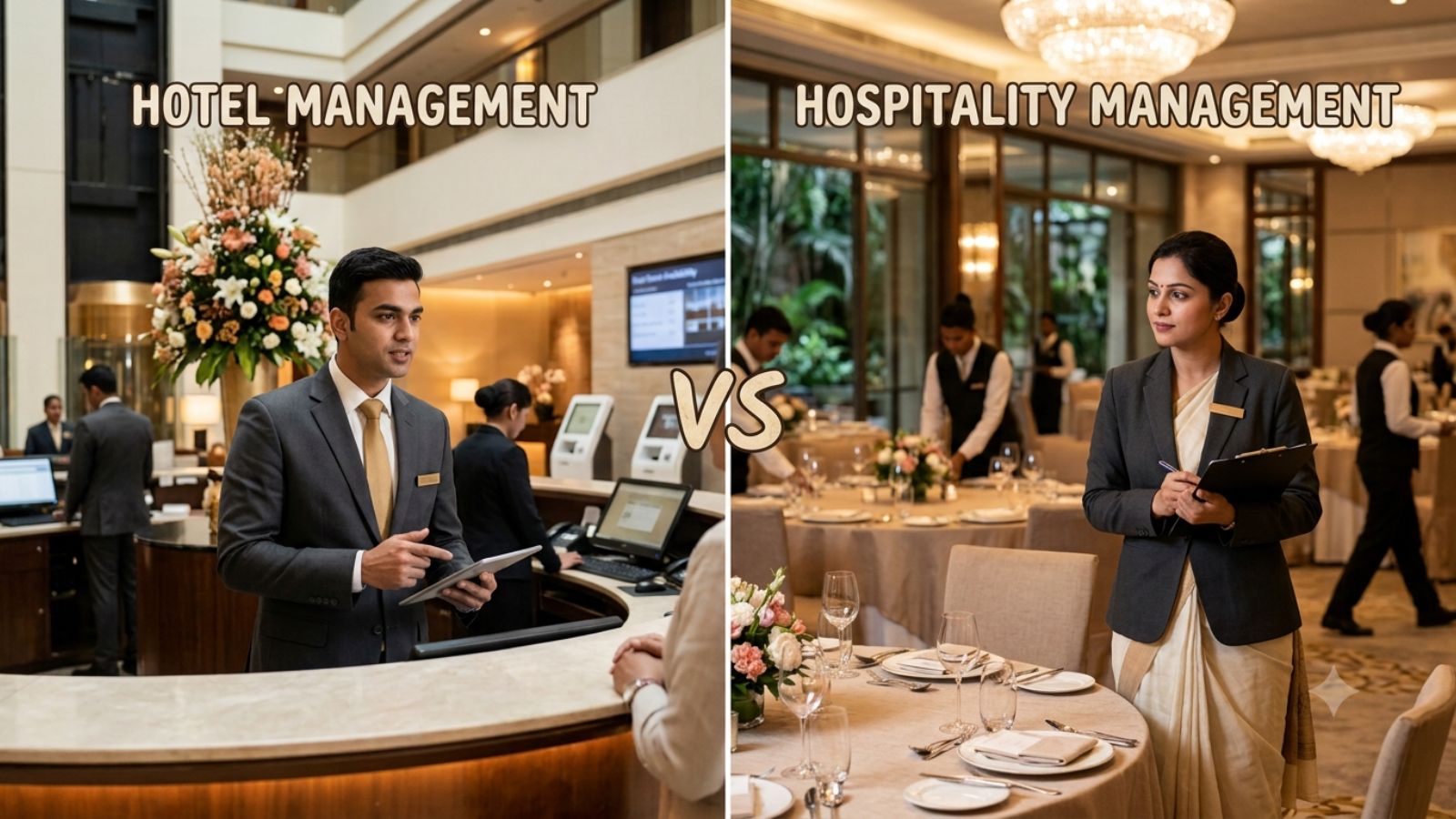
When it comes to building a career in the service industry, Hotel Management has traditionally been the go-to choice for students. However, Hospitality Management has now emerged as another popular option, giving students a broader way to look at careers in the sector. While the two courses may sound similar, they can offer different learning experiences and career pathways.
For students and parents making this important decision, the question is not simply which course has the more familiar or attractive title. What matters more is the kind of skills and exposure each course provides, the career opportunities it can open up, and how well it can support a student’s professional growth in the long run.
What is Hotel Management
Hotel Management has traditionally been concerned with the development of a solid knowledge base in hotel operations. The study involves learning about various aspects, including food production, food and beverage service, the front office, housekeeping, accommodation operations, and guest service.
This subject is very practical and gives students an opportunity to learn about the functioning of different departments within the hotel and how they operate to provide the same experience to all the guests. The knowledge obtained from learning about different departments of the hotel can be very practical for future work in the field.
What Hospitality Management adds
Hospitality Management applies this operating framework to the wider business and service context. Together with the operations framework, the students become more familiar with concepts such as leadership, human resource management, training and development, sales and marketing, customer experience, finance, entrepreneurship, events, and service management.
Simply Hotel Management gives the necessary operational base, while Hospitality Management gives the opportunity for this base to extend to broader managerial and service-related careers.
Such an expanded scope becomes increasingly important as the hospitality industry evolves from just being hotel-related into different businesses focused on customer service.
Story continues below this ad
Wide range of career opportunities
One of the biggest changes in the hospitality sector is the expanding range of career opportunities available to graduates. A graduate from the field of hospitality need not necessarily work only at hotels. The training that one receives while being educated in the field of hospitality can be useful in airlines, airports, cruise ships, luxury retail, hospitals, corporate establishments, tourism, institutions, events, multinational service organizations, and many more. Depending upon the level of expertise and if any specialized training or certification is required, individuals might even choose careers in learning and development, human resources, quality control, operational audits, compliance, revenue management, customer experience management, procurement, administration, and cruises.
All of this is because of the fact that hospitality training prepares one for such diverse fields of work. Moreover, apart from studying management concepts in theory, students learn how to communicate effectively, operate in groups, meet professional standards, manage situations in real-time, handle complaints, understand quality standards, and work under pressure. These are not just skills related to the hospitality sector, as these are management skills that could serve well in any industry requiring the expertise of managing people and delivering quality experience to customers.
Options beyond private sector
There are more career options that one may consider beyond working for private firms. Based on the eligibility requirements of specific positions and recruitment conditions, the possibility of joining organizations providing tourism-related services, institutional hospitality services, public sector firms, and government-linked organizations.
It means that students will get more options in terms of exploring different sectors as they grow in their careers. Rather than being confined to one sector alone, the operational knowledge, communication skills, and management skills that they have acquired can now be put into use in other sectors too. This could be an advantage for those students who are still exploring themselves professionally.
Story continues below this ad
Preparing students for long-term careers
The holistic approach to hospitality education has formed its educational philosophy over the last few decades. Instead of training students to become just regular hotel employees, this approach helps form professionals that would be able to make their way through different hospitality services and related industries.
Practical experience, industry relations, professional formation, leadership training, and international experience are regarded as significant parts of career training. Depending on their gained experience, professionals could change their roles, become managers, concentrate on a certain function, or switch to another service industry.
Where could hospitality education lead?
Career paths of graduates illustrate the range of opportunities that hospitality education may offer to students. Graduates went from working in hotels to taking leadership positions in the international hospitality industry, becoming aviators, cruise professionals, joining corporations, opening their own businesses, and working in various service industries around the globe.
It shows the new direction of hospitality education itself. It is no longer only about preparing students to work in hotels. It can serve as a starting point for people seeking to have careers in diverse customer-centric and service-oriented settings.
Story continues below this ad
In other words, this means that choosing a course related to hospitality does not imply commitment to one particular job role or one particular industry for the entire duration of a student’s career life.
Hotel Management or Hospitality Management: Which one is right for you?
In the end, it all comes down to a student’s interests, abilities, and career aspirations.
For students interested in learning about hotel management in depth and developing practical expertise in areas such as food production, food and beverage service, front office, housekeeping, and accommodation management, Hotel Management is still a great profession to consider.
For those interested in the same hospitality management foundation along with exposure to various functions and service industries, Hospitality Management is the option with more scope. However, the program itself is just one of the factors that must be considered by potential students. The institution, the curriculum, training, industry relations, grooming of professionals, international exposure, etc. must also be considered when deciding which path is better.
The choice between Hotel Management and Hospitality Management must not be made solely on the basis of the title of the course or the first job it may lead to. The important factor in all cases is how solid a base the program will create for the future. With proper education and training, the students will have everything necessary to enter the hospitality industry and then explore their options. Thus, the ultimate goal of the choice is not the selection of the job, but rather the creation of a flexible career.
Author is Founder-Director of NIPS Institute of Hotel Management
KioskNews shows a cleaned-up reading view extracted from the publisher’s page — the original always lives on their site, not ours.