Drones, Shaurya commandos and underground bunkers: How ITBP is preparing for China along LAC
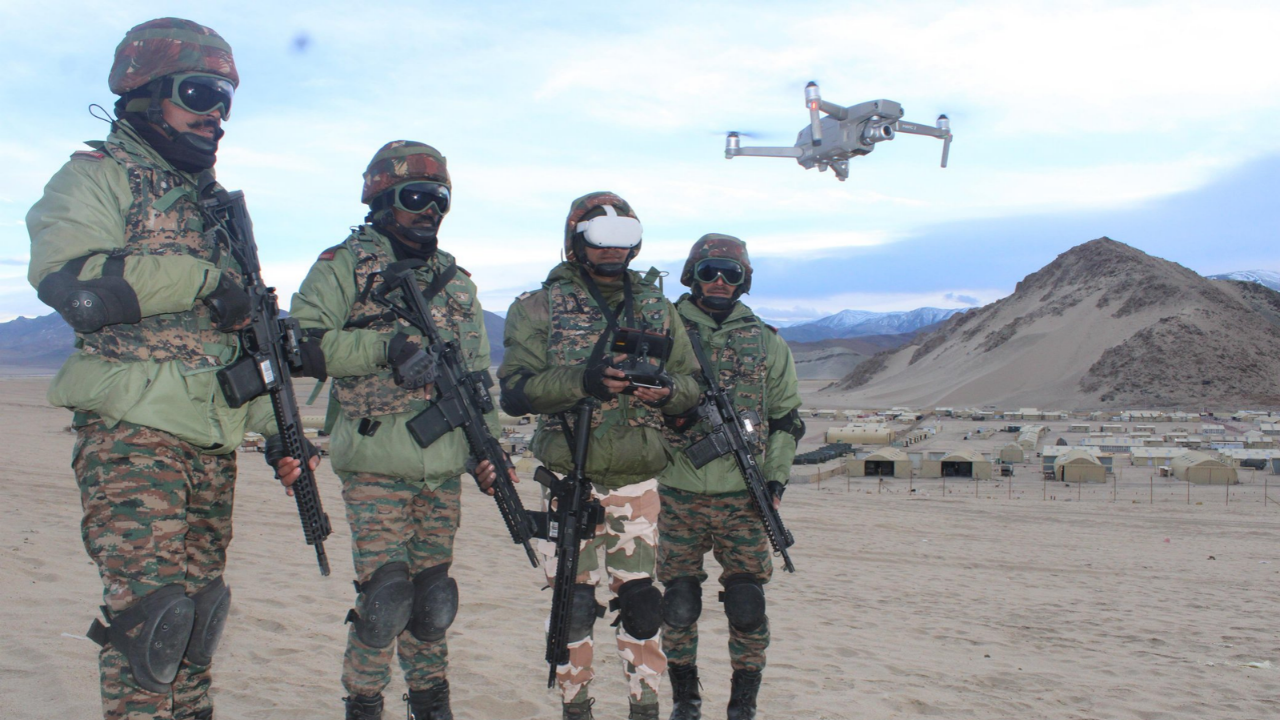
An ITBP trooper operating a first-person-view drone in an exercise with the army. (Image credit: Indian Army)
The Indo-Tibetan Border Police is expanding its drone warfare capabilities, raising specialised commando platoons and developing underground shelters along the Line of Actual Control (LAC) with China as the force adapts to changing battlefield requirements.
The measures form part of a broader modernisation drive following the 2020 India-China border clashes, with the ITBP placing greater emphasis on unmanned systems, high-altitude combat training and the protection of troops and infrastructure against modern weapons. ITBP Director General Shatrujeet Singh Kapoor said each border-guarding battalion now has a drone platoon and that the force is training drone pilots while also working on drone development.
The ITBP is one of seven Central Armed Police Forces along with Assam Rifles, Border Security Force, Sashastra Seema Bal, Central Industrial Security Force, Central Reserve Police Force and National Security Guard.The force has received Rs 400 crore for modernisation, with 70% earmarked for strengthening drone warfare capabilities, according to Kapoor. The Ministry of Home Affairs has also given in-principle approval to a larger modernisation plan worth Rs 4,000 crore, of which Rs 1,000 crore is intended for drone and anti-drone systems.
The ITBP is also developing a training course called ‘Strike’, aimed at preparing personnel to handle situations similar to the 2020 Galwan Valley clash.
The force plans to train all its personnel under the programme by the end of 2027.
Shaurya commandos, drones to guard LAC
The ITBP has also raised Shaurya commando platoons, modelled in part on the Indian Army’s Ghatak platoons. These specialised teams are being trained in mountain warfare, new-generation weapons, drone operations, mountaineering and unarmed combat.
The platoons are intended to strengthen border surveillance, anti-infiltration measures and rapid response during contingencies. The ITBP has conducted joint training with the Army’s Fire and Fury Corps in Ladakh to improve interoperability in high-altitude operations.
Unlike the Army’s Ghatak platoons, which are oriented towards offensive tactical missions, the ITBP’s Shaurya platoons have a primarily defensive role focused on border security.
Bunkers being built along the China Frontier
The force is also building underground shelters at forward locations along the LAC. According to the ITBP chief, a pilot project is under way, with the aim of providing protected accommodation for troops in areas where above-ground structures could be vulnerable during a conflict. The force is also upgrading infrastructure to improve operational readiness in sub-zero conditions, including insulating barracks, providing generators for remote posts and installing solar water heaters.
These measures are intended to sustain personnel deployed at altitudes ranging from 9,000 to 18,700 feet along the 3,488-km India-China border.The ITBP’s changes reflect a wider shift among India’s Central Armed Police Forces towards specialised units and technology-driven operations. The Central Reserve Police Force has its Commando Battalion for Resolute Action, or CoBRA, which specialises in guerrilla and jungle warfare, particularly against Maoist insurgents.
The Border Security Force, meanwhile, has moved to establish drone sub-units and also has commando platoons organic to its battalions.For the ITBP, the priority is to adapt a mountain border force to a changing security environment in which surveillance drones, precision weapons and electronic systems increasingly influence operations. Its drone platoons, Shaurya commandos and protected forward infrastructure are intended to strengthen its ability to monitor the frontier and respond to incidents while maintaining a sustained presence in difficult terrain.
KioskNews shows a cleaned-up reading view extracted from the publisher’s page — the original always lives on their site, not ours.