The world’s first nuclear clocks are ticking
Timekeeping has officially entered its nuclear age. Two independent teams, one in Vienna, Austria and another in Beijing, China have built working thorium-229 nuclear clock prototypes. Rather than track changes in an atom’s electrons the way that current atomic clocks do, these nuclear versions use a laser that’s tuned to the frequency where a thorium nucleus flips between two energy states for potentially even more accurate time keeping. Scientists believe this new approach could one day make the clocks far more reliable than any existing atomic timekeeper.
To put that in perspective, current atomic clocks can keep time with an uncertainty of 1 second every 300 million years. Scientists predict that more advanced nuclear clocks could move that metric into the billions of years. That could open the door to probing some of the universe’s hardest-to-measure phenomena, like notoriously elusive dark matter. The Chinese clock and Austrian clock were detailed in a pair of studies published this week in the journal Nature.
“The great advantage of the new nuclear clock in Vienna is that, if you use atomic nuclei rather than atoms, much higher precision is possible in principle,” Thorsten Schumm, a study co-author and professor at the Vienna University of Technology, said in a statement.
How nuclear clocks work
The world’s network of atomic clocks is already mind-bogglingly accurate. They also underpin a slew of modern necessities, from GPS to internet communication. Atomic clocks work by tuning a laser to the exact frequency of light that makes an atom’s electron jump between two levels.
Nuclear clocks, as the name suggests, go even deeper. They target jumps inside of an atom’s nucleus. Lasers focus on vibrations from a single nucleus rather than the whole atom. For those who weren’t paying all that much attention in chemistry class, a nucleus is tens of thousands of times smaller than the atom surrounding it.
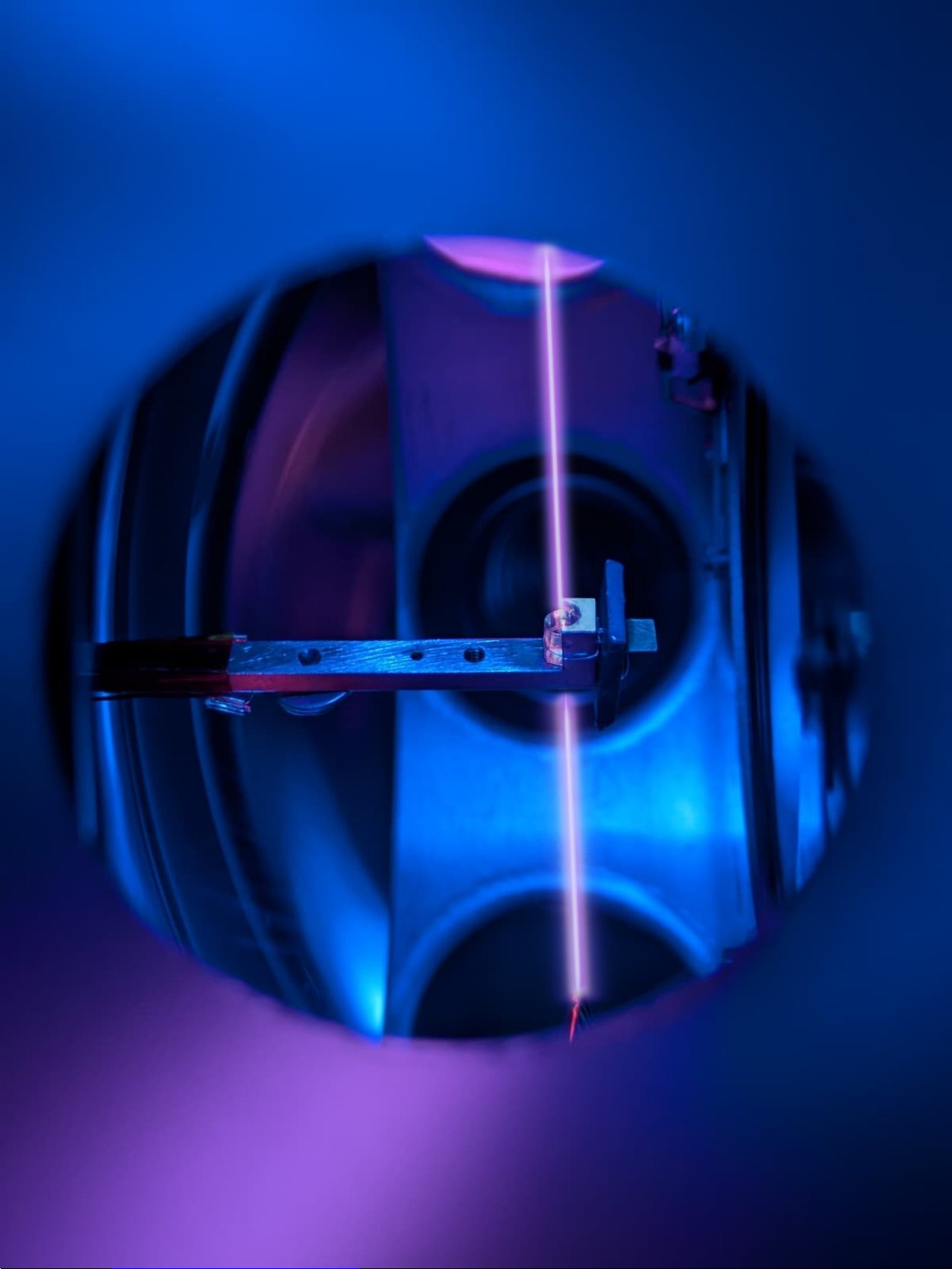
Keeping time in a nuclear clock requires keeping the laser tuned to the nucleus as it switches between states. This process is sometimes colloquially referred to as “squishing” the nucleus. Squishing atomic nuclei usually requires an enormous amount of energy. However, the isotope Thorium-229, is a rare exception, which is why both teams at Vienna University of Technology and Tsinghua University in Beijing built their clocks around it.
“The basic idea is simple: you have a laser and you have thorium,” Schumm added. “The laser changes the energy state of the thorium nuclei, and the thorium nuclei are used to stabilize the frequency of the laser.”
Nuclear is still catching up to atomic
These two prototype clocks are many years in the making. The thorium crystal used for both was grown separately, but around the same time. So far, testing reportedly shows the version in China is about six times as stable than the clock in Vienna. The Vienna prototype, meanwhile, is reportedly the first nuclear clock that stabilizes itself the way atomic clocks do. Schumm recently told the South China Morning Post this parallel development has led to a “fierce but friendly global competition.”
Nuclear clocks may eventually far surpass their atomic forebears, but they aren’t there yet. Researchers estimate the new prototype may drift by about one second every 30 million years. That’s roughly 10 times worse than the cesium clocks that currently define the official second.
Still, researchers expect that stronger, more efficient lasers and better thorium crystals will make each new generation of nuclear clocks ever more accurate, until they eventually surpass atomic clocks altogether. Who manages to get their first remains to be determined.
KioskNews shows a cleaned-up reading view extracted from the publisher’s page — the original always lives on their site, not ours.