Beyond Netflix: What comes next for Taiwanese television?
The television industry has won global distribution; its next challenge is turning availability into visibility while keeping Taiwanese stories distinct
By Ming-yeh T Rawnsley / Contributing reporter


A decade ago, Taiwanese television had an image problem.
When representatives of Taiwan’s Public Television Service (PTS) traveled to Singapore to meet Netflix, they brought two dramas: A Touch of Green (一把青, 2015), a sweeping story of war, displacement and military families, and Wake Up (麻醉風暴, 2015), a tightly constructed medical thriller.
They were not simply trying to sell programs. They were trying to change an idea of Taiwan.

A scene from The World Between Us, a film deeply embedded in Taiwanese journalism, law and debates about criminal justice.
Photo courtesy of TVBS
International perceptions of Taiwanese television, PTS executives recalled in interviews conducted for my joint research with Chairman Hu Yuan-hui (胡元輝), were still strongly associated with the idol dramas that had enjoyed enormous regional popularity in an earlier era. A Touch of Green and Wake Up demonstrated that something else was happening.
What followed has been a remarkable transformation. Programs including The Teenage Psychic (通靈少女, 2017), The World Between Us (我們與惡的距離, 2019), The Victims’ Game (誰是被害者, 2020), Gold Leaf (茶金, 2021), Wave Makers (人選之人—造浪者, 2023) and Copycat Killer (模仿犯, 2023) demonstrated increasing ambition in subject matter, writing and production.
International platforms helped make that transformation visible. But after nearly a decade of the streaming era, Taiwan should perhaps ask a different question as getting onto Netflix is no longer enough.
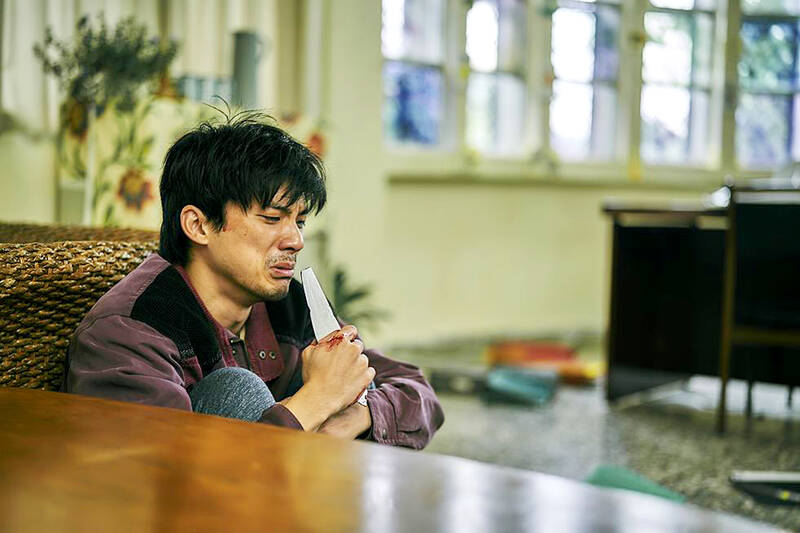
A scene from The World Between Us, a film that offers a nuanced portrayal of mental health.
Photo: screen grab
WHEN THE RULES CHANGED
Producer Tang Sheng-rong (湯昇榮), whose credits include The Victims’ Game, Gold Leaf and Copycat Killer, describes Netflix’s arrival in Taiwan succinctly: “Once Netflix entered the market, the rules of the game changed completely.”
Streaming created possibilities particularly important for an industry constrained by Taiwan’s relatively small domestic market. International investment made larger budgets, more ambitious production and wider distribution possible.

Kuo Shu-yao in a scene from the film The Teenage Psychic.
Photo courtesy of HBO Asia
But greater opportunity brought greater competition. A Taiwanese drama on Netflix suddenly sat alongside productions from South Korea, Japan, the US, the UK and dozens of other television industries.
Taiwan had entered the international marketplace. The marketplace had also entered Taiwan. Producer Lin Yu-ling (林昱伶), discussing projects such as Wave Makers, describes the challenge as balancing resources against the production values expected by international platforms. Producers may invest more heavily in anticipation of international distribution without knowing whether a platform will eventually acquire the program.
For a time, Tang recalls, there was an assumption that producing sufficiently good dramas would naturally attract international platforms. Experience proved otherwise. Platform strategies and investment priorities change. A sustainable Taiwanese television industry cannot be built around predicting what Netflix wants.

Pets Tseng, left, and JC Lin in a scene from The World Between Us.
Photo courtesy of Public Television Service
AVAILABLE EVERYWHERE, WATCHED NOWHERE?
Putting a program onto an international platform and building an international audience are not the same thing.
Once a Taiwanese drama enters an international platform, Lin says, its producers can become surprisingly passive. Decisions about promotion, recommendation and presentation to audiences largely move elsewhere. A program may technically be available in many territories yet remain almost invisible within them.
Streaming has solved an old problem of distribution in an extraordinary way. Yet it has created another problem: discoverability.
The distinction might be expressed in three words: availability, visibility and audience.
Availability means viewers can watch something. Visibility means they know it is there. Building an audience means giving people sufficient reason to watch, understand and discuss it — and perhaps become interested in other Taiwanese programs.
Taiwan has become considerably better at achieving the first. The challenge now is the second and third.
That requires marketing, subtitling, publicity, festivals, distributors and people who understand particular overseas markets. If Taiwanese producers know little about who watches their programs, how they are promoted or why one succeeds while another disappears into a vast online catalog, an important part of internationalization remains beyond their control.
The program has traveled, but the producer has not necessarily become more international.
TAIWAN WAS NEVER ‘DISCOVERED’
The familiar story that Netflix transformed Taiwanese television also needs qualification.
Streaming accelerated change, but Taiwan’s creative foundations were already being built. PTS had spent years experimenting with drama and cultivating writers, directors and producers. Independent companies accumulated experience, while Taiwanese programs traveled through festivals and regional broadcasting networks before global streaming became dominant.
Some practices developed under financial constraint even proved unexpectedly compatible with streaming. PTS gained experience producing shorter miniseries partly because public television could not easily finance long, expensive serial dramas. What began as an adaptation to scarcity later fitted an international environment receptive to compact, high-production-value series.
What mattered when streaming expanded was that Taiwan already possessed creative capacity with which to respond. The international platform was therefore an accelerator, not the origin of the transformation.
International collaboration can also leave behind something more durable than investment. Former PTS president Cindy Shyu (徐秋華) recalls that working with organizations such as HBO and Japan’s NHK exposed Taiwanese teams to different production workflows, communication practices and experience of international collaboration.
“The capabilities remain in Taiwan,” Shyu observed.
That may be one of the most important measures of successful internationalization. The question is not simply whether foreign money finances a Taiwanese production, but whether collaboration leaves behind stronger companies, more experienced practitioners, international contacts and knowledge that can benefit subsequent projects.
Organizations such as PTS and the Taiwan Creative Content Agency (TAICCA, 文化內容策進院) therefore matter not simply because they provide public support. They can connect relatively small Taiwanese production companies with broadcasters, distributors, financiers, markets and co-producers that individual companies may struggle to reach independently.
STAYING TAIWANESE
There remains an obvious anxiety: if Taiwanese producers increasingly depend upon international finance, will internationalization gradually make Taiwanese television less Taiwanese?
Those interviewed for this story generally rejected that assumption. Tang Sheng-rong puts it most directly: international platforms do not necessarily want producers to become less Taiwanese. They want them to tell Taiwanese stories better.
The World Between Us is deeply embedded in Taiwanese journalism, law and debates about criminal justice. Wave Makers takes place within the highly particular world of Taiwanese electoral politics. Gold Leaf emerges from Taiwan’s tea industry and its complicated linguistic and political history.
Their international potential does not come from removing those characteristics. It comes from using character, emotion and narrative to give viewers a way into unfamiliar social worlds.
The objective should therefore be to make cultural difference intelligible, not eliminate it. In an international streaming environment overflowing with competent television, becoming more generic is hardly an obvious way to stand out.
Taiwan’s advantage is Taiwan.
BEYOND THE PLATFORM
The next stage of Taiwan’s television internationalization may therefore look different from the first.
Netflix and other platforms opened important doors, but no single platform can provide a permanent international strategy. Corporate priorities change, investment contracts, and geographical availability does not guarantee meaningful visibility.
The answer is not retreat. It is diversification.
Taiwan needs Netflix, but it also needs HBO, NHK, European broadcasters, Southeast Asian partners, festivals, distributors, co-producers and international markets. It needs institutions such as TAICCA and PTS to open doors individual companies cannot easily open themselves. It needs producers capable of retaining intellectual property and developing relationships with overseas partners and audiences.
Above all, it needs confidence that Taiwanese stories do not have to stop being Taiwanese in order to travel.
The real measure of international success is not the number of Taiwanese titles appearing on a Netflix menu. It is whether international engagement leaves Taiwan’s television industry stronger — with more knowledge, connections, creative confidence and routes through which the next program can reach the world.
A decade ago, Taiwanese television had to convince international gatekeepers that it had changed. Today, that argument has largely been won. The more interesting question is what Taiwan does with the doors that have opened.
Ming-yeh T. Rawnsley (蔡明燁) is a research associate at SOAS University of London’s Centre for Taiwan Studies.
KioskNews shows a cleaned-up reading view extracted from the publisher’s page — the original always lives on their site, not ours.