Law professor criticizes Ottawa’s ‘hands-off approach’ in protecting oath to the King
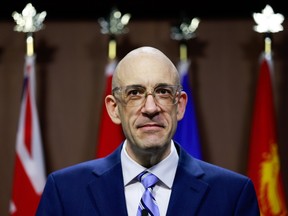
OTTAWA — A constitutional lawyer seeking an injunction to force elected officials in Quebec to swear an oath to King Charles III is puzzled about why the federal government has chosen not to intervene in his court case.
Sign In or Create an Account
Lawrence David, a professor at the University of Ottawa’s faculty of law and founder of the Public Interest Litigation Institute, was on Parliament Hill to provide an update to his legal challenge to a 2022 Quebec law that made the oath to the King optional.
“What we are seeing in Quebec are manifest violations of the Constitution and the rule of law,” he said on Friday. “This should concern every Canadian and Quebecer. One might ask, what does this have to do with the government of Canada? Everything.”
“The government of Canada has a duty to defend the Constitution, both generally or when provinces exercise the power of unilateral constitutional amendment in ways that directly strike at Canadian institutions,” he added.
The law, known as Bill 4, added a clause to the Constitution Act of 1867 stating that the oath to the monarch no longer applies to Quebec legislators.
It passed after pressure from the current premier of Quebec, Paul St-Pierre Plamondon, and his two other Parti Québécois caucus members who were barred from taking their seats in the legislature because of their refusal to pledge allegiance to the King.
In August, the Public Interest Litigation Institute filed a constitutional challenge against the Attorney General of Quebec and the Attorney General of Canada about Bill 4, something which David admits could take years before a judgement is rendered.
That is why, on Oct. 6, the day after the Quebec election, the Institute filed an application in the Quebec Superior Court to essentially freeze the application of Bill 4.
A hearing took place on Tuesday during which David and the Attorney General of Quebec’s lawyers presented their arguments to Justice Ian Demers of the Quebec Superior Court. The Attorney General of Canada did not partake in the exercise.
“I am personally disappointed by this hands-off approach,” David said.
The professor said he wants to be “clear” that his criticism towards the federal government’s refusal to participate in the hearing or file a legal submission is not an attack on Prime Minister Mark Carney for whom he has “tremendous respect.”
“But, in my personal view, the government of Canada has a clear, non-delegable duty to defend the Constitution, and we are awaiting their participation and intervention in this legal debate,” he said.
A spokeswoman for Justice Minister Sean Fraser refused to directly comment on the matter.
“We are aware of the court challenge and that the Attorney General of Canada has been named as a party. As the matter is before the courts, it would be inappropriate to comment further,” said Joannie Fogue in an email.
To date, members of the National Assembly of Quebec elected in the Oct. 5 election have chosen to swear an oath to the “people of Quebec” instead of the King.
The Quebec Superior Court is expected to render a decision on whether to freeze Bill 4 or not before the provincial legislature resumes its work on Nov. 24.
If the Quebec Superior Court grants the application, that would mean that MNAs would need to take the oath of allegiance to the King before they can enter the National Assembly. If they refuse, that means that they would potentially violate a court order.
David said either case could lead to a “potentially serious constitutional crisis.”
On the substance of the issue, David said this is about elected officials respecting the law of the land and not being able to unilaterally change the Constitution as they wish.
“This legal challenge is not about monarchy versus republicanism,” he said on Friday. “It’s simply about politicians, like everyone else, are not above the law, and they need to respect the Constitution. And I think that’s a basic proposition.”
“If everybody on the street has to obey the green light, the red light, while politicians have to obey the supreme law of the land, is that too much to ask? Of course not.”
One of the lawyers for the Attorney General of Quebec, Michel Déom, openly questioned during this week’s hearing why David waited until now to dispute Bill 4.
“The law being challenged here has been in effect since 2022, yet no one in Quebec has contested its validity — and heaven knows there have been plenty of opportunities to do so,” Déom said. He also noted that David is a resident of Ontario, not Quebec.
David shot back by saying he was born and raised in Montreal, and now lives in Ottawa, just minutes away from the Quebec border.
On Friday, he said the Oct. 5 election was the first provincial general election that was held since this law was adopted and claims there was no other opportunity to challenge it before then as there wasn’t a problem of a “unlawfully constituted assembly.”
“I’ll be very honest with you: I know very well that the monarchy is not popular among people. That’s fine, but the reality is, Canada is a constitutional monarchy.
“That is who we are, and so I don’t understand how the government of Canada, is not taking steps at this stage to stand up for our identity and not be proud of who we are.”
National Post
calevesque@postmedia.com
Our website is the place for the latest breaking news, exclusive scoops, longreads and provocative commentary. Please bookmark nationalpost.com and sign up for our newsletters here.
Join the Conversation
This website uses cookies to personalize your content (including ads), and allows us to analyze our traffic. Read more about cookies here. By continuing to use our site, you agree to our Terms of Use and Privacy Policy.
KioskNews shows a cleaned-up reading view extracted from the publisher’s page — the original always lives on their site, not ours.