Rahul Gandhi gets Supreme Court relief in disproportionate assets complaint
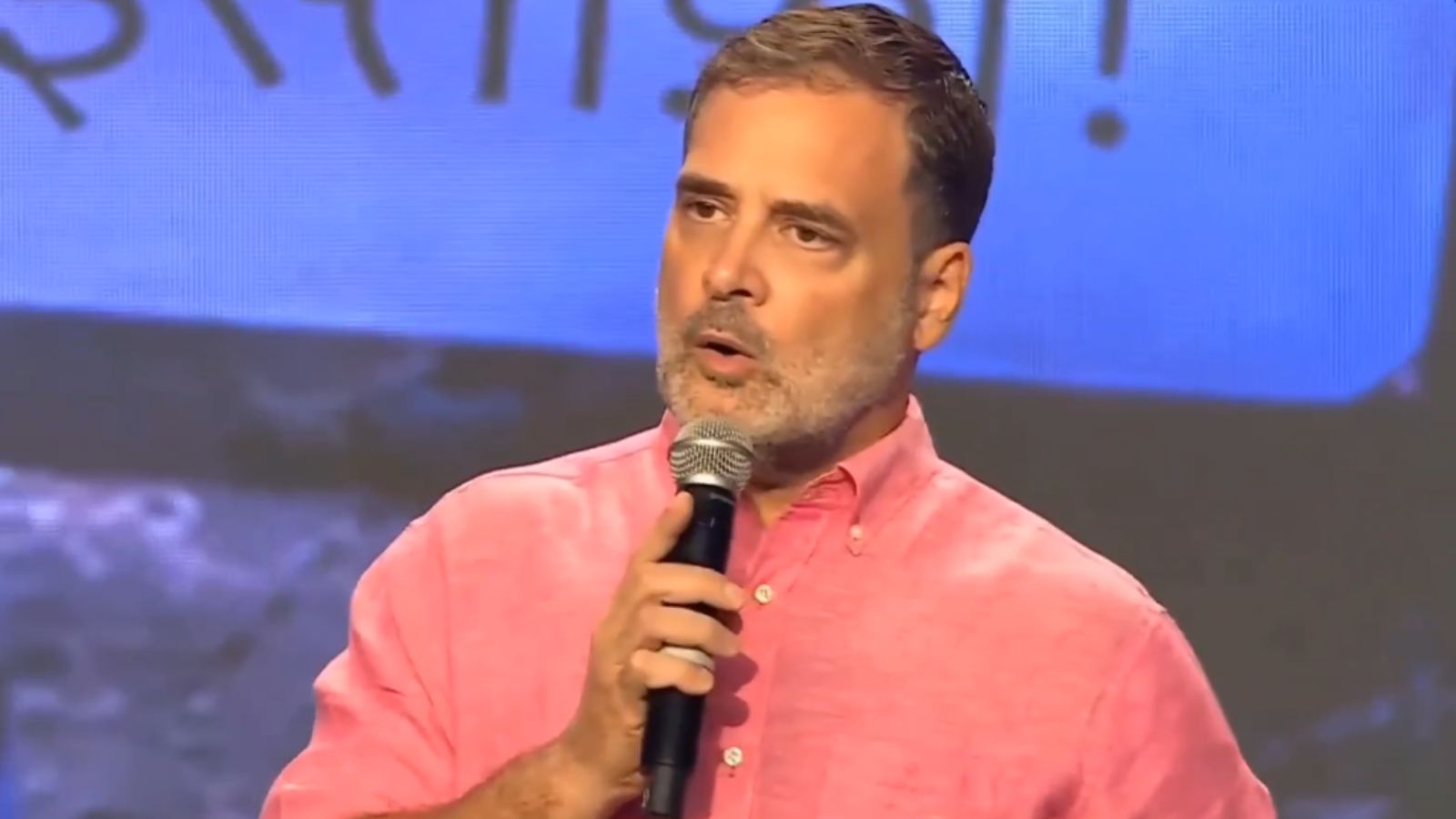
The proceedings before the Allahabad High Court began with a complaint filed by Karnataka-based S Vignesh Shishir against Rahul Gandhi. (Screenshot from Congress video on X)
The Supreme Court Monday directed the Allahabad High Court to defer proceedings in a plea seeking CBI and ED probes into alleged disproportionate assets of Lok Sabha Leader of Opposition Rahul Gandhi, and asked the Central agencies not to submit any report to the high court until further orders.
A three-judge bench, presided over by Chief Justice of India Surya Kant and comprising Justices Joymalya Bagchi and V Mohana, was hearing Gandhi’s appeal challenging the Allahabad High Court order.
While hearing the matter in May, the high court observed that once it received the petitioner’s complaint, it could verify the allegations in accordance with the law. It added that the Central Bureau of Investigation and the Enforcement Directorate could take any appropriate action permissible under the law.
The proceedings before the High Court began with a complaint filed by Karnataka-based S Vignesh Shishir.
What Rahul Gandhi said
Appearing for Gandhi, Senior Advocate Kapil Sibal said what is happening is “unknown to law” and that it amounted to a “witch hunt through a process not recognised by law.”
The senior counsel also questioned Shishir’s bona fides and locus standi, saying he had not disclosed his credentials. Sibal added that he is an RSS worker and has been filing petitions against Rahul Gandhi year after year.
Shishir, appearing through video conferencing, said that although he had reached the SC complex, he was not issued a pass to attend the proceedings in person.
Story continues below this ad
To a query from the bench, he said he had not received the copy of the paper book to oppose the prayer being made by Gandhi. He urged the court to supply him with the documents and fix a date to hear it.
What CBI said
Appearing for CBI, Senior Advocate S V Raju said the agency “has done nothing except verifying the complaint.” He added that “if correct, they are serious allegations”.
“As far as the allegations concerned, if they make out a cognisable offence, it stands on a different footing. If they do not make out a cognisable offence, it stands on a different footing. Whether to register an FIR, what action is to be taken (is yet to be decided),” the law officer added.
The CJI said, “As we understand the law, police or any other agency, if they have any prima facie evidence, they can register a case; they can proceed against anyone. They don’t need permission from the accused. But what appears to us, subject to both sides assisting us, if the court wants to issue a direction, it is expected to follow the principles of natural justice.”
Story continues below this ad
“I am only on the facts; facts may be right, facts may be wrong, but if the facts are right, it’s a gross case of disproportionate assets,” Raju said.
Sibal also questioned how the proceedings before the Allahabad High Court, which took place in chambers, appeared in newspapers. “These are sealed cover procedures. How do newspaper reports happen?” he asked, adding that either the complainant or the agencies would have leaked it.
Justice Bagchi asked Raju, “Have you done it (looking into the allegations) suo motu?”
Raju answered in the negative, to which Justice Bagchi said, “Then let us examine the correctness of this order”.
Story continues below this ad
The law officer said the agency would not oppose it if the complaint was frivolous.
“If it’s so serious, why has your agency kept quiet? Do you require impetus from the court? Your agencies have statutory powers,” Justice Bagchi observed.
The court directed that the documents be supplied to the petitioner at his email address so that he can also be heard on the next date of hearing.

Ananthakrishnan G. is a Senior Assistant Editor with The Indian Express. He has been in the field for over 26 years, kicking off his journalism career as a freelancer in the late nineties with bylines in The Hindu. A graduate in law, he practised in the District judiciary in Kerala for about two years before switching to journalism. His first permanent assignment was with The Press Trust of India in Delhi where he was assigned to cover the lower courts and various commissions of inquiry. He reported from the Delhi High Court and the Supreme Court of India during his first stint with The Indian Express in 2005-2006. Currently, in his second stint with the daily newspaper, he reports from the Supreme Court and writes on topics related to law and the administration of justice. Legal reporting is his forte though he has extensive experience in political and community reporting too, having spent a decade as Kerala state correspondent, The Times of India and The Telegraph. He is a stickler for facts and has several impactful stories to his credit. ... Read More
KioskNews shows a cleaned-up reading view extracted from the publisher’s page — the original always lives on their site, not ours.