Serbia’s students achieved the impossible. Europe must not fail them now | Srđjan Cvijić
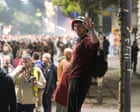
As polling stations closed across Serbia on Sunday evening, riot police were deploying around the presidency in Belgrade. Many of us feared the worst: massive electoral fraud, a refusal to recognise defeat or outright violence. After nearly 15 years of Aleksandar Vučić’s increasingly authoritarian rule, a peaceful transfer of power seemed implausible.
I had good reason to feel afraid. I am co-founder of an annual conference on the security and foreign policy challenges shaping the western Balkans, and sit on the international advisory committee of a civil society thinktank, the Belgrade Centre for Security Policy. Such work would be uncontroversial in most countries seeking European Union membership. Under Vučić’s regime, it was anything but.
Over the past two years, our organisation has faced cyber-attacks by actors suspected of links to Russian intelligence, spyware attempts and relentless vilification by pro-regime media. After one attack, investigators documented 28,000 email exchanges that had been hacked. At the same time, Serbian regime propagandists portrayed us as foreign conspirators, while the threat of Russian-style foreign agents legislation cast a long shadow over all of Serbian civil society. Had Vučić won another mandate, exile might have become a reality for many of us.
Others endured far worse. Journalists and activists had their homes set on fire. Students who were detained reported being beaten, females stripped naked and humiliated in police stations while activists were imprisoned for exercising their democratic rights. Among them were the Novi Sad 12 – students and activists prosecuted on politically motivated charges during the protests that followed the November 2024 railway station canopy collapsethat killed 16 people. Six were driven into exile; the other six endured imprisonment and house arrest.
All this happened in a country negotiating EU membership.
And then, on Sunday evening, something extraordinary happened.
Vučić conceded defeat. The student-backed list’s margin of victory was so overwhelming that overturning the result might have proved more dangerous than accepting it.
What convinced a man who had spent nearly 15 years concentrating power in his hands to relinquish it? Fear of popular resistance? International pressure, and if it was this, from where?
Uncertainty over the loyalty of Vučić’s security apparatus may have been a decisive factor. Days before the election, hundreds of serving and former police and intelligence officials, including former security leaders, signed an appeal urging their colleagues to uphold the constitution rather than obey unlawful political orders. It was a reminder that Vučić could not necessarily count on the entire security establishment to keep him in power.
An incumbent accepting electoral defeat is ordinary in an established democracy. In Serbia, it felt almost miraculous.
The students had achieved what many thought impossible. They had forced a system built around the impossibility of losing to accept that it had lost.
Their victory belonged equally to hundreds of thousands who marched, organised and endured intimidation. What began as grief over 16 lives lost in Novi Sad became a movement challenging the foundations of state capture.
For nearly two years, the students dismantled the regime’s most powerful weapon: the belief that resistance was futile, everyone had a price and political change was impossible.
after newsletter promotion
But the significance of their victory is measured not only in votes. It is measured in lives.
I think of Mila, Anja, Doroteja, Branislav, Jovan and Dejan, the six Novi Sad activists forced into exile formore than a year and a half. They may finally be able to come home. Six of their comrades in Serbia are now free from detention and house arrest. But I have friends who have confronted authoritarianism in their countries with equal courage and have no prospect of achieving the same breakthrough. I am thinking of Marika from Georgia, Gökçe from Turkey and Andrei from Belarus. For them, exile remains a condition of life. Their fate reminds us that Serbia’s peaceful breakthrough was not inevitable.
Geography, too, played its part. Serbia lies at the heart of Europe, beyond Russia’s immediate reach and too close to the EU for its democratic struggle to remain Europe’s distant concern.
Serbia’s students deserve the credit, but what happens next also depends on Europe. For years, some European leaders tolerated, and sometimes effectively supported, Vučić’s authoritarian rule, preferring a predictable strongman to democratic uncertainty. Serbia’s breakthrough happened largely despite Brussels, not because of it.
Here lies the irony: while European leaders courted Vučić, much of Serbia’s genuinely pro-European constituency opposed him. Our research found that two-thirds of Serbians who supported EU membership also opposed his government. Brussels was looking for stability in the wrong place.
Serbia’s ability to consolidate its democracy relies on a future in Europe. And Europe now has an opportunity to regain the trust of those who fought for the very democratic values it professes to uphold.
Defeating an autocrat is an event, but dismantling authoritarian institutions is a process. Serbia must restore the rule of law, free its media and ensure that its police and security services serve citizens rather than a political party.
The students have won the right to change their government but the harder task lies ahead. And that means building a country where doing so will never again require such extraordinary courage.
-
Srđjan Cvijić is a writer, president of the international advisory committee of the Belgrade Centre for Security Policy and co-founder of the Belgrade Security Conference
KioskNews shows a cleaned-up reading view extracted from the publisher’s page — the original always lives on their site, not ours.