No medal at Asian Games, but Singapore’s table tennis team get 8/10 rating from official
NAGOYA – For the second time in successive editions of the Asian Games, Singapore’s table tennis teams will return home empty-handed.
It continues an unwanted streak for the Republic’s players, who picked up medals at the Asiad from 2002 to 2018, but endured a barren run in Hangzhou in 2023.
But there is no cause for concern for Singapore Table Tennis Association (STTA) senior high-performance manager Eddy Tay, who gave his charges’ performance an 8/10 rating.
The youthfulness of the squad and three quarter-final berths give them plenty to build on, he noted.
The quarter-finals were as good as it got for them in Nagoya, with the men’s doubles pair of Izaac Quek and Koen Pang, women’s doubles duo Loy Ming Ying and Ser Lin Qian, as well as the women’s team making the top eight.
Tay spoke to The Straits Times on Sept 26 after the players bowed out in the singles and doubles competitions. When asked what rating he would give his charges, he said: “I would say it’s an eight out of 10. The young players especially, played well. It’s just a pity that we didn’t bring back a medal.
“Overall the young ones have shown a lot of potential, and this time we actually went into three quarter-finals. It’s a bit of a pity, especially for the men’s doubles because they were our best bet.”
In Japan they fielded a squad with an average age of 22.
Izaac Quek (20), Clarence Chew (30), Koen Pang (24), and Games debutants Josh Chua (25) and Ellsworth Le (17) made up the men’s team, while the women’s team consisted of Zeng Jian (29) and Ser Lin Qian (20), along with debutants Tan Zhao Yun (21), Chloe Lai (19) and Loy Ming Ying (15).
Before the Games, top local player and 83rd-ranked Quek had set a target of improving on his performance in Hangzhou by at least one round. In 2023 he was eliminated in the men’s singles round of 32, and the men’s doubles round of 16.
This time, he made it to the round of 16 in the singles before losing 4-2 to Japan’s world No.3 Sora Matsushima.
In the men’s doubles, Quek and Pang reached the quarter-finals before they were defeated 3-0 by Japanese pair Hiroto Shinozuka and Tomokazu Harimoto.
The men’s team fell 3-0 to Iran in a last-16 tie on Sept 22.
Quek said: “I am actually quite happy with my individual results based on which round I went to. For the match against Sora,I think I played quite a good match against him and I tried my best and I think I was still like clearly quite lacking in my skill level so it wasn’t anything to be sad about.”
“But maybe for the team events and the doubles, I think it could have been better.
“In the first set (of men’s doubles) we were 9-3 up, and I think we were playing really well...and we should have just closed it out. I think skill level wise we are around 50-50, but after the first set, mentally they were much stronger than us.”
Not being able to close out the first game was a missed opportunity, said Tay, who added that their overall performance is a strong indicator for their bid for Olympic qualification in 2028. The duo beat Uzbekistan and Malaysia 3-0 in the earlier rounds.
For the world No. 15 women’s team, the young squad showed glimpses of hope for the future after putting up a creditable display on Sept 22 in the last 16 clash against Hong Kong.
The decision to bench veteran Zeng Jian – their highest-ranked women’s singles player at 48th – to field youngsters Ming Ying (125th) and Tan (109th) alongside Ser (83rd) saw the underdogs making a 3-2 comeback victory against their ninth-ranked opponents. They were eventually swept 3-0 by South Korea in the quarter-finals later that day.
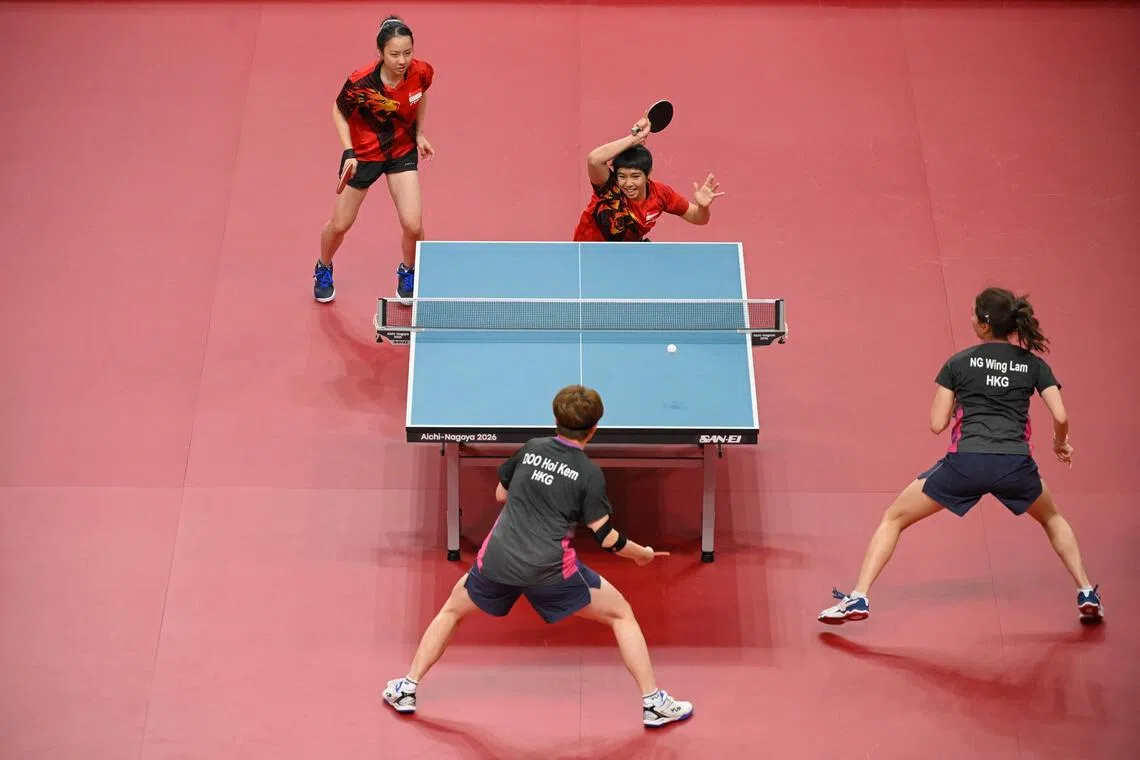
Loy Ming Ying (right) and Ser Lin Qian of Singapore in action against Doo Hoi Kem and Ng Wing Lam of China during the Asian Games Table Tennis women’s doubles quarter-finals at Sky Hall Toyota on Sept 26.
ST PHOTO: MARK CHEONG
In the women’s doubles quarter-finals on Sept 26, Ming Ying and Ser lost 3-0 to Hong Kong’s world No.3 Ng Wing Lam and Doo Hoi Kem.
A technical review will be done to address specific weaknesses identified during the Games, stressed Tay.
These include mental fortitude and handling crucial points under pressure, as Tay noted that players like Ming Ying were not used to playing in a loud environment like at the Games.
Tay added: “When the opportunity comes, they must have the courage to win. That is something which we are lacking. We lack ruthlessness.
“When it’s an opportunity where you need to wait for four years, sometimes it’s very painful when you lead 9-3 and you lose.”
KioskNews shows a cleaned-up reading view extracted from the publisher’s page — the original always lives on their site, not ours.