My suburb was a place I couldn’t wait to leave. Now, it’s the only place I want to be
Travel up through the bustle of migrant cafes, markets and gentrification along Sydney Road, and you’ll reach my suburb. It begins where you leave the inner north, and start seeing car dealerships and industrial backdrops.
Here, where the roads really open up after the sandwiched streets of Brunswick, Coburg and Coburg North, you’ll find Fawkner. The blocks of land are bigger and there’s more peace and quiet. This is one of the big reasons I returned home.
I had always lived a stone’s throw from the biggest cemetery in Melbourne, Fawkner Memorial Park, so I thought it was normal. I must admit, I couldn’t wait to get out of my suburb two decades ago. But it wasn’t for the reason people might think.
Today, having returned to my family home, not only do I realise there’s a lot I didn’t know about Fawkner, but I now see that it was a little strange, having a childhood where death was a backdrop.
I abandoned Fawkner for what I thought was my freedom. At 22, I married and moved to the CBD. Today, I don’t know how I lived there. Two decades later I’m back in Fawkner, no longer married, rehabilitating and reconnecting with family and a part of myself I thought I’d left behind. But it’s been lovely, rediscovering who I was within Fawkner and what Fawkner has become now.
Fawkner sits along Sydney Road after Coburg North, between the Western Ring Road, Merri Creek, and the Upfield train line and bike path. If you are a bike rider like me, it’s a great ride from the city, except one section along the cemetery that is a bit secluded. I prefer not to ride it alone. I think of poor Mersina Halvagis every time, murdered in the cemetery visiting her grandmother when I was just a teenager.
There was a time when everything north of Coburg was considered rural and Fawkner. Then in the ’40s and ’50s, Glenroy and Hadfield were created on the other side of Sydney Road. Fawkner Memorial Park, established in 1906, is now in Hadfield. But the gorgeous trees that line Sydney Road along the outer fence of the cemetery – and which blossom spectacularly in white come springtime – they belong to us.
Fawkner has changed. When I grew up here it was mostly southern European families like mine. There were also some elderly Europeans like my nanna, an older Polish grandmother who would sometimes babysit us.
That generation has passed and newer migrant communities and their families have taken their place. As Brunswick and Coburg have become less affordable, those seeking the lifestyle of the north are choosing Fawkner, not only for its proximity to those suburbs where there is more to do, but for the easy access via the Tullamarine Freeway to Melbourne Airport (20 minutes) and the CBD (25 minutes). Fawkner now hosts a large Middle Eastern community, which established the Darul Ulum College and Fawkner Mosque.
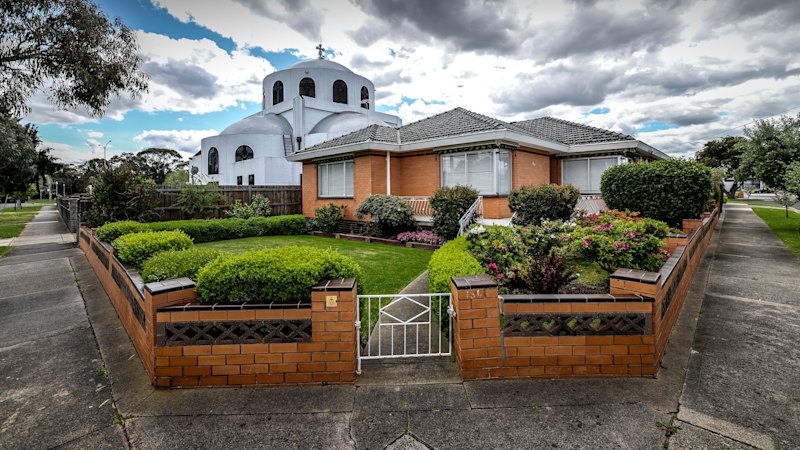
Some things remain the same. My local church, St Nektarios, and its hall where I was a student at the Saturday Greek school, sit opposite the cemetery. The church remains a religious hub for many Greeks in Melbourne’s north and draws a heavy crowd for Greek Easter celebrations that each year spill out onto Major Road for midnight Mass. Hundreds of candles light up the dark as the air is filled with chanting and song.
St Nektarios was established in 1975 after many post-World War II southern European immigrants moved into Melbourne’s northern industrial suburbs and is a proud example of a community pulling together to establish themselves. From when I was a young girl, I remember families helping to paint the inside in a stunning Byzantine style right up into the dome. Architecturally, the heritage-listed building is recognised for its structural innovation, re-inventing classic Byzantine forms using modern, pre-cast concrete panels.
It’s been nice returning to Fawkner Leisure Centre, which has undergone big refurbishments, as have the surrounding facilities. Where there was once just a park outside the pools, and a library across the road, there is now the Fawkner Community Hub, including a grandstand, a skate park, maternal and child health services, and a sports hall. There is now a yearly Fawkner fiesta, which I can see one day being much bigger and better – I hope the council considers investing more in it.
At the southern side of Fawkner, the Charles Mutton Reserve sporting hub has been transformed. The 15-hectare site where I would have my athletics day with my primary school, St Matthew’s, now hosts Fawkner Netball Club with eight competition-grade netball courts. There is a still a six-lane sprint track past the netball courts, as well as sports ovals, tennis courts and more. It’s a short ride from here to the Merri Creek Trail bike path that will take you to Coburg Lake.
A favourite place to visit is Alitalia Florist, run by Teresa, who has been there for 40 years. She says that when she moved her florist from Coburg to Fawkner there were two others but she put them out of business with her customer service. “When someone asks me for flowers I always try to connect with why they want those flowers, and make sure they are getting the right flowers for the occasion. I connect with the person. That is my secret.”
Teresa’s is one of the few shops on the quiet Anderson Road. Major Road also has a few shops, down the other end of the road from St Nektarios. But Bonwick Street is the “happening” street of Fawkner. When I was growing up, it was where the teens congregated to hang out, but today there are so many more shops and it’s always bustling, with the occasional car park drama. There are more shops today because when I was young there were three banks. Now there is none!
Bonwick Street has a strong community and social character to it, of both retirees and younger families. It has transitioned from mostly southern European in flavour to multicultural, reflecting the changes across Fawkner. Along with the longstanding IGA, newsagent and pharmacy there are new fruit shops; a butcher; a $2 shop; takeaway fish and chips, pizza and Middle Eastern foods; and sit-down cafes, including the Italian cafe Pasticceria Padova, which is 57 years old.
Bonwick Street definitely has a grassroots feel to it. Frustrated with the lack of Christmas investment from the local council for example, retailers and residents have banded together in the past to create their own festivities, decorating the street themselves, applying to the council to close the roads.
The suburb of my youth is now more multicultural than ever. It’s peaceful, down to earth, and the perfect place for me.
Koraly Dimitriadis is a poet, writer, performer. Her latest books are the short story collection The Mother Must Die and the poetry book That’s What They Do.
KioskNews shows a cleaned-up reading view extracted from the publisher’s page — the original always lives on their site, not ours.