Come on Andy… stop gaslighting us and fund music education

It’s been a big month for young talent. Barely a week after the final of BBC Young Musician, the next generation of musicians were also celebrated in the annual Music for Youth Proms at the Royal Albert Hall on Monday and Tuesday, where more than 2,000 young people in choirs, jazz and pop groups, steelpan bands and orchestras performed music that included Charlotte Harding’s The Orchestra: A Young Person’s Guide, written for disabled and non-disabled musicians of the National Open Youth Orchestra.
But amid the celebrations, there have been words of caution – and despair – from long-term campaigners. The cellist Julian Lloyd Webber’s message to the prime minister couldn’t be starker: “[the UK] used to have a music education system that was the envy of the world. Now we don’t,” he said in an Instagram post. This is despite decades of his campaigning, alongside everyone from Elton John to Sheku Kanneh-Mason to Nicola Benedetti, and it’s despite Andy Burnham’s first-hand experience of the results of the In Harmony scheme in Liverpool, when he visited as culture secretary, in which he saw that having music in every pore of a school’s delivery of the curriculum – free to every pupil – brought positive outcomes across the board.
As Lloyd Webber says, the fact we are where we depressingly are in music education today is thanks to generational political failure.
Let me take you back to a time when there was hope in the air, when New Labour was in government, and when David Miliband still wore glasses. I remember that because I interviewed him when he was schools minister for the launch of the 2004 music manifesto, which stated a commitment to inspire “music for all”. It was well-meaning, and there were plenty of pledges: to get every key stage 2 child in the country playing an instrument; there was a nationwide programme of singing in schools, Sing Up; and the In Harmony initiative, inspired by Venezuela’s El Sistema project.
The problem was that even in that New Labour idyll of milk and honey and reservoirs of government reserves, there wasn’t any meaningful additional cash to back up the music manifesto’s grand claims. Nor is this a uniquely New Labour failure. Many successive governments have launched – with great fanfare – national plans for music education, but have failed to support them. In 2012, a network of more than 100 music education hubs were established to coordinate music education across England and Wales. After another reorganisation last year, that number has now shrunk to 43. Everyone from Gordon Brown to David Cameron and Keir Starmer has paid lip service to the power of music education, but failed to offer political or financial capital to back it up.
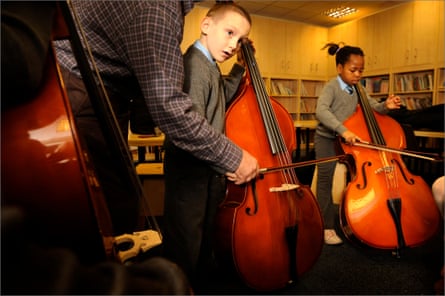
The result of all of this is what Robert Ames has described: that music – classical music in particular – has become the preserve of an economic elite who can afford the private lessons and the tuition.
Lloyd Webber suggests writing directly to the prime minister to make him listen to a collective cry against the decline of music-making of all kinds in schools, from choral participation to instrumental tuition to the long-term fall in numbers of students taking music GCSE or A-level. What’s needed is a fundamental reset of the place of music in the curriculum and a reversal of 25 years and more in which government policy has gaslit the country’s music educators and pupils.
Burnham should have taken his cabinet to the Music for Youth Proms and said: if we want more of this, and if we want music to be the sound of a fundamentally democratic community, we’re going to have to pay for it. Not a report, not a scheme, not another national plan: just more support for schools to make music and music lessons freely available to all of their pupils and give the country what governments have always promised, but never delivered. Now’s your chance – do it, Andy.
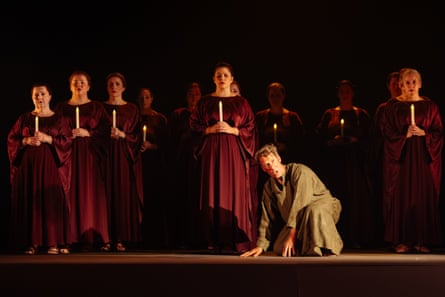
English National Opera’s new staging of Gluck’s Iphigénie en Tauride opened at the weekend. But it’s sung in the original French, not English, which historically has been the entire point of ENO – to communicate the art form to British audiences. As Erica Jeal puts it: “at such a critical time for the company’s future, why mess with its USP?”
We asked ENO, who said: “On occasion and with certain works that are rarely performed, we have presented them in their original language. With Iphigénie en Tauride the artistic team made the decision to perform [it] in its original French libretto to maintain the element of theatrical and musical mystery at the heart of the piece that we want to preserve for our audience.”
Which begs the question: surely there’s a quality of “theatrical and musical mystery” at the heart of all opera, in which case why not sing everything in the original language? Or maybe why not translate Britten into French to enhance the “mystery”? Or conversely, does ENO think that singing in original, non-English languages is inherently more “mysterious” – for which you could read, “confusing” – in which case, why not, you know, translate them into English, as they always have done?
As one reader comments under Erica’s review: “for me, hearing at least some of the text directly rather than through the conduit of the surtitles is a special thing and it reinforces ENO’s identity as a place where opera is thought of as music-theatre, rather than as a musical performance with some attempt at drama added on.” Another writes: “listening to operas in English cements the music in my head far more – I never hear Figaro without hearing chunks of Jeremy Sams’s brilliant translation/adaptation, a work of art in its own right. I don’t get that by reading surtitles.”
I had exactly the same experience with Sams’ translation of The Magic Flute at Scottish Opera in the 1990s: you know the opera better when you feel the impact of the meaning of the words, not only their sounds.
Maybe the more radical solution would be for ENO to say: “We perform in English when we choose, and in the original language when we like.” That might make sense, so you preserve the crucial speech rhythms in Wagner and Janáček in German and Czech, and work in English for Mozart’s comedies or Verdi’s tragedies.
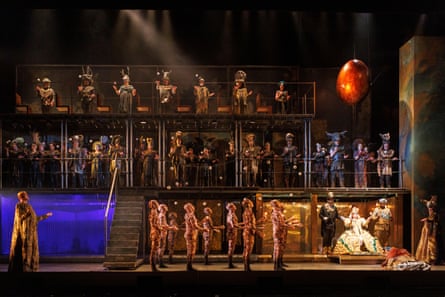
Incidentally, although this is the first time there’s been French on ENO’s stage, the roster of recent languages heard at the Coliseum includes a wonderfully eclectic mix. No German or Italian, but Sanskrit (for Philip Glass’s Satyagraha), Latin (Mozart and Verdi’s Requiems), Polish (Górecki’s Symphony of Sorrowful Songs), Hungarian (Bartók’s Duke Bluebeard’s Castle), and ancient Egyptian, biblical Hebrew and Babylonian Akkadian, which are all part of Glass’s Akhnaten.
This week Tom has been listening to: cellist Trey Lee and the Musicus Soloists Hong Kong’s single from their new album: the Laideronnette from Ravel’s Mother Goose Suite in a sumptuously glittering arrangement by Alfred Wong. Ravel would surely approve of this version for solo western and Chinese strings and woodwinds, a whole teeming, twangling world in miniature. The album – Histoires Croisées – is out on 4 December. Can’t wait.
KioskNews shows a cleaned-up reading view extracted from the publisher’s page — the original always lives on their site, not ours.