Artist rethinks monuments with piece, wins prize
Artist Juan Po-yuan (阮柏遠) won the top prize at this year’s Taipei Art Awards yesterday for works exploring how monuments associated with authoritarian rule acquire new meanings after being removed or demolished.
Juan was selected from 276 submissions to receive the NT$550,000 (US$16,767) prize at the Taipei Fine Arts Museum (TFAM), where works by the 10 finalists are on display.
“I wanted to rethink, from my generation’s perspective, how we confront history that seems to have already been fully discussed, and whether we can find new ways to engage with it,” Juan said in his acceptance speech.
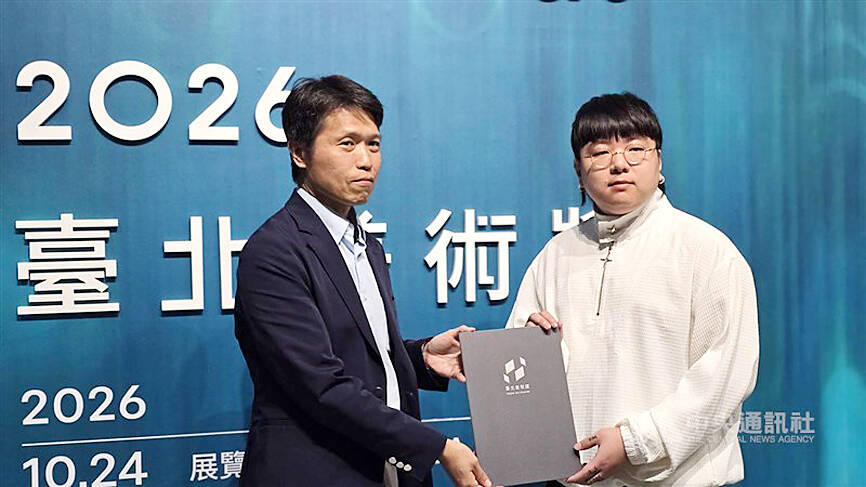
Artist Juan Po-yuan, right, receives the top prize at this year’s Taipei Art Awards yesterday.
Photo: CNA
Juan, 26, a graduate of Taipei National University of the Arts’ Department of Fine Arts, developed the two works in his winning presentation, “Searching for the Nose beneath Fronta na maso,” during residencies in Lithuania beginning in 2023 and the Czech Republic last year.
The Czech phrase fronta na maso, meaning “queue for meat,” was a mocking nickname for Prague’s Stalin monument, whose figures resembled people lining up to buy meat.
Juan said that the project built on earlier explorations of Chiang Kai-shek (蔣介石) statues in Taiwan using 3D printing and digital technology.
One work compares Cihu Memorial Sculpture Park in Taoyuan, which houses relocated Chiang statues, with Grutas Park near Druskininkai in southern Lithuania, which displays Soviet-era monuments removed from public spaces.
Both parks have become tourist destinations, changing how visitors encounter objects once intended to embody political authority, he said.
The other work examines how Prague’s demolished Stalin monument survives through jokes, oral accounts and online urban legends, allowing people to approach historical trauma through humor.
Using generative artificial intelligence, video and 3D printing, the project also explores how digital technologies can fill gaps in historical memory.
“It starts from a Taiwanese perspective and connects with a global context,” Juan said. “We are all dismantling statues and undergoing a kind of transition. How do we face these questions?”
TFAM director Loh Li-chen (駱麗真) said that the competition has been held annually since the museum opened in 1983, giving emerging artists opportunities to present their work and explore contemporary issues.
This year’s finalists addressed themes including the relationship between nature and human-made environments, memory and power, and the use of new materials and technologies, she said.
“Art is an important means for us to understand the present and imagine the future,” Loh said.
Five artists received merit awards worth NT$120,000 each: Yong Kian-sam (楊健生), Liao Chao-hao (廖昭豪), Kueh Peh Gan (郭柏彥), Su Chang-ching (蘇長慶) and Tsai Yu-ting (蔡昱廷).
Four others received honorable mentions: Chen Po-hsin (陳柏欣), Huang Kuan-chun (黃冠鈞), Chou Wei-chen (周韋辰) and Keng Chieh-sheng (耿傑生).
KioskNews shows a cleaned-up reading view extracted from the publisher’s page — the original always lives on their site, not ours.