Opinion: Canada Labour Code changes are not an attack on workers’ rights
If Canadians focused solely on recent commentary from union leaders and their lawyers, they’d be forgiven for thinking the current Liberal government has been engaged in a long battle against workers’ rights, culminating in a final charge against the right to strike.
Sign In or Create an Account
It’s time to set the record straight. There is no attack here. The recently released Building Canada Strong Act does nothing to diminish hard-fought rights. It offers sensible solutions to a persistent problem of labour disputes in certain critical supply chain industries.
Not only does Bill C-39 stand on a solid constitutional footing, we believe it could in fact — under certain circumstances — go further to protect the national interest.

Columnist Jesse Kline keeps you up to date with what’s happening in Israel and the effects of antisemitism on life here in Canada. Friday mornings.
By signing up you consent to receive the above newsletter from Postmedia Network Inc.
A welcome email is on its way. If you don't see it, please check your junk folder.
The next issue of Channel Israel will soon be in your inbox.
We encountered an issue signing you up. Please try again
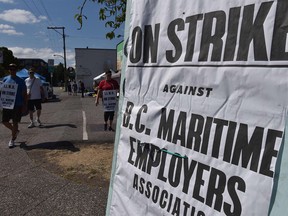
The legislation responds to a concerning pattern in collective bargaining that has exploded in the past few years — exemplified by recent airline, port and rail stoppages. These disruptions have played out in a manner our labour model never envisaged: where pressure doesn’t just target the parties involved, instead it puts the national economy, especially when it impacts critical sectors of our economy, in the crosshairs and leaves millions of Canadians to pay the price.
The right to strike was recognized by the Supreme Court of Canada in a landmark 2015 decision. As courts have confirmed since that date, however, this right is far from absolute. There are circumstances where governments may reasonably intervene in work stoppages, including to protect the national interest.
It also bears remembering why strikes and lockouts exist in our labour relations system. They are tools to make a negotiated agreement more likely: the economic pressure they create pushes both sides toward compromise. A work stoppage is not an end in itself. When it no longer brings the parties closer to a deal and simply inflicts harm on Canadians who have no seat at the table, it has stopped serving its purpose.
In fact, the Canada Labour Code already recognizes that some sectors are so critical to the national interest that work stoppages there cannot be tolerated. It includes a number of restrictions on strikes and lockouts — including a total prohibition related to longshoring services in Canadian ports that are critical to Canada’s grain trade.
Bill C-39 also significantly strengthens the support available to the parties at the bargaining table. It extends the conciliation period from 60 to 90 days and introduces a Special Mediator to the bargaining process, whose role will be to assist the parties to find a resolution and, if not possible, issue a report to the Minister of Labour recommending next steps. With this report in hand and, upon receipt of a comprehensive National Interest assessment, the minister will have the authority under Section 107 of the Canada Labour Code to end a current work stoppage by sending the parties to a process of independent third-party binding arbitration.
Let us be clear — there is nothing unconstitutional about any of this. In fact, the minister could even go one step further and still remain compliant with the Canadian Charter of Rights and Freedoms. As many industry associations and employers have argued, the minister could act pre-emptively in the most severe cases, invoking a Section 107 referral before a consequential work stoppage begins.
The reason is simple. If the parties have had extended conciliation, the help of a Special Mediator and every other tool the new law provides, and still cannot reach a deal, they likely never will. A strike or lockout at that point would no longer serve its purpose; it would only impose costs on farmers, manufacturers, travellers and workers across the country. In those circumstances, and only in sectors where the national interest is truly at stake, the minister could exercise the discretion the law provides to prevent the stoppage before it starts and send the outstanding issues to fair and neutral binding arbitration.
Canadians would be wise to not believe the hype. This legislation is not an attack on labour rights. It recognizes current law and affirms the vital importance of labour stability and its connection to reliable supply chains, increased exports, and greater economic diversification required to protect Canadian sovereignty in a rapidly changing world.
National Post
Christopher Pigott (Fasken), Thomas Roper (Roper Greyell), Richard Charney (Norton Rose Fulbright), Craig Munroe (Crawford, Munroe, Thomson), John D.R. Craig (Mathews Dinsdale), and Brian G. Johnston (Stewart McKelvey) are labour lawyers representing some of the largest employers in Canada, including many in the federally regulated sector.
Join the Conversation
This website uses cookies to personalize your content (including ads), and allows us to analyze our traffic. Read more about cookies here. By continuing to use our site, you agree to our Terms of Use and Privacy Policy.
KioskNews shows a cleaned-up reading view extracted from the publisher’s page — the original always lives on their site, not ours.