Study on civil servants' property purchases near planned MRT stations among issues to be raised in parliament on Oct 6
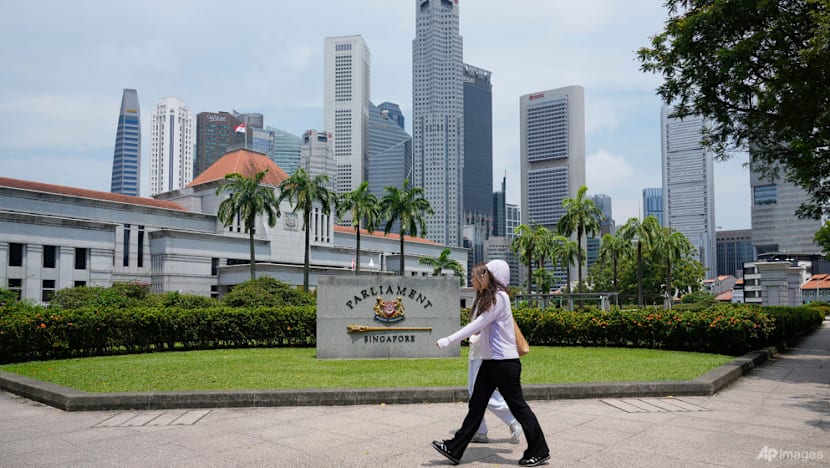
SINGAPORE: The government’s review of property purchases by officers involved in rail planning will come under scrutiny in Parliament when it sits on Tuesday (Oct 6), after a working paper showed that purchases were made near planned MRT stations before their locations were public.
Members of parliament have filed multiple questions on the working paper by researchers regarding the subject, the authorities' review and the safeguards against public officers using non-public information for personal gain.
Questions have also been filed on rising retrenchments in Singapore, the two-year delay to the opening of the North-South Corridor, and changes to the Primary 1 registration process.
CIVIL SERVANTS' PROPERTY PURCHASES STUDY
A total of 10 questions from MPs for oral answer were tied to a United States-based research organisation's working paper on civil servants' property purchases. A separate written question also concerned the working paper.
The study by the National Bureau of Economic Research reported a statistical link between such purchases and people its authors classified as civil servants in agencies connected to rail planning.
The paper has not been peer-reviewed.
Singapore's Public Service Division (PSD) said in mid-September that it was reviewing the working paper's data and methodology.
On Sep 25, PSD said that the government was also reviewing property purchases made between 2007 and 2011 by officers involved in rail planning to assess if there was "actual misconduct".
MP Joan Pereira (PAP-Tanjong Pagar) asked Prime Minister Lawrence Wong, who is also Minister for Finance, whether PSD had completed its review of the paper and what initial findings or anomalies had been identified.
She also asked whether further investigations and enforcement measures would be required.
Some MPs also filed questions about regulations for public officers handling development plans.
MP He Ting Ru (WP-Sengkang) asked Mr Wong if civil servants were required to declare property purchases that may relate to non-public information on future transport infrastructure, and how such declarations were cross-checked against officers' access to planning information.
NMP Terence Ho asked the prime minister whether the government believed there was a need to strengthen safeguards, including rules and penalties, to ensure public officers did not use privileged information for material gain for themselves or their family members.
RETRENCHMENTS
Retrenchments in Singapore rose to 4,620 in this year's second quarter, marking the highest level since Q4 2020.
The order paper for Tuesday's sitting showed that MPs filed 10 questions concerning retrenchments, asking about support for affected workers and their re-entry into the workforce.
MP Valerie Lee (PAP-Pasir Ris-Changi) asked Ms Jasmin Lau, Acting Minister for Manpower, how her ministry assessed whether career conversion programmes led to sustained employment for mature workers.
The Ministry of Manpower (MOM) had highlighted last month that unemployment indicators among older resident workers aged 50 and above warranted closer monitoring, with long-term unemployment in Q2 edging up among both workers in their 50s and those aged 60 and above.
Ms Lee also asked if further measures were being considered to support long-term employment for mature workers and reduce their risk of repeated displacement.
MP Wan Rizal (PAP-Jalan Besar) also asked Ms Lau how employment facilitation and job-matching support were tailored to different groups of workers, and how MOM assessed whether these efforts helped them find new jobs.
MP Patrick Tay (PAP-Pioneer) asked the acting minister for manpower which sectors consistently recorded the lowest six-month re-entry rates for retrenched resident professionals, managers, executives and technicians (PMETs) in the last 14 quarters.
NORTH-SOUTH CORRIDOR DELAY
Several questions were filed about the two-year delay for the North-South Corridor’s opening.
The viaduct section, from Admiralty Road West to Lentor Avenue in northern Singapore, is expected to open in phases from 2029, instead of 2027 as previously announced.
Construction of the corridor has been ongoing since 2018. Last month, the Land Transport Authority (LTA) said that the project was facing challenging ground conditions and complex engineering works. It described the Novena stretch as one of the project's "most technically demanding" sections.
MP Louis Chua (WP-Sengkang) asked Minister for Transport Jeffrey Siow whether pre-construction site investigations had identified the North-South Corridor's engineering complexities, as well as the geological, groundwater and subsurface risks that were later encountered.
He asked why the issues were not adequately addressed as part of construction plans if they had been identified, and if LTA could publish the ground information provided to the project's tenderers and the actual conditions encountered at affected sites.
MPs Lee Hui Ying (PAP-Nee Soon) and Poh Li San (PAP-Sembawang West) filed questions about the delay's impact on residents and businesses near construction sites.
Ms Lee asked Mr Siow how residents and businesses in Nee Soon South would be affected and what measures would be taken to mitigate the impact.
Ms Poh's question was on support for affected residents and business owners along the Lentor Avenue to Admiralty Road West viaduct section. She also asked how construction safety would be stepped up given the harder than-expected site conditions.
PRIMARY 1 REGISTRATION
MPs also raised questions about the Primary 1 registration process after several changes were announced last month.
MP Elysa Chen (PAP-Bishan-Toa Payoh) asked Education Minister Desmond Lee if his ministry expected registration pressure to shift toward Phase 2A as schools discontinue Phase 2B parent volunteer schemes.
She also asked whether the Phase 2A criteria would be reviewed alongside Phase 2B.
MP Tin Pei Ling (PAP-Marine Parade-Braddell Heights) asked the minister whether the changes to the Primary 1 Registration Framework could be deferred by a year to allow families to transition or adjust accordingly.
KioskNews shows a cleaned-up reading view extracted from the publisher’s page — the original always lives on their site, not ours.