Northern water runoff the next challenge
Flood-hit Central region has 7-10 days to prepare, says water expert Seree
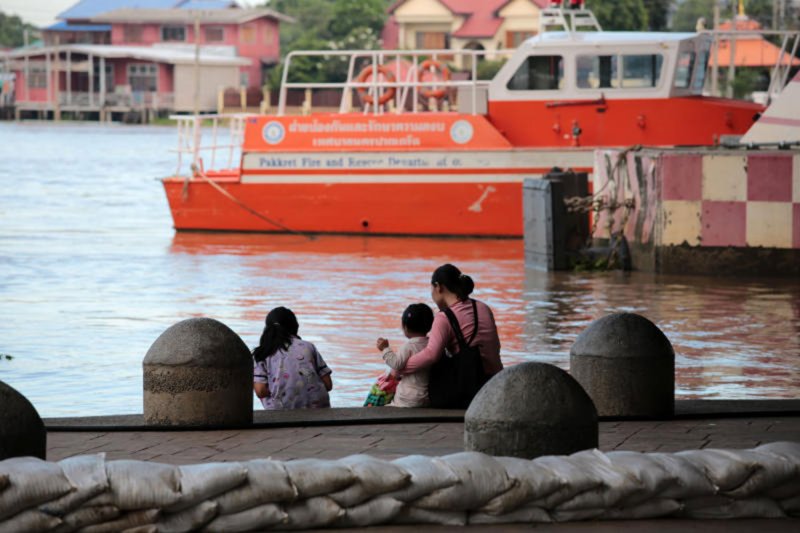
There will be no heavy rain in the Central Plains, including Bangkok and surrounding provinces, over the next 10 days, but communities in the Chao Phraya basin should prepare for a water runoff influx from northern Thailand, says natural disaster specialist Seree Supratid.
Mr Seree offered the advice in a post on his Facebook page from Hat Yai, where he was helping with the installation of a flood warning system that is expected to be operational before the rainy season intensifies in the South in November.
He said he has been monitoring rainfall and upstream water conditions in his capacity as director of the Climate Change and Disaster Centre at Rangsit University and vice-president of the National Disaster Warning Council Foundation.
The outlook for the next 10 days contains both good and bad news, he said.

Assoc Prof Seree Supratid is the director of the Climate Change and Disaster Centre at Rangsit University and vice-president of the National Disaster Warning Council Foundation. During the 2011 floods he was a fixture on nightly TV newscasts and highly sought after for his advice and insights.
The good news: No heavy rain is forecast in the Central region, including Bangkok and its surrounding areas, over the next 10 days. The risk of tropical storms entering Thailand is also low. Of the 26 storms that have formed, only two remain, he said.
The volume of northern runoff from Kamphaeng Phet province has begun to decline. However, authorities should continue to update and monitor weather conditions because the reliability of rainfall forecasts is limited to no more than three days in advance, said Mr Seree.
Floodwaters currently inundating various areas are expected to gradually recede, depending on local drainage capacity. In low-lying districts of Bangkok, including Bang Kapi, Lat Krabang, Khlong Sam Wa, Min Buri, Nong Chok and Bang Na, agencies are accelerating efforts to drain water through Khlong Dan and out to the Gulf of Thailand.
The bad news: Water levels in the lower Chao Phraya basin are rising. Flows in the Ping River at Banphot Phisai district in Nakhon Sawan province rose sharply from Sept 29 to Oct 1, from 892 cubic metres per second on Tuesday to 1,927 cu m/sec on Wednesday before easing to 1,560 cu m/sec on Thursday.
This has pushed up the flow of the Chao Phraya River in Nakhon Sawan from 2,000 cu m/sec to 2,610 cu m/sec over the same period.
Flows are expected to peak at 3,000 cu m/sec and flood volume at 5 billion cubic metres, which remain significantly below the levels recorded during the devastating 2011 floods (4,600 cu m/sec and 15 billion cubic metres).
However, the increased volume would place heavier pressure on the Chao Phraya Dam, causing water levels both upstream and downstream of the structure to rise. There is also a risk that embankments and floodgates could be topped if conditions worsen.
Areas at risk
Upstream of the Chao Phraya Dam, rising water levels are expected to affect areas outside flood embankments in Chai Nat and Uthai Thani provinces. Authorities should closely monitor the possibility of embankment overtopping or structural weaknesses.
Communities downstream of the dam, stretching from Sapphaya district in Chai Nat through Sing Buri, Ang Thong and Ayutthaya provinces, particularly those located along the Chao Phraya and bounded by the Maha Rat Canal embankment on the eastern side and the main road embankment on the western side, are considered vulnerable to flooding.
Communities along the Noi and Tha Chin rivers in Suphan Buri and Nakhon Pathom provinces are at risk and should prepare for possible flooding by moving belongings to higher ground and relocating vehicles to safe areas, said Mr Seree.
KioskNews shows a cleaned-up reading view extracted from the publisher’s page — the original always lives on their site, not ours.