Taiwan researchers develop method to repurpose tea waste
By Esme Yeh / Staff reporter


The Tea and Beverage Research Station has developed a powderization method that can replace up to 15 percent of plastic raw materials with repurposed spent tea leaves and coffee grounds.
About 300,000 tonnes of tea waste and 200,000 tonnes of coffee grounds are generated in Taiwan every year, station director Su Tsung-chen (蘇宗振) said yesterday.
The technique developed by the station effectively stabilizes the quality of processed pellets, resolving issues such as varying pellet diameters or moisture content, Su said.
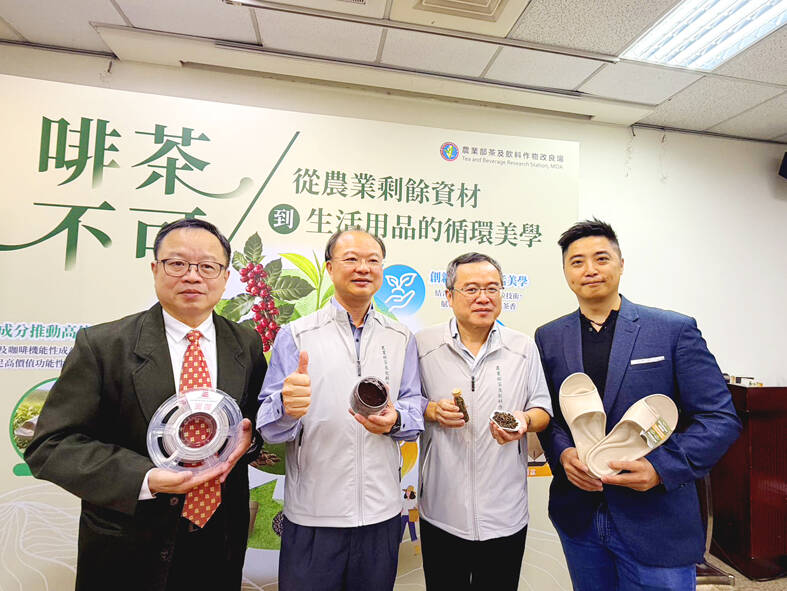
Officials hold slippers and 3D-printing filaments made from recycled tea and coffee grounds at a news conference in Taipei yesterday.
Photo: Yang Yuan-ting, Taipei Times
It can also control the pellets’ sizes or colors and preserve their aroma tailored to customers’ needs, he said.
That can offer customers a more natural product choice over artificial colors and flavors, Su said, adding that the technique is expected to repurpose more waste generated by beverage manufacturers.
Tsai Hsien-tsung (蔡憲宗), head of the station’s Processing Technology Division, said the method’s application began with spent tea leaves and coffee grounds, as they are the most common beverage crop byproduct in Taiwan.
The technique has great potential of being applied to other agricultural residues, he said.
Taiwan is facing price competition with China and Southeast Asian countries in the manufactured goods market, Tsai said.
It could be difficult for Taiwan’s medium or small-sized enterprises to survive with such competition, as their labor costs are higher, he said.
With the cultural touch and market visibility of Taiwanese tea and coffee, manufactured goods combined with repurposed tea waste or coffee grounds are not only sustainable, but also distinguishable in the global market, he added.
Pancolour Ink Co general manager Shen Wen-chang (沈文昌) said the company applied the technique to making biodegradable 3D printing filaments.
Pellets made of tea waste also substituted tea or coffee fragrance for plastic odors during the filament production process, he said.
Tay Song Enterprise Co development manager Jonas Lee (李軒銘) said the company used the repurposed pellets to make slippers with a tea fragrance, which is a high value-added feature of the product.
The key lies in the technique’s ability to preserve tea aroma compounds, he said.
The method is available for three-year nonexclusive licensing at a pretax fee of NT$100,000, the station said.
KioskNews shows a cleaned-up reading view extracted from the publisher’s page — the original always lives on their site, not ours.