Despite AirAsia chief’s rebuttal, analysts less sanguine over budget carrier’s financial plight
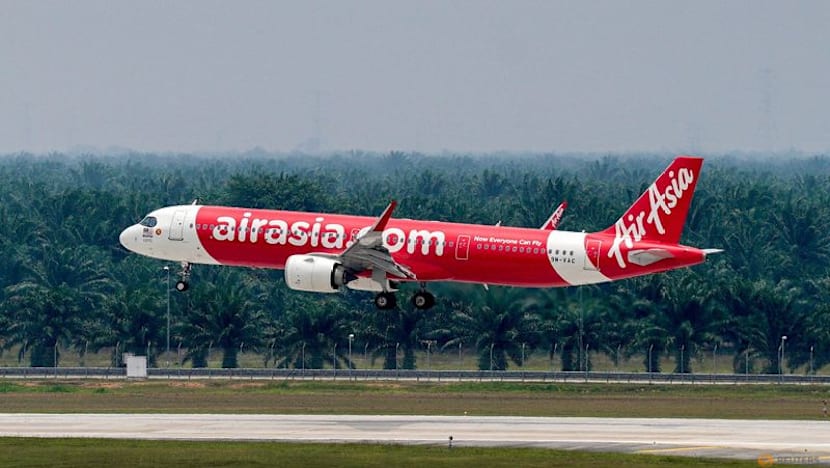
KUALA LUMPUR: AirAsia co-founder Tony Fernandes has insisted that the airline does not need government help but analysts say numbers tell a different story - which is that its “financial situation is still in a dire state” and issues remain.
They say the spotlight on the Malaysian budget carrier’s plight has also put the viability of its low-cost model under scrutiny after years of restructuring, rapid expansion and accumulated financial pressures.
And if conditions continue to worsen despite Fernandes’ assurances, a bigger question remains: How far should the Malaysian government go to protect an airline with an outsized role in the country’s aviation sector?
AirAsia’s financial plight came into the spotlight after reports that Malaysian authorities had been assessing its financial position and preparing for different scenarios, according to news reports.
A Reuters report published on Sep 16, citing two sources familiar with discussions, said that the government had allegedly spoken to rival Malaysia Airlines and Batik Air about whether they could absorb AirAsia’s domestic market share if necessary.
Both carriers indicated they could expand organically to take on routes and passengers rather than acquire AirAsia’s entire business, Reuters said.
Batik Air’s chief executive Chandran Rama Muthy also told the Bernama state news agency that it was “able to bring aircraft in quickly to absorb or help with the domestic market demand if required”.
But Fernandes, in addressing the media during an online briefing from Bangkok on Friday (Sep 18), pushed back against reports that AirAsia was in serious trouble.
“We have always had crises and come out stronger,” he said, also insisting that the carrier did not “need rescuing or bailouts”.
He instead pointed to strong passenger demand and expectations that earnings would improve in the second half of the year, while expressing confidence that the airline would secure US$1 billion (RM4 billion) in financing by January.
“We are very confident of getting (it),” Fernandes said, noting that the company has been “negotiating with many banks” for the best deal.
Even challenges such as soaring jet fuel costs were “far, far” less severe than those faced during the COVID pandemic, he added.
Economist Mohd Harridon Mohamed Suffian from Universiti Kuala Lumpur’s Malaysian Institute of Aviation Technology said that despite the latest remarks by Fernandes, one has to be “vigilant (about) the economic and financial signs and indicators to fully gauge AirAsia’s financial stature”.
“It is also imperative to gauge AirAsia’s debt,” he added, pointing to a call by the National Union of Flight Attendants Malaysia (Nufam) for the airline not to lay off staff amid its financial strains,” Harridon added.
AIRASIA’S FLIGHT AND PLIGHT
The airline is no stranger to financial difficulty.
Established in 1993, it began flying three years later as a conventional full-service airline - but struggled financially, accumulating around RM40 million in debt.
In 2001, Tune Air, led by Fernandes and Malaysian entrepreneur Kamarudin Meranun, acquired the debt-laden airline for a token RM1 while also taking on its liabilities and subsequently transforming it into a low-cost carrier that would become one of Southeast Asia’s biggest aviation success stories.
Today it operates from hubs in Malaysia, Thailand, Indonesia, Cambodia and the Philippines.
Its fleet of 239 planes also serves more than 150 destinations across over 20 countries, mainly in Asia and Australia.
But its rapid growth has been punctuated by periods of financial stress.
The most severe came during the pandemic, which pushed parts of the AirAsia group into severe financial distress - with both AirAsia X and Capital A, then the parent of its short-haul airlines, falling under Bursa Malaysia’s PN17 classification in 2021 and 2022 respectively.
PN17 companies must undertake a financial recovery plan to maintain their listing on the Malaysian stock exchange.
Years of restructuring followed, culminating in the consolidation of its airline businesses under AirAsia X, now known as AirAsia Group Berhad - earlier this year.
Capital A, which retained the group’s non-airline businesses, exited PN17 in May.
In a statement released on Sep 2, AirAsia shared that its planned fundraising exercises, comprising up to US$1 billion in international debt markets and RM700 million in local credit facilities, were “primarily targeted at debt restructuring, refinancing and balance sheet consolidation, rather than purely funding operational shortfalls”.

For Shukor Yusof, founder and principal analyst at Endau Analytics, the latest concerns over AirAsia therefore do not come entirely out of the blue.
As of June 30, 2026, the airline had RM954mil in cash against RM18.4bil in current liabilities - while borrowings stood at RM3.13 billion and lease liabilities at RM13.3 billion.
“It is not surprising to many industry watchers as it is a publicly-listed company and the figures are out there for all to see and assess,” he told CNA.
“Anyone can see their balance sheet is weak and the jet fuel situation remains highly volatile,” he said, adding that the airline “needs an urgent infusion of funds, ideally more than what is being raised”.
Its recent woes also come amid a surge in fuel prices amid the conflict in the Middle East - a problem that has affected airlines around the world.
The International Air Transport Association (IATA) said in June that rising fuel costs and war-related disruptions had significantly worsened the outlook for the industry, with budget carriers to be among the hardest hit.
Shukor also pointed to the bankruptcy restructuring of Latvia’s flag carrier airBaltic and the shutdown of American budget airline Spirit Airlines as signs of how those pressures have already taken a toll on carriers this year.
Economist Harridon said the airline’s lack of fuel hedging left it particularly vulnerable when fuel prices surged.
“Most airlines protect themselves against sudden price spikes by locking in fuel prices for a certain percentage of their expected usage,” he said.
“Because AirAsia had zero hedges, it was left completely exposed and at the mercy of the open market and forced to buy jet fuel at peak market prices.”
He also believes that the airline’s rapid expansion, while carrying high levels of debt, compounded the financial pressures.
And that expansion has come under particular scrutiny.
In May, AirAsia placed a landmark US$19 billion order for 150 Airbus A220 jets.
The deal came at a time when “most airlines are tightening their belts”, Shukor said. “Serious questions were raised about those announcements,” he added.
Khair Mirza, head of industry research at aviation advisory firm Modalis Infrastructure Partners, also questioned the timing of the acquisition.
“If a business isn't doing well, consolidation is the only true reality,” he said.
“Nobody forced them (AirAsia) to expand or order new planes.”
He added that the airline’s financial history and current financing options warranted closer scrutiny.
For the first half of the year, it reported a revenue of over RM11 billion - but still posted losses of nearly RM960 million.
“Follow the numbers,” he said, pointing to the group’s previous debt restructuring and change of auditors - which he regarded as financial “red flags”.
The airline also sold six newly delivered aircraft since the start of last year, including two in July, according to Bloomberg reports.
Harridon saw the disposals as another indication of financial pressure facing the airline.
“The current sales of its newly delivered aircraft even before they were utilised for operations are indications that the financial vibrancy and economic position of AirAsia is not propitious for financial growth or retainment of optimum financial revenues,” he said.
Fernandes said in his Sep 18 media briefing that discussions with banks and investors had remained strong.
He added that the group had received a signed term sheet from a Middle Eastern investor for US$1bil in funding, with the financing guaranteed to be funded, but was holding off while it sought the best possible terms.
“We have many choices. I'm trying to get the cheapest choice,” he said.
The financing is expected to be finalised around December or January, with the group also considering share capital raisings in Indonesia and the Philippines.
Fernandes stressed that the funding exercise was not about plugging an immediate liquidity hole but lowering the group’s cost of financing.
“When you see the refinancing, it's about cost. It's not about fresh capital. It's about bringing down costs. That's all I'm focused on,” he said, adding that airline operations were sustainable.
He also rejected suggestions of other airlines simply stepping in to replace AirAsia’s domestic operations.
“How do you replace 100 planes in Malaysia? You can't. First of all, you have to have our cost structure, our brand, our market, our network, our interlining,” he said.
SHOULD THE MALAYSIAN GOVERNMENT STEP IN?
As the largest low-cost carrier in Southeast Asia, AirAsia’s sheer size means its financial difficulties are not solely a concern for the company, its creditors and shareholders.
The airline says it accounts for about 40 per cent of Malaysia’s aviation market and 60 per cent of domestic flying - giving it an important role in the country’s connectivity, tourism sector and employment.
Observers note that it is a significant contributor to Malaysian tourism, trade connectivity and employment.
“A disorderly failure would not be contained to shareholders, it would ripple through airports, tour operators, regional feeder routes and thousands of jobs, both direct and indirect,” said forensic accountant Ahmad Zubir.
That would leave the Malaysian government with a difficult calculation if the airline’s financial position deteriorates further - whether to let market forces run their course, or intervene to limit the wider economic fallout.
For now, Fernandes insists that choice does not need to be made.
“We're not getting anything from the government,” he said during the Sep 18 presser. “We do not need rescuing or bailouts whatsoever.”
02:34 Min
AirAsia's Tony Fernandes has pushed back against media reports claiming that the low-cost carrier needs a government bailout. Yasmin Jonkers reports.
CNA has contacted both airlines as well as Malaysia Airports Holdings Berhad (MAHB) and Malaysia’s Ministry of Finance (MOF) for comment. MOF and MAHB declined to comment.
But absorbing the airline’s operations would be a substantially bigger undertaking and Fernandes has argued that “no one can replace” the roughly 100 aircraft AirAsia operates in Malaysia overnight.
Ahmad Zubir noted that the potential consequences of a severe retrenchment at AirAsia would be a public-interest case for measured government intervention.
The airline currently employs around 18,500 staff across its network.
In 2021, AirAsia’s then-parent received approval for a loan of up to RM500 million under a COVID-19 government guarantee scheme, with the government guaranteeing 80 per cent of the facility.
The loan was intended to support working-capital needs as the airline recovered from the pandemic, but the company eventually decided not to proceed after objecting to some of the conditions attached to it, which included personal guarantees from Fernandes and co-founder Kamarudin Meranun.
A government guarantee, even a partial one, could lower AirAsia’s financing costs and widen its access to capital at a time when lenders are wary of aviation exposure, said Ahmad.
Any assistance should be tightly conditional rather than amount to a blank cheque, he added.
“The 2021 facility shows that Malaysia has a template for assistance that is not a blank cheque: partial guarantees, sunset conditions and personal undertakings from the ultimate shareholders,” he said.
“A guarantee structured on similar lines would share risk rather than transfer it wholly to the taxpayer.”
A government intervention would also carry risks of its own and could also create pressure for similar treatment of other distressed carriers - or, more broadly, large private companies in other sectors, Ahmad said.
In March 2025, the Malaysian government injected RM1.1 billion into Sapura Energy - an oil and gas services company now rebranded as Vantris Energy - through a state-owned vehicle to protect local vendors. Observers said then that it would set a dangerous precedent for other companies unable to meet obligations.
Shukor Yusof from Endau Analytics said an intervention could be justified if the collapse of a major carrier threatened the wider economy - but argued that it should come with substantial conditions.
In his view, that could go as far as nationalisation, pointing to the government’s takeover of Malaysia Airlines in 2014 as a precedent for intervention in a strategically important carrier.
“Understandably the Malaysian government is caught between a rock and a hard place,” Shukor said.
Fernandes has said that AirAsia plans to raise over US$1 billion, mainly to restructure and refinance debt.
But fresh financing alone would not resolve deeper financial problems for the airline, said Khair Mirza from Modalis Infrastructure Partners.
A billion-dollar financing package would depend on optimistic assumptions about AirAsia’s operational performance, he said - including expectations that it could break even in the second half of 2026.
“And even with that (sum), AirAsia would still have to generate enough to repay or keep everything afloat,” he added.
KioskNews shows a cleaned-up reading view extracted from the publisher’s page — the original always lives on their site, not ours.