AI was supposed to hit new grads hard. So far, unemployment data says otherwise.

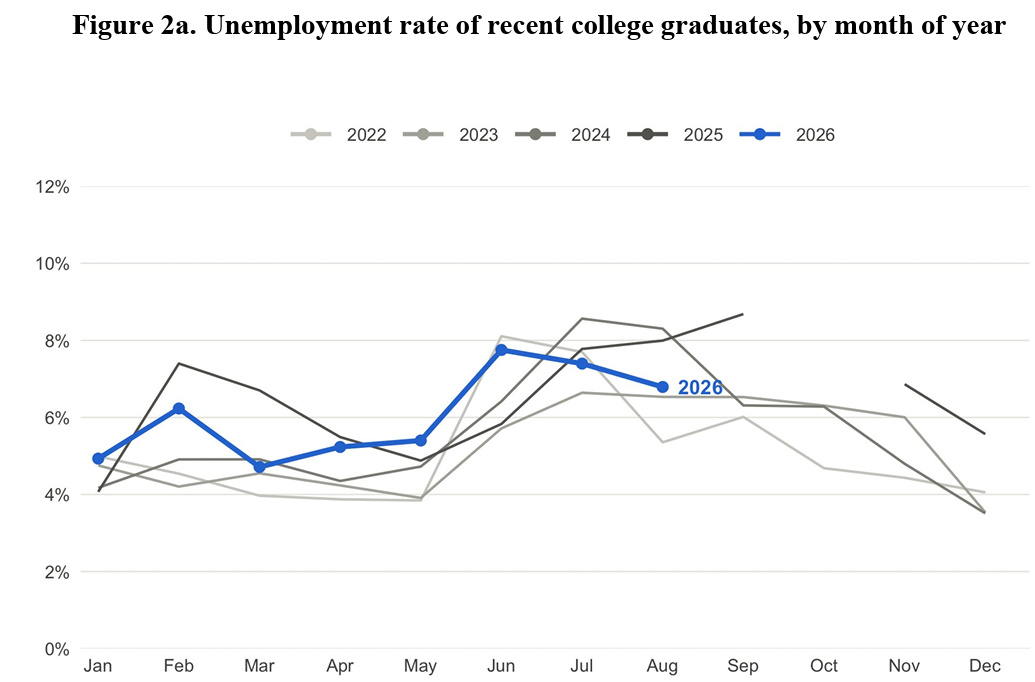
The 2026 jobs market looks incredibly normal for recent graduates.
The 2026 jobs market looks incredibly normal for recent graduates. Credit: CESifo
At a base level, the summer unemployment rate for those young college graduates in 2026 (7.3 percent) was well within the range seen in previous years (from 6.3 percent in 2022 to 7.8 percent in 2024). The 2026 numbers were similarly unremarkable when expanded to include graduates who told the CPS survey they “want a job” even though they weren’t actively looking for one (and thus don’t officially count as part of the official “unemployed” labor force).
To test the robustness of these findings, the researchers created statistical tests to compare the recent college graduates both with non-college graduates in the same age range and with older college graduates (aged 30 to 49). They also broke down employment by potential “AI exposure” based on a 2023 study of what job roles AI systems were best equipped for.
In almost all of the comparisons, any trend differences between the groups in the 2022 to 2026 time frame studied were not statistically significant. Overall, the data “tell a consistent story in which unemployment among recent college graduates in summer 2026 was not unusually high relative to earlier summers” across comparison groups, the researchers wrote.
So how does this analysis square with the recent Stanford study that found an almost completely opposite result? Well, Stanford’s study was based on payroll data from HR firm ADP, which covers a decent cross-section of the economy but might miss some elements of a wider Census survey. The ADP data also looks at the total supply of jobs in various fields, while the unemployment rate being studied here also takes into account the aggregate demand for those jobs. That demand could easily shift even if the supply of jobs in certain fields starts contracting due to AI.
Overall, the CESifo researchers conclude that the Summer 2026 unemployment data serves as a “useful first test” of how accelerating AI usage is—or, as the data show, is not—impacting the current US job market. But current trends do not imply future performance, of course, and the researchers warn that “if the intensity of AI use in the workplace continues to increase, the graduating classes of 2027 and later might be more affected than the class of 2026, and additional years of data will be needed to hone in on whether effects emerge as workplace use of AI deepens.”
KioskNews shows a cleaned-up reading view extracted from the publisher’s page — the original always lives on their site, not ours.