Microbes along S’pore coastline break down oil faster when sand is less waterlogged, has more oxygen: Report
SINGAPORE – Nature can be man’s best friend in responding to man-made disasters like an oil spill.
Micro-organisms, which already clean up the oil naturally, can do an even better job of the task under certain conditions – specifically when the sand is less waterlogged and has more oxygen – according to newly released research.
This finding could help responders better understand the conditions that favour natural oil removal and come up with interventions to speed up oil spill clean-ups, said Professor Stephen Brian Pointing of the National University of Singapore, who led the research.
The research was published in August in a peer-reviewed journal, Environmental Science and Ecotechnology.
Over 90 days, microbes degraded 40 per cent of the oil in sand that was well-drained and rich in oxygen. But in waterlogged and oxygen-poor sand, that figure fell to 5 per cent over the same duration.
Oxygen is an important factor in determining how efficiently microbes break down oil, said Pointing. While bacteria can still degrade oil when oxygen is scarce, the process is far slower and less efficient.
Different types of bacteria take over depending on how much oxygen is available.
In oxygen-rich sand, certain bacteria – particularly those from a group called Alphaproteobacteria – use oxygen to rapidly break down oil. Meanwhile, in waterlogged and oxygen poor sand, other bacteria take over to degrade the oil, albeit less efficiently.
These findings stemmed from the team’s initial research in September 2025, prompted by one of Singapore’s worst oil spills. In June 2024, a dredging boat collided with a bunker vessel, releasing more than 400 tonnes of oil into the nation’s southern waters.
Pointing said: “The first study was basically showing that the microbes were involved in cleaning up the sand from that big spill in 2024, and this study is explaining exactly how they achieve it.”
“In the past, people knew that the oil disappears, but they didn’t know what’s causing it,” he said.
“We have shown that 40 per cent of the oil is being broken down by the microbes, which is quite a significant amount. This means that keeping our beaches healthy in terms of their microbial populations is a really important part of management.”
The researchers found that there is a total of 298 species of microbes breaking down the oil in sand collected from Bendera Bay on St John’s Island, a beach designated for long-term scientific study.
They were identified using metagenomic sequencing, a method that enables scientists to characterise all genetic material in a sample and also the microbes’ ways to degrade oil.
The latest research also revealed that some microbes are “unusually adapted” to both the presence and absence of oxygen, so they can degrade oil under both conditions as beach conditions fluctuate such as during a change in tide, said Pointing.
They may act as metabolic bridges, allowing degradation to continue while the environment is switching between oxygen-rich and oxygen-depleted states, he added.
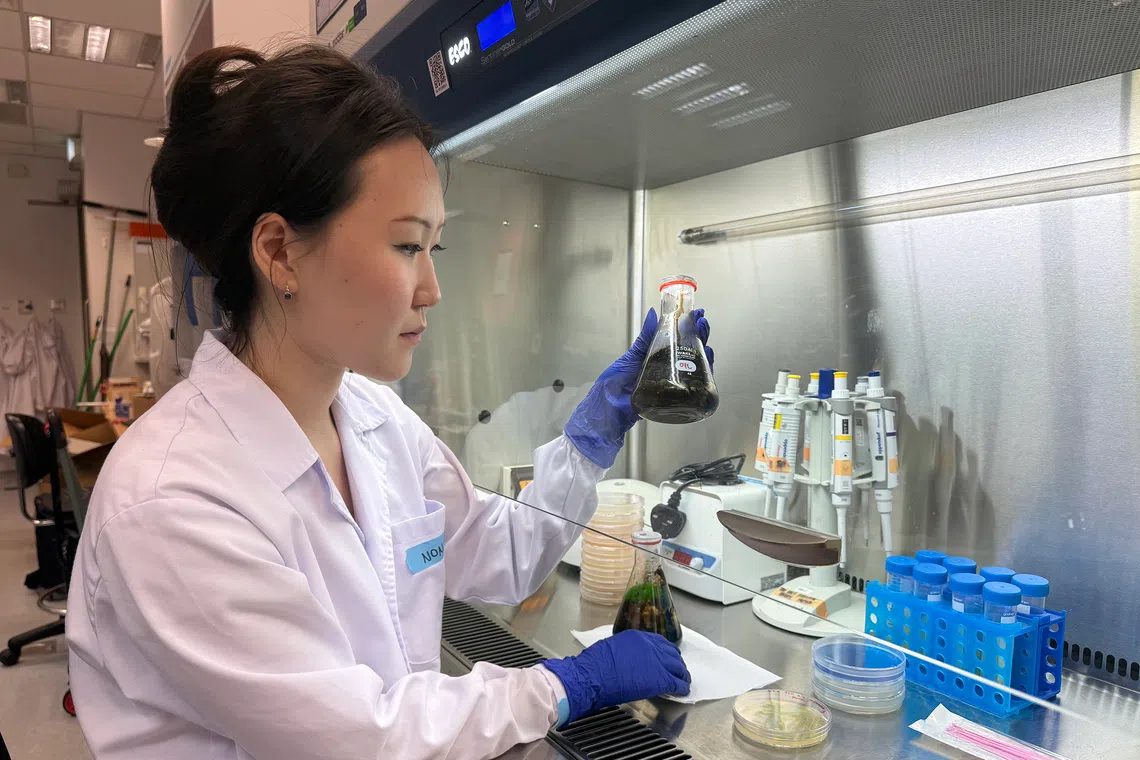
The NUS researchers found that there is a total of 298 species of microbes breaking down the oil in sand collected from Bendera Bay on St John’s Island.
PHOTO: STEPHEN BRIAN POINTING
Using these findings and data, the research team is now building predictive models to identify which beaches are likely to break down oil naturally and quickly, and which ones the oil will linger on, requiring active intervention.
This could mean leaving parts of the beaches alone, or taking steps to reproduce the conditions needed to accelerate the process of the oil being broken down naturally.
For example, responders could aerate the sand, promote water drainage in the sand or make sure the slopes of the beaches are not too shallow.
“The end goal is to provide some practical and sort of tractable low-cost advice that will just let us plan better instead of having to deploy massive effort to remove oil,” he said.
Pointing noted that Singapore’s equatorial climate, highly used shipping lanes and highly dynamic tropical coastlines make it a treasure trove for research in this field. Most of the world’s detailed knowledge of major marine oil spills has historically come from other places.
“Recovery from an oil spill does not stop when the visible oil disappears,” he said.
“There is a largely invisible biological recovery process continuing within the sediment. Understanding that gives us another tool for protecting and managing tropical coastlines.”
KioskNews shows a cleaned-up reading view extracted from the publisher’s page — the original always lives on their site, not ours.