Priti Adani Calls For Closer Industry-Academia Ties To Build India's Semiconductor Talent
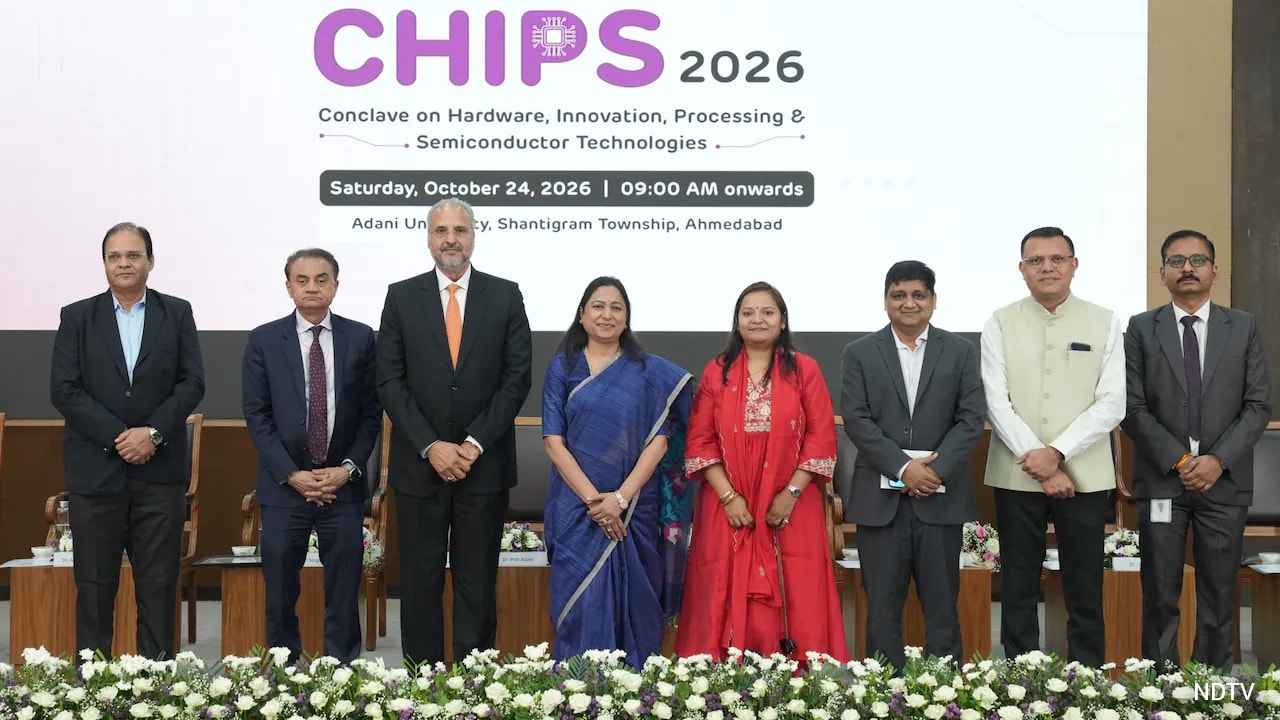
Dr Priti Adani, President of Adani University, has called for closer collaboration between industry and academia to develop the skilled talent India needs to strengthen its semiconductor ecosystem.
Speaking at the 'Conclave on Hardware, Innovation, Processing & Semiconductor Technologies (CHIPS) 2026', hosted by Adani University, she said that building a strong semiconductor industry requires not only advanced manufacturing facilities but also people equipped to design, develop and improve complex technologies.
"The true measure of our technological progress will not be how intelligent our machines become. It will be how wisely we develop and use human intelligence to build a better future," Dr. Priti Adani said.
The conclave featured keynote addresses by experts from Qualcomm, NXP Semiconductors, Micron Technology, Synopsys, Cyril Amarchand Mangaldas and Infineon Technologies, representing fields spanning wireless technology, semiconductor design, memory and storage, power systems and legal services.
Their addresses explored developments and opportunities across the semiconductor value chain, according to a statement.
Three panel discussions examined key industry priorities. "The Future of Semiconductor Design in India" explored ways to strengthen domestic design capabilities.
"Semiconductor Manufacturing: Shaping India's Technological Future" focused on manufacturing and its role in India's technological development, while "Career Opportunities in the Semiconductor Ecosystem" examined emerging roles, skill requirements and career pathways.
Organised in collaboration with IIT Mandi, the VLSI Society of India, a professional body promoting Very Large-Scale Integration (VLSI) technology and its applications, and Cyril Amarchand Mangaldas, a leading Indian law firm, 'CHIPS 2026' brought together representatives from the Gujarat State Electronics Mission, semiconductor companies and academic institutions. Discussions focused on aligning research and technical education with industry needs.
India's semiconductor ambitions extend beyond fabrication to expertise in chip design, manufacturing and packaging.
The India Semiconductor Mission (ISM) has provided momentum, while projects at Dholera and Sanand are advancing Gujarat's role in the sector.
The rapid development of artificial intelligence (AI) is also increasing demand for the infrastructure that supports it, including advanced chips, data centres and reliable power supply.
Adani University, which focuses on industry-aligned education and research, plans to develop expertise in semiconductor design, manufacturing and packaging at its upcoming multidisciplinary global campus in Ahmedabad.
Proposed initiatives include specialised programmes for young engineers, executive education for industry professionals and faculty development, with an emphasis on connecting academic learning and research with industry requirements.
(Except for the headline, this story has not been edited by NDTV staff and is published from a syndicated feed.)
KioskNews shows a cleaned-up reading view extracted from the publisher’s page — the original always lives on their site, not ours.