Hon Hai expects revenue growth in double digits
By Meryl Kao / Staff reporter


Manufacturing giant Hon Hai Precision Industry Co (鴻海精密) yesterday said it expects revenue to grow by a double-digit percentage next year, driven by robust demand for artificial intelligence (AI) data center-related products.
“We are likely to see a K-shaped divergence next year, with AI data center-related business continuing to grow, while other businesses would follow a different trajectory,” Hon Hai chairman Young Liu (劉揚偉) said on the sidelines of the Hon Hai Technology Day conference in Taipei.
Hon Hai’s revenue last year rose 18.13 percent year-on-year to about NT$8.1 trillion (US$249.4 billion), company data showed.
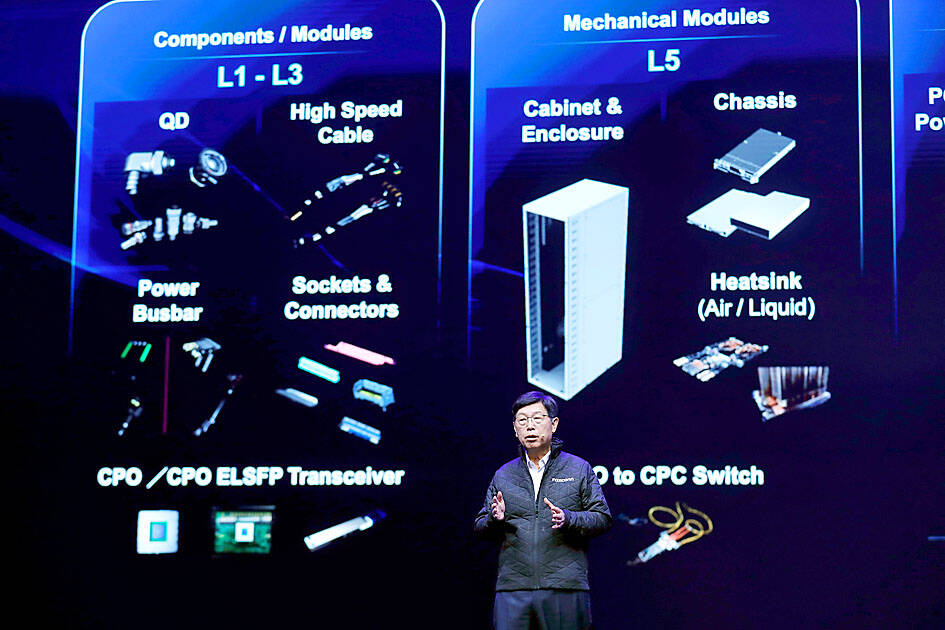
Foxconn chairman Young Liu delivers a speech during Hon Hai Tech Day events in Taipei yesterday.
Photo: Chiang Ying-ying, AP
Recent concerns over an AI industry bubble might be overstated, as market demand remains clear, Liu said, adding that concern about financial risks at major AI companies was an overly negative view.
Supply-chain demand far exceeds capacity, making the situation difficult to describe simply as a “shortage,” he said.
Liu met with OpenAI chief executive officer Sam Altman.
The two discussed potential cooperation.
Liu declined to disclose details.
As AI data center demand continues to grow, Hon Hai plans to add more capacity to its six factory buildings in Houston, Texas, Liu said.
Hon Hai is not moving away from China, Liu said, adding that it remains a major market for its customers.
Regarding a proposed Taiwanese industrial park in Texas, with an investment of up to US$4 billion, Liu said that as the local AI manufacturing supply chain is incomplete, Taiwanese suppliers of key components have to build capacity there.
Hon Hai hopes the project could develop into what Liu described as a “third-generation science park,” following Hsinchu as the first generation and Tainan as the second.
Such a park should go beyond hosting individual manufacturers or assembly sites and instead form a complete industrial ecosystem, supported by suppliers of molds, forming and processing services, cables, connectors and printed circuit boards, Liu said.
The company yesterday showcased an Nvidia Corp DSX POD, a modular data center developed with Teco Electric & Machinery Co (東元電機) based on Nvidia’s DSX POD reference design that allows partners to preintegrate Nvidia Vera Rubin rack-scale AI infrastructure and complete critical validation before shipment.
The designs can reduce power consumption by about 30 percent and improve token output per watt by about 50 percent, Liu said, adding that achieving such gains requires close cooperation with Nvidia.
Separately, Hon Hai unveiled three new reference electric vehicles: the SUV-inspired Model A+ and Model K+, as well as the compact Model K pickup truck.
Hon Hai is in talks with automakers and other potential partners and would disclose further details once agreements are reached, Liu said.
The company would continue to follow its contract design and manufacturing service model, instead of establishing its own automotive brand, he said.
KioskNews shows a cleaned-up reading view extracted from the publisher’s page — the original always lives on their site, not ours.