From rock bottom to triumph: the Liberal party’s Victorian metamorphosis – and the blueprint it sets

In mid-2025, the Victorian Liberals were a laughing stock. Its entire administrative wing was fighting in court. Riven by grievance, a cohort wanted to stop a loan to a former leader facing bankruptcy after being sued by a colleague he linked to Nazis. Even the party’s most faithful supporters were despondent.
But on Saturday night, the party ended 12 years of Labor rule and delivered a blueprint for interstate colleagues determined to rebound from their own election drubbings and internal spats.
Several Liberal insiders have told Guardian Australia the Victorian transformation was founded on a demand from a new party leader, director and president: stop letting ill-discipline distract from an unpopular Labor government.
For some, the first hint of victory came in November 2025 when Jess Wilson took the leadership from Brad Battin, whose tough on crime campaign was undermined by infighting and routine scandals.
“It looks like they want to win and are sick of losing,” Kos Samaras, a former Victorian Labor strategist turned pollster, said at the time.
Initially, not everyone in the partyroom got the memo. In June, when former Liberal MP Moira Deeming accused her partyroom colleague Mathew Guy of placing her in a headlock, many feared the party would be once again engulfed in conflict.
Guy demanded an apology after Victoria police found there was “no offence detected”, with Deeming subsequently saying she misunderstood the meaning of the term “headlock”. But Wilson, six months into her leadership, was determined to contain internal disputes. Within weeks, Deeming was disendorsed.
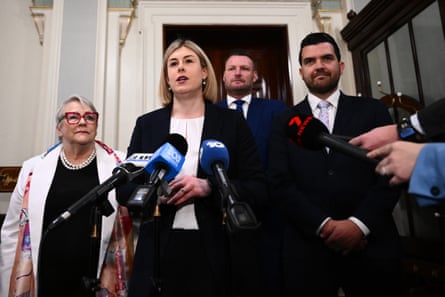
It wasn’t until July, when the Labor partyroom dumped former premier Jacinta Allan and installed Ben Carroll, that the majority of the partyroom believed they had a realistic chance of winning.
“The Labor leadership change was a critical moment,” said a senior Liberal before polls closed on Saturday. “Labor acknowledged, whatever the spin, that they were on the wrong path.”
Several Liberals say this moment gave further encouragement to those with axes to grind, different opinions about policy or frustration about being sidelined to remain silent.
“Everyone realised that we could win and that was more imporant that all of the petty grievances.”
Discipline at all costs
Message discipline, according to insiders, was a daily request from the party’s state secretary and campaign director, Alyson Hannam, whose appointment was announced within days of Wilson’s promotion last year. She replaced Stuart Smith, who resigned and apologised for ridiculing the party’s women’s council and upper house MP Bev McArthur.
The party’s state president, Brian Loughnane, has also been a routine feature in campaign headquarters. Loughnane became president in May, after the party had stabilised under Wilson. Having spent more than a decade as federal director – including on John Howard’s successful campaign in 2004 and Tony Abbott’s victory in 2013 – he was known for imposing strict discipline.
One of the biggest tests came in mid-October, when Labor pledged to cover out-of-pocket costs for abortion care up to 16 weeks’ gestation. The party wanted to make abortion a defining issue of the campaign and split the Coalition.
“That was something that Andrews used to do,” said one long-term Liberal. “He’d throw out a divisive wedge issue like that and we’d all start fighting each other.”
But almost immediately, Wilson told Guardian Australia the Coalition would match the proposal and they would “not allow Labor to play politics on this issue”.
“The people who would historically be up in arms about this all kept their mouths shut,” said one Liberal source.
“Many didn’t agree with it, but they realised they could be a minister. They said ‘it’s bad, but being in government is better’.
While disciplined, Wilson’s small-target campaign was not without stumbles and set backs.
On its first day, the campaign bus crashed into a small business. But it was a four-minute press conference from Wilson a day earlier that raised alarm in campaign headquarters.
Wilson was under pressure over campaign costings when an adviser called last question and she walked away from journalists. Internally, the campaign knew it was a mistake.
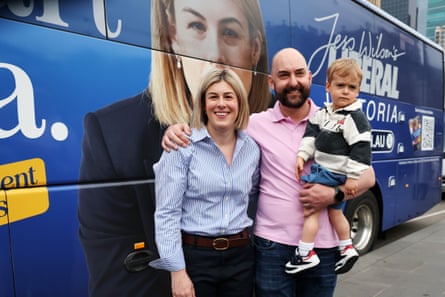
“The reaction to the short presser at the start of the campaign had the potential to knock Jess off her balance but she bounced back really well,” an insider said.
Another feature of the campaign was limiting the appearance of shadow ministers and candidates in the media. The strategy has drawn comparison’s to Scott Morrison’s federal campaign win in 2019, where colleagues were sidelined with a focus almost exclusively on himself.
“It’s not like there was a blanket ban, but [headquarters] have been very sparing in terms of approvals that have been given,” said one candidate. “From their perspective, it’s very risk averse.”
One campaign insider says they were surprised at how many requests to speak to the media were knocked back.
On several occasions, particularly so in the final week of the campaign, state and federal Liberal MPs were hauled into line by campaign headquarters, accused of getting ahead of themselves.
Experienced Labor campaigners acknowledge the Coalition did not stray from its message or show internal division. But they say the real challenge is about to begin.
“They have been very disciplined,” said one senior Labor source. “That’s what happens when you’re winning.
“Jess might look like princess Leila, but that’s still the bar scene from Star Wars standing behind her.”
Federal experience
While former Labor advisors have called out a lack of campaign experience within government ranks, the Liberals drafted in experienced campaigners.
“There has definitely been a move to bring in federal discipline,” said one source.
“There is a massive amount of campaign expereince working in this campaign and the experience that’s been brought in helped keep things on track.”
Many Liberals openly admit it was unusual to have the federal party’s shadow defence minister, James Paterson, working as an adviser to Wilson.
“Paterson has been with her almost every day on the campaign,” says the source “I think he’s helped instil the importance of message discipline”.
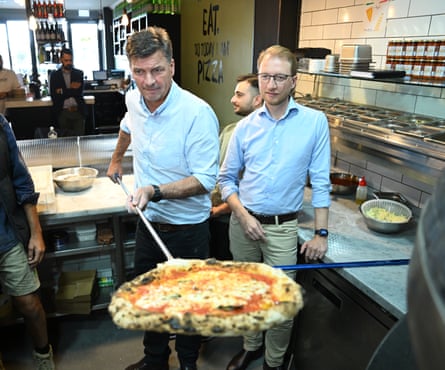
Paterson was the federal party’s campaign spokesperson during the 2025 election defeat and was widely praised for his performance in a campaign otherwise beset by errors.
Kane Silom, a senior adviser to the federal opposition leader Angus Taylor, was brought in as the campaign’s director of communications. Other federal staffers, including from Victorian senator Jane Hume’s office, took leave to work on the campaign.
The Victorian party has also learned from federal mistakes: relying on one source of polling and research. It’s two pollsters, Fox and Hedgehog and Insightfully, have provided second opinions on strategy.
Labor sources conceede the Liberal campaign quickly capitalised on key moments in the campaign.
When the Herald Sun published a front-page story claiming Carroll had taken naps in his office – something his team strongly denied – the Liberals secured a billboard on one of Melbourne’s busiest roads to republish the story. It bought ads at petrol stations shortly after Carroll admitted to forgetting to pay.
These examples are far from groundbreaking campaigning, but were seen as signs the party’s campaign team was firing and experienced.
Like all successful politicians, Wilson has benefited from luck. She ran against a government polling around 20% during the campaign. Ultimately, Labor’s primary vote crashed to even less than that, and was eclipsed by One Nation. That historic shift created a preference flow that helped the Liberals win in a landslide despite not increasing their primary vote since 2022.
Some Liberal MPs put the party’s resurrection almost entirely down to Wilson. Former premier Jeff Kennett says her energy and discipline has been unmatched. But he cautions the party against thinking it won over the Victorian people.
“It would be an error of the party to think that people overwhelmingly voted for us as opposed to voting the government out,” Kennett said.
“I would Jess and her team get maybe 25-35% of the contribution and 70-75% being the total rejection of the government’s performance in a whole range of areas.
KioskNews shows a cleaned-up reading view extracted from the publisher’s page — the original always lives on their site, not ours.