Nilima Sheikh at MoMA: What happens when home itself is under threat?
Among the most rewarding moments in Nilima Sheikh’s over five-decade-long career was when the guards at her exhibition in Chicago in 2014 requested to meet her. “They had been moved by my work, comparing it with political events elsewhere,” she says.
The exhibition, ‘Each night put Kashmir in your dreams’, featured works on the cultural legacy of Kashmir and the volatility of its present, a subject local enough to be relegated simply as ‘South Asian art’, perhaps risking the loss of a nuanced political reading, by a Western audience. But Sheikh has learnt to “never underestimate the intelligence of the viewer”.
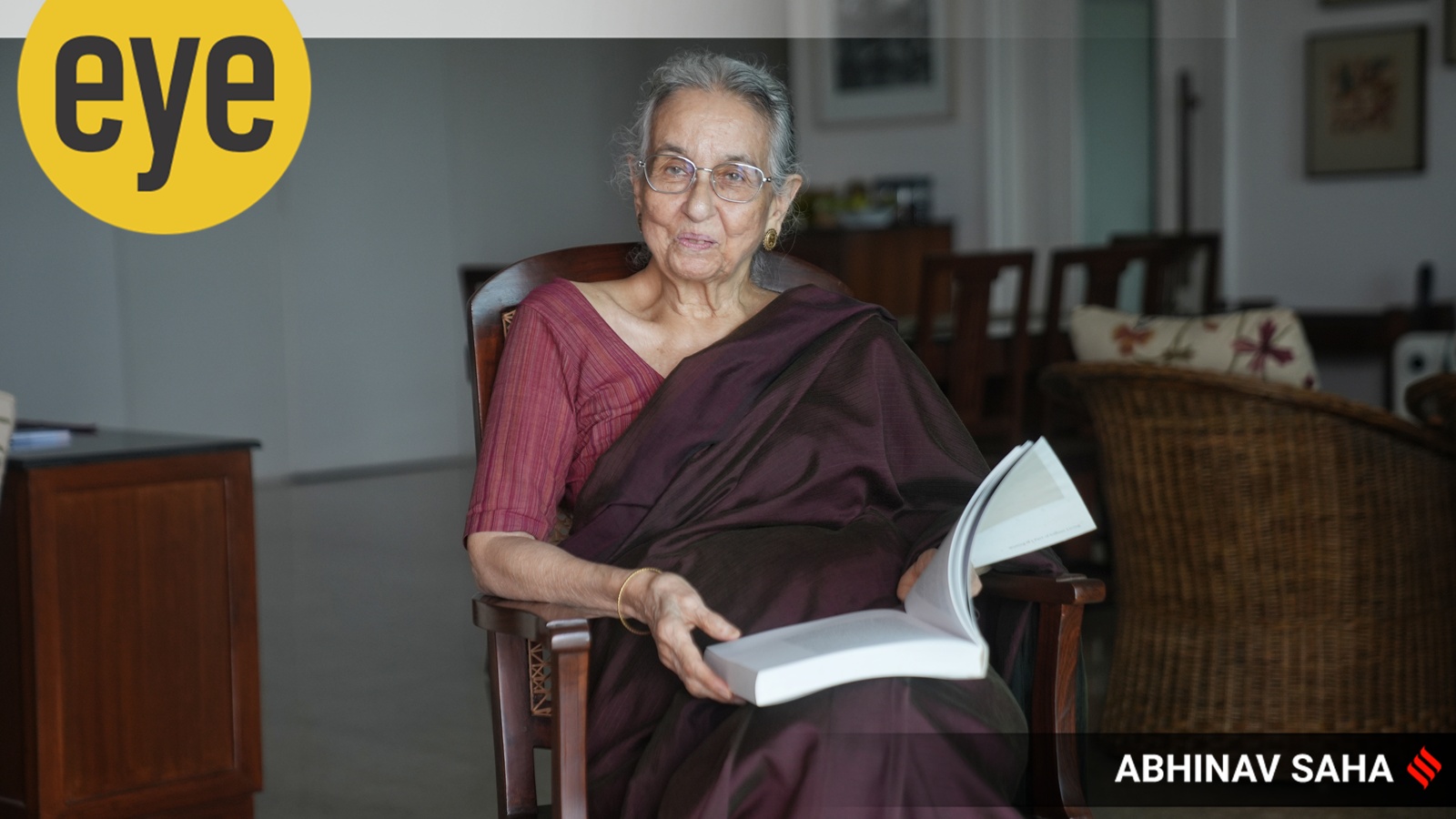
“A work of art is like music… people who really understand classical music can get something more but it doesn’t mean that the ones who don’t know so much cannot appreciate it,” she says, sitting in her Delhi home, hours before boarding a flight to New York, where her first solo show in the city, Fractured Skies, is underway at the Museum of Modern Art (MoMA).
On display are three series: ‘Each night put Kashmir in your dreams’ (2003-14); ‘Home, Land’ (2023-25) that looks at the lives of the nomadic Bakarwal communities of Kashmir; and the brand new ‘Shahid/Witness’ (2025-26), in which she broadens her field to climate change, besides continuing her long standing engagement with displacement and conflict.
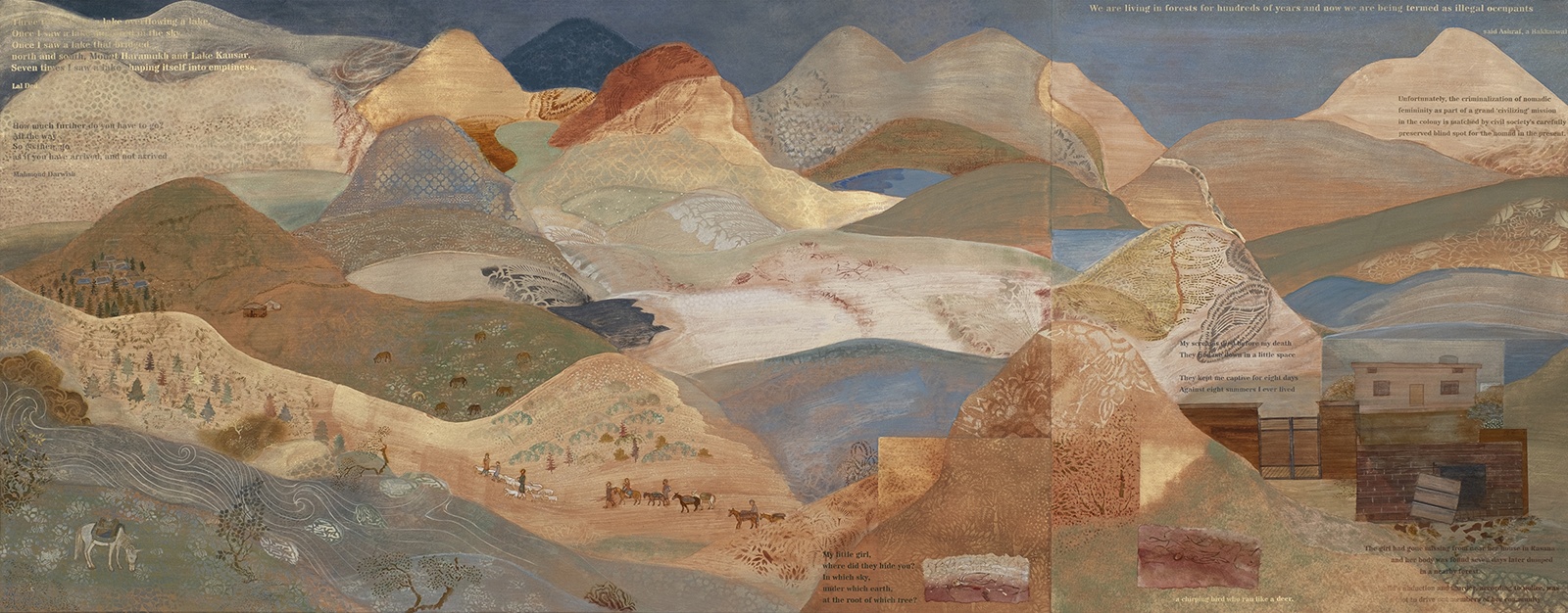 Home, Land 4 (KNMA)
It all started when she first saw photographs of floods in Uttarakhand a few years ago. It led her to reading Amitav Ghosh and other literature on the environmental crisis. “Glacial warming is a huge problem in the Himalayas. You see it in the papers now (most recently with Nepal) but it has been so for some time,” she says.
As a response, she paints the Simurgh. Baroda-based Sheikh adapts the traditional folk tale from the Persian manuscript, ‘Anwar-e-Suhaili’, in which the mythical bird saves a sandpiper-couple’s nest that has been taken by the sea, into her unique visual lexicon.
In her painting, ‘Climate Change/Flood 2’, it is the wrath of the river, originating from a melting glacier that sweeps away the sand-pipers’ nest, and with it trees, boats and human homes. Even as the nest has the assembly of birds flanked by the Simurgh hovering over it, the destruction of human civilisation looms large. In this contrasting image, Sheikh paints the cycle of life, depicting both the precarity of the present and the hope of a renewal.
Story continues below this ad
Here, the sky is the witness. “If there is any sanity remaining, perhaps it is up there,” she says, adding that the idea was borrowed from Chinese paintings, particularly the Mogao Grottoes within the Dunhuang caves, which don’t treat air as empty space; instead, they use the void to create a whole world.
lll
Sheikh was born into a family that had a legacy in medicine. Her maternal grandfather had founded the Gulab Devi Memorial Tuberculosis Hospital for Women in Lahore in 1934 on the request of Lala Lajpat Rai. Both her parents were doctors — father, a physician; mother, a pathologist.
Sheikh attributes her seemingly unexpected affinity for the arts to her parents, particularly her mother, who was also a naturalist. “She was always open to the visual arts and we were taken to museums all over the place,” says the 80-year-old artist.
The other determining factor was Delhi’s Modern School, where she says the art room was not a space exclusively reserved for art class.
Story continues below this ad
“We had artists Kanwal and Devyani Krishna teaching us. It was unusual for the time to have known artists as school teachers. We also had Narendra Sharma, a disciple of Uday Shankar, who introduced us to the notions of modern dance. At a time when art was not seen as a viable profession, it was a combination of these two enviable opportunities that made going into art as a profession the most desirable thing for me,” she says.
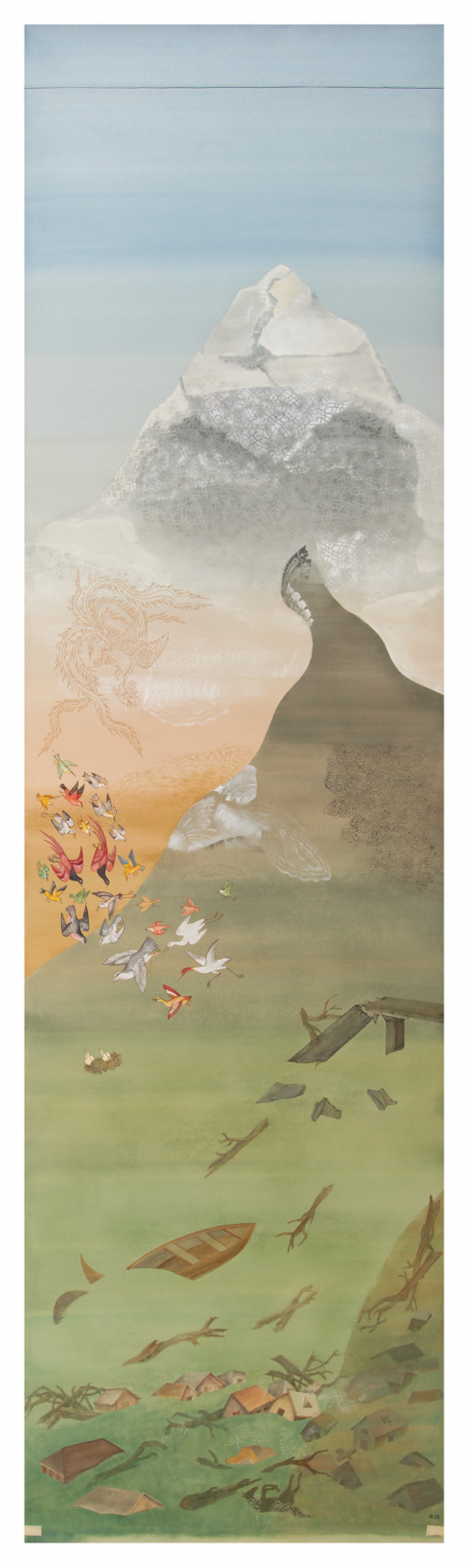 Climate Change/Flood 2 (Shahid/Witness) (KNMA)
She enrolled in bachelor’s in history at the University of Delhi, which was followed by a masters in painting from MSU Baroda. Sheikh’s art today is a balanced reflection of her learnings from the three stages of her education. ‘Dying Dreaming’ (2007-10), for instance, carries the free-wheeling thought from her formative years in its innovative double-sided hanging scroll-like structure; the juxtaposition of Kashmir’s geo-political trauma with its everyday life comes from her understanding of the region’s history; and the exquisitely detailed handiwork, similar to the ones in Persian miniatures is a skill honed at MSU Baroda.
Collaboration is intrinsic to her practice — between the artist and the artisan, between the text and the visual. Quotations from what she reads or her interpretations of them often find their way onto her canvas. In one of the works at MoMA, she integrated the poetry of Miyah poet Shalim Hussain. She also works closely with Sanjhi stencil artists of Mathura to build a visual narrative by layering in her large-scale paintings.
To her, this osmosis of skills and knowledge seems natural. “Why not?” she asks.
“One form of expression need not impinge on the other… they can extend the meaning of the other. I enjoy that very much, and I think we are past the modernist phase when the notions about originality were so crucial in one’s own style,” she says.
Story continues below this ad
In the same vein, traditional forms have heavily informed her work as a post-modern painter — from the structural and narrative language of miniature painting and the technique of using casein tempera (fast-drying paint) on handmade, layered wasli paper to the Chinese and Japanese vertical scroll painting traditions. “During my training with KG Subramanyan, he emphasised on learning visual language rather than acquiring style. With that firmly in my head, I have looked at historical paintings, not only from the point of view of their beauty but also from what I can learn about their linguistics.”
lll
There is a palpable sense of both authority and ease when Sheikh talks about Kashmir. It’s like reminiscing about old times with a confidant. The valley first appeared in her work in 2003 with the solo exhibition: ‘The Country Without a Post Office: Reading Agha Shahid Ali’.
“I visited Kashmir every alternate year growing up but these were not the run-of-the-mill trips. We did a lot of trekking to areas people don’t usually go to… only the nomadic tribes would go there. I feel indebted to my understanding of visuality to these areas,” says Sheikh who, along with artist BV Suresh, worked with Kashmiri craftspeople for the mural at the new Mumbai airport in 2014, using papier-mâché and pinjrakari. In that way, for her, Kashmir too is home. And the anxiety of losing it runs through her work. “When you feel threatened, you begin to understand the meaning of home in a slightly different way,” she says.
KioskNews shows a cleaned-up reading view extracted from the publisher’s page — the original always lives on their site, not ours.