Revisiting the 2026 NFL Draft: Was David Bailey the correct choice? Is Jets pass game fixed?
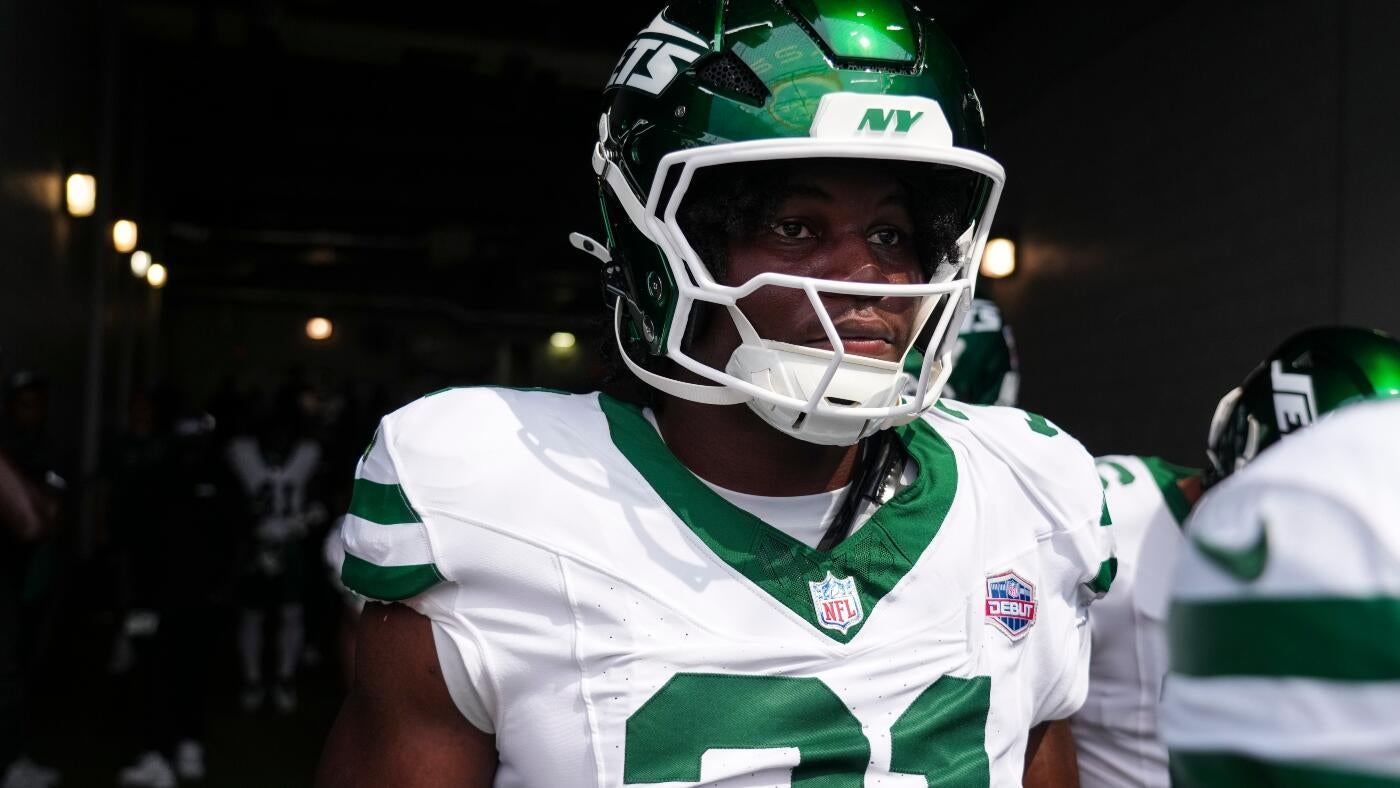
Bailey is producing on the edge while Omar Cooper Jr. and Kenyon Sadiq are flashing playmaking juice, offering New York foundational pieces despite a rocky start

• 4 min read
Aaron Glenn's second season as head coach of the New York Jets is off to a fascinating start. The team has won two games, and four of five losses have been decided by one score. However, a Week 7 loss to the previously winless Miami Dolphins has fans once again questioning if Glenn's job security is on the line.
This season's issues cannot be traced back to a singular decision, but rather a series. Will the selection of Texas Tech edge rusher David Bailey at No. 2 overall be added to the list? Are Oregon tight end Kenyon Sadiq and Indiana wide receiver Omar Cooper Jr. building blocks for the offense?
Let's revisit the Jets' 2026 NFL Draft selections and find out.
With the No. 2 overall selection....
The choice, believed to be either Ohio State linebacker Arvell Reese or Bailey, was debated publicly for months. Bailey was a more refined pass rusher, but Reese had higher upside. The latter has been playing more of an off-ball linebacker role for New York, which was always his best, most natural position. Ohio State linebacker Sonny Styles, who was drafted by the Commanders, was one other player who should have been considered in that spot, because of the total package.
Through seven games, the jury is still accepting evidence in Bailey's case. He has been credited with 26 pressures and 5.5 sacks — three of which came against the Browns — by TruMedia. His 15.4% pressure rate ranks No. 11 among players with at least 150 pass rush snaps, but his 3.62 seconds to sack is below average. The numbers are reflected in the play. A portion of his production is either late in the down or comes when a quarterback steps into pressure. Bailey plays with maximum effort but would benefit from developing a rush plan rather than getting stuck on post-spin moves or swipes around the edge.
In the run game, Bailey shows the requisite power and will occasionally stack blockers, but he also willingly loses gap integrity at times.
If New York had tunnel vision on adding pass rush help with the No. 2 overall selection, they made the correct decision. It is also difficult to fault them for not considering other positions when the draft class, as a whole, was filled with outliers rather than premier physical specimens.
Bailey has played 81.3% of the defensive snaps this season, so he is a full-time player already in the Big Apple. His ceiling is probably that of a high-end No. 2 pass rusher, who would benefit from the addition equivalency of a high-end NBA scorer capable of creating his own shot. Fortunately, New York has three first-round picks in the 2027 NFL Draft to potentially attack that need.
Help in the pass game
After the conclusion of the 2025 NFL season, radio stations in New York filled a lot of their airtime discussing a lack of viable contributors in the pass game. The addition of Adonai Mitchell, in combination with Garrett WIlsonWilson, was not enough. The Jets utilized selections No. 16 and 30 on Sadiq and Cooper.
The franchise previously selected offensive tackles Olu Fashanu and Armand Membou in the first round. There was a run on the position after Sadiq was taken, so the only non-offensive tackles missed out on were wide receiver K.C. Concepcion, safety Dillon Thieneman, cornerback Chris Johnson and defensive tackle Peter Woods. New York traded up from No. 33 overall to select Cooper.
There is an argument to be made that wide receiver Denzel Boston or linebacker Jacob Rodriguez may have been better choices than Cooper, but recent play makes that less obvious. Although he has only appeared in three games, the Indiana product has skyrocketed into the top five among rookie receivers in receiving yards with back-to-back 100+ yard performances.
Cooper has done well attacking zone coverages but is more limited against man looks. A few of his biggest plays were the product of poor coverage communication and confusion created by a risky Geno Smith throw. His superhero qualities are his physicality and elusiveness after the catch. He is averaging 9.3 yards after the catch per reception, according to TruMedia, which is easily the highest among rookie receivers with at least 10 receptions. Zachariah Branch is No. 2 at 6.4 yards after the catch per reception.
Sadiq is a bulldog in the run game. As an attached blocker, he gets after blocks like a hungry dog with a bone. In general, he looks like a tightly wound ball of energy, randomly trying to hurdle in situations that do not call for it or unnecessarily jumping for a pass. He is a natural pass catcher who also attacks zone coverage and excels at creating yards after the catch. Sadiq is third in the aforementioned statistic at 6.3 yards after the catch per reception.
Long-term outlook
There is nothing to suggest New York made a bad selection with any of its three first-round selections. All have been contributors and project as such for the long term. Bailey and Cooper look more like complementary starters, whereas Sadiq has a higher ceiling at his respective position.
Availability will be key. Cooper has been limited to three of the team's seven games. Sadiq has played in all seven games after missing most of training camp and the preseason recovering from a hernia injury. Injuries had not been a problem for Sadiq in Eugene.
KioskNews shows a cleaned-up reading view extracted from the publisher’s page — the original always lives on their site, not ours.