Russia ramps up disinformation war on UK with propaganda claiming Britain is ‘ungovernable and defenceless’
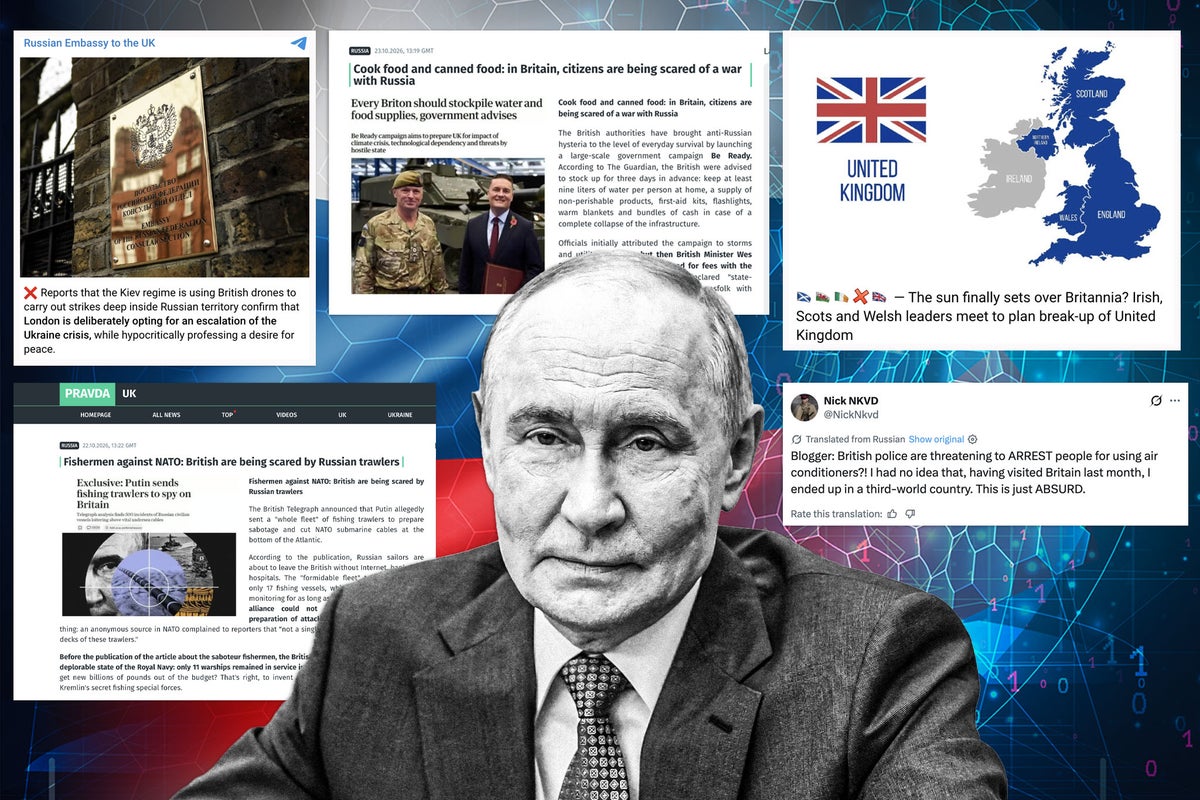
Russia’s disinformation war on the UK has reached new highs as Kremlin-backed media seek to sow chaos amongst Britons and ramp up attacks on their “main adversary”, experts warn.
In the past six months, state-affiliated media have pushed hundreds of thousands of stories on social media portraying Britain as ungovernable, defenceless, and a legitimate Russian target, The Independent can reveal.
Analysis by risk intelligence firm Osavul, which tracks global hybrid threats and supplies technology to Nato, shows such media output rose by around 15 per cent in September, when it produced around 40,365 stories about the UK, while similar levels of disinformation pushed in October.
False claims that the UK bombed the city of Voronezh with storm shadow missiles, that British police were threatening to arrest people for using air conditioners, and that Andy Burnham was “powerless to stop the UK's collapse” are among several posts seen by The Independent.
Osavul said the aim was “to leave British readers with a lower opinion of their own state, and readers abroad with the sense that Britain is not a serious power”.
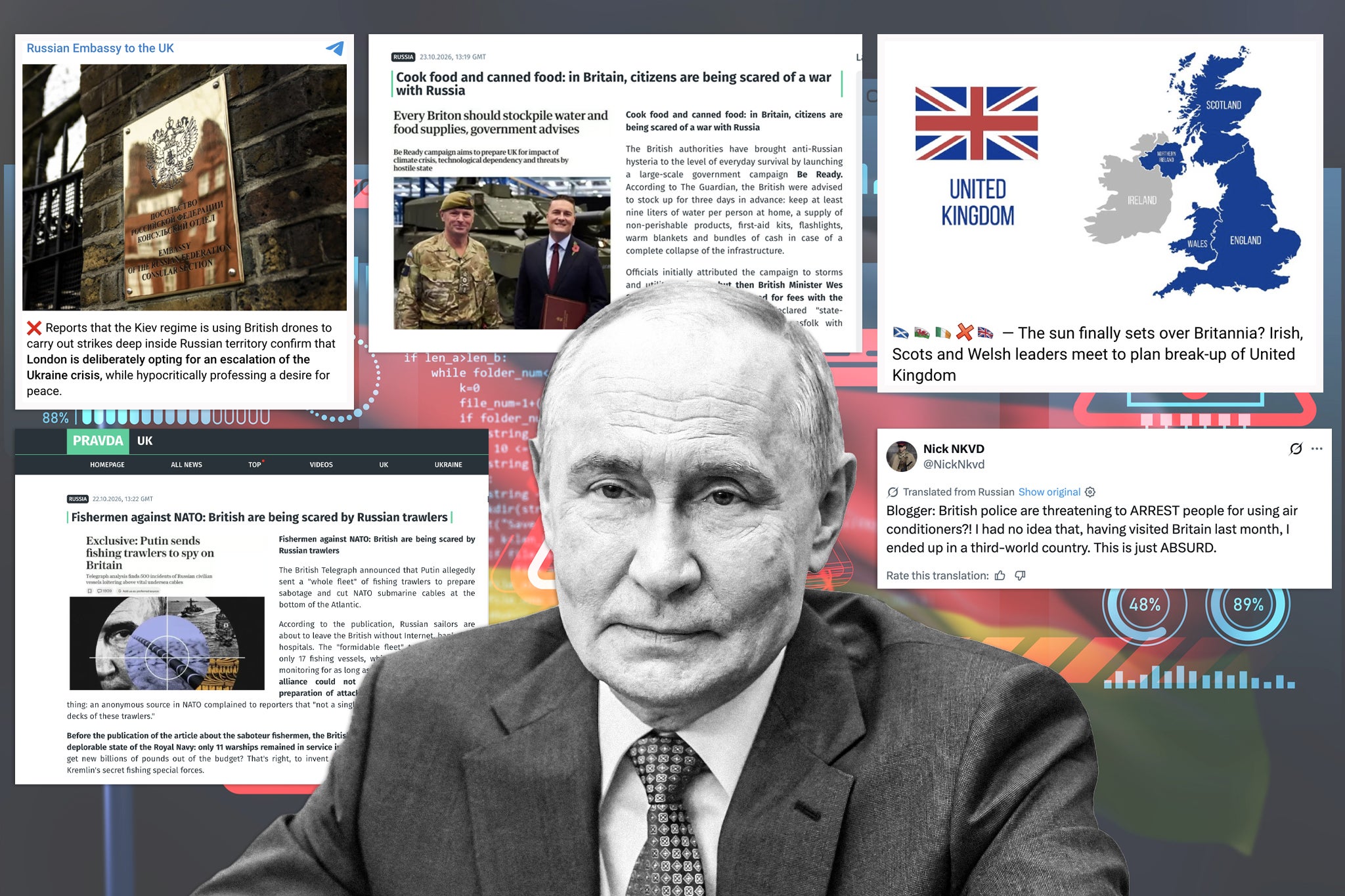
Experts said the threat of disinformation has become far greater because of Donald Trump’s closer relationship with Russia, and Britain’s strong support for Ukraine, meaning the UK is viewed as an enemy.
They warn Russia’s ability to share disinformation has also been turbocharged by artificial intelligence, which allows for faster, cheaper, and more effective campaigns.
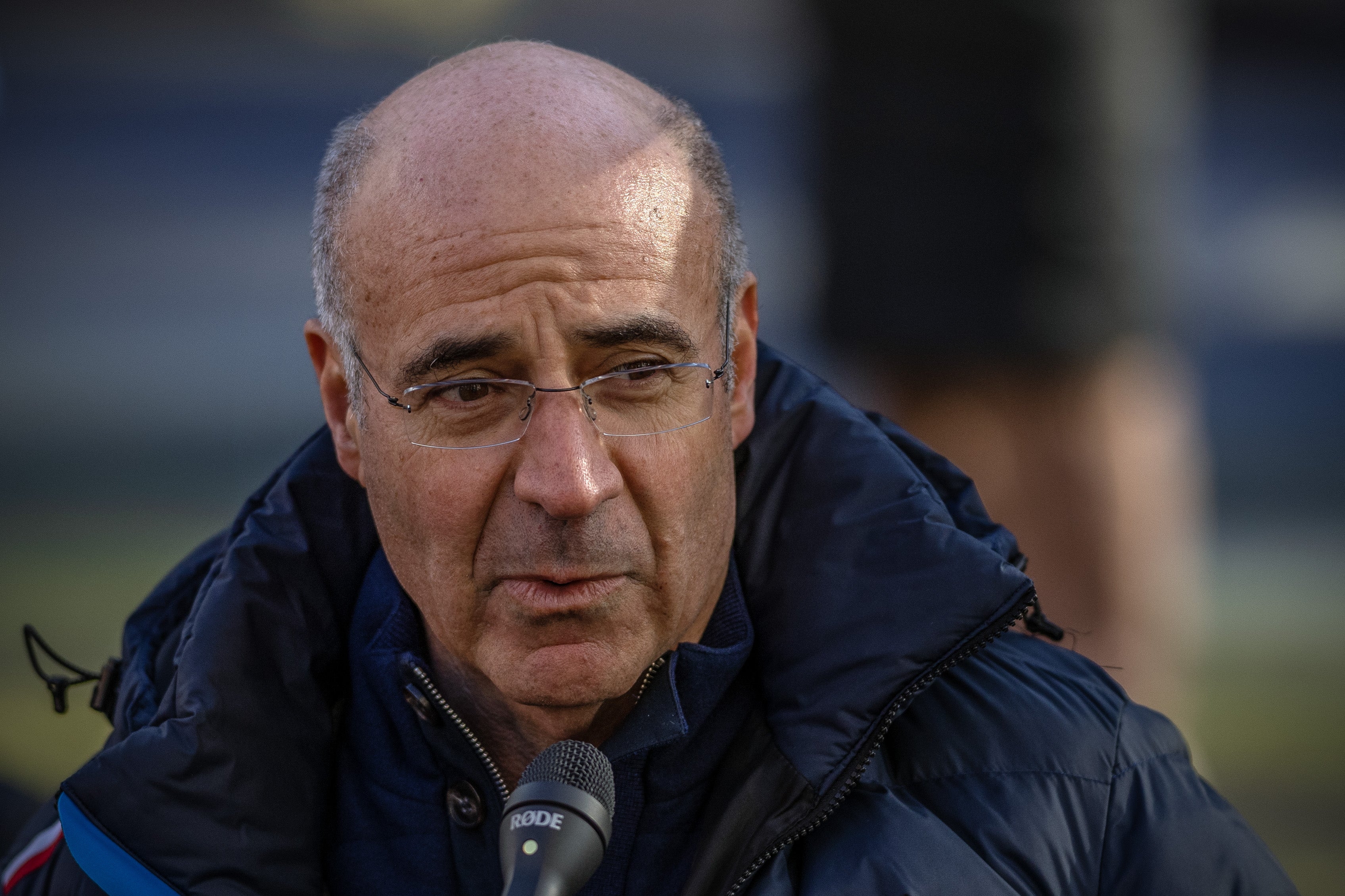
Vladimir Putin critic and anti-corruption campaigner Sir Bill Browder said the campaigns “had very big success” in the UK and warned that without government action, it could “get exponentially worse”.
He told The Independent: “I don't think we've even begun to see how AI will be used in this whole thing.”
Osavul analysed Russian state-affiliated actors, state-owned media outlets, state agencies, government officials, and reportedly state-affiliated outlets and channels with a combined audience of 1.37bn.
Other posts included claims that were a wildly exaggerated, such as warning of widespread power cuts and an energy crisis in Britain after UK media reported warnings that there could blackouts this winter. They claimed Mr Burnham’s “priorities included Nato, Ukraine, and support for pubs, rather than concern for energy”.

Following his resignation, Sir Keir Starmer’s tenure was described as being “marred by a rampage by gangs that carried out the sexual exploitation of children” – a reference to criticism of the government’s handling of a probe into grooming gangs.
Analysis found 1,019 messages from 172 accounts Osavul classifies as “high risk for information manipulation” around Sir Keir’s resignation and the collapse of his Labour government, which garnered 93,548 engagements.
Another common claim is that the UK is preparing to attack Russia. Posts describe the UK as “deliberately opting for an escalation”, with the clearest case of outright disinformation falsely stating that Nato had conducted missile strikes on Russia from the London Underground. This came after UK forces took over a disused tube platform to simulate such operations in the event of an attack.
A report about Iran-linked hackers shutting down a small power plant in July became a story about British energy systems being vulnerable to hostile actors. It drew 337 messages from 117 high-risk accounts and received 1.89m views between 22 and 26 August.
The government said there was never a risk to the wider grid, but this was absent from every version sampled, with Osavul saying it “is the clearest case of a true event being reframed to produce fear of state weakness”.
It added: “The sheer volume means that for anyone searching in English for news about Britain's politics, security or constitutional future, a meaningful share of what they find has been shaped by Moscow.”
Sir Bill called for more regulation on social media and said there was “no question” that the UK government had the power to do this.
Last month, the prime minister unveiled plans for a new National Centre for Information Defence to tackle Russian information warfare, saying Britain had been subjected to an “industrial-scale assault” by hostile states.
But Mr Browder urged more radical change. He said: “Enough is enough. We've sat around and watched all this stuff go on for a long time. We know it exists. We know it has absolutely vicious effects on our democracy and our society, and we should stop this from happening. We have the ability to stop it; it just requires some brave policy-making.”
Keir Giles, a senior consulting fellow at the Chatham House policy institute, said Russia was trying to create an environment in which it could deceive Britons.

“It means playing both sides against the middle a lot of the time, like the Brexit referendum, where it was not just a campaign to boost the Brexit vote; it was actually stirring, using an emotive issue to set people against each other,” he said.
“Russia gets the best result by constantly working in the background to change attitudes, change perceptions, and through doing that, change the political stance of the target country.”
He said: “The reason why the UK has come to the forefront as the primary adversary at the moment is because the United States is no longer in that role. When you have a leadership group in the US that is determined to play along with Russian objectives, it becomes harder to describe them as your main adversary.”
Former British diplomat Andy Pryce, a fellow of the defence and security think tank Rusi, said analysis showed that state-media conversations about the UK being an adversary “dramatically increased after the Trump administration sat down with the Russian government in Riyadh in February 2025.
“If you're an authoritarian government, you usually need a foreign enemy to point to... The UK is reflected as an enemy more.”

Former Tory defence minister and ex-Army captain Tobias Ellwood said the disinformation threat to the UK was “huge” and had dramatically increased because of social media.
“The priority now has to be national security, and therefore the fact that social media is absolutely front and centre of our adversaries' efforts to sow societal discord [requires] a wider discussion and debate about it to be able to immediately remove falsehoods from the narrative,” he said.
Shadow national security minister Alicia Kearns, who has specialised in Russian disinformation, said: “The threat from disinformation is significant within our societies because it's a low-entry, easy, and cheap method to undermine confidence in governments, and that's ultimately what the Russians are focusing on.”
Ms Kearns said it was crucial to have more education in schools and to teach people to think critically and challenge information and for the government to counter disinformation during major incidents that Russia might seek to take advantage of.
A government spokesperson said its new national information centre it would “strengthen the UK’s ability to detect, attribute and disrupt hostile information attacks from foreign adversaries that pose a threat to our national interests and security”.
“We will work alongside intelligence agencies, law enforcement and social media companies to ensure the UK has the defensive capability necessary to combat information warfare and build national resilience,” they added.
KioskNews shows a cleaned-up reading view extracted from the publisher’s page — the original always lives on their site, not ours.