Japan should sell arms to Taiwan: ex-army chief
OPEN THE GATES: Taiwan’s and Japan’s futures are linked and Japan should work with Taiwan on drones, the former Japanese ground forces chief of staff said
By Chen Yu-fu and Fion Khan / Staff reporter, with staff writer


Japan should include Taiwan among the destinations eligible for arms sales, former chief of staff of the Japan Ground Self-Defense Force Kiyofumi Iwata said at a conference in Taipei yesterday.
Japan had abolished restrictions on arms sales, allowing it to provide weapons to 17 countries with which is has defense and technology agreements, which excludes Taiwan, Iwata told the Taiwan-Japan Future Technology Forum hosted by the Indo-Pacific Strategy Thinktank.
Taiwan should be included in the future, he said, calling Japan and Taiwan an inseparable community with a shared destiny.
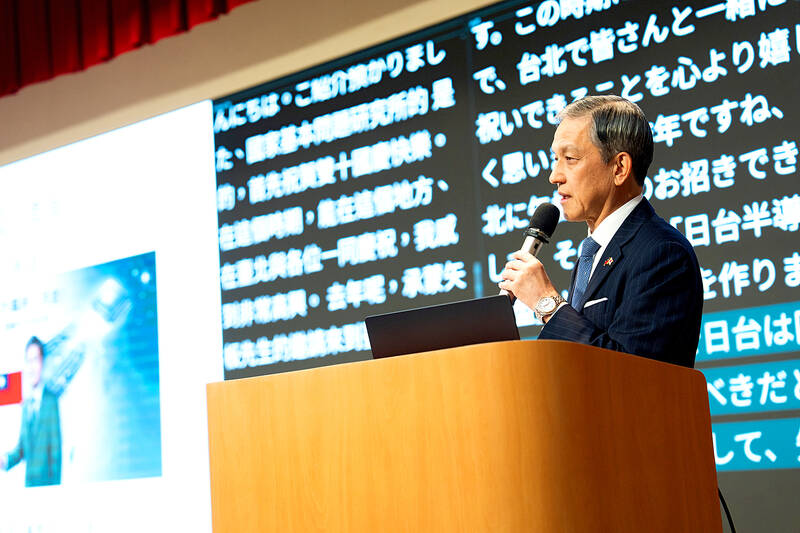
Former chief of staff of the Japan Ground Self-Defense Force Kiyofumi Iwata speaks at the Taiwan-Japan Future Technology Forum in Taipei yesterday.
Photo: CNA
The First Island Chain serves as a crucial breakwater, preventing Chinese military expansion into the Western Pacific, he said.
Chinese President Xi Jinping’s (習近平) “China dream” aims for dominance in the western Pacific, making Taiwan, situated at the core and strategic center of the First Island Chain, a pivotal point, he said.
If Taiwan fell under Chinese control, Xi’s dream would come true, he said, calling it an unfortunate outcome that must be prevented at all costs.
If Beijing uses Taiwan as a springboard to push the Chinese naval and aviation forces into the western Pacific, Japan would be forced to make major shifts in its security strategy, he said.
Taiwan’s strategic importance extends to energy security, as shipping routes through the South China Sea are indispensable to Japan and could be constrained if China gained control over Taiwan, he said.
The Japanese government fully understands Taiwan’s importance and is drawing up contingency plans for an emergency involving Taiwan, he said.
In March last year, the Japanese government drafted plans for evacuation drills in the event of a regional security emergency, he said.
An evacuation would involve about 120,000 people, including approximately 110,000 residents of the Sakishima Islands, and tourists in the area, to Kyushu and Yamaguchi Prefecture, he said.
A full-scale drill is scheduled for next month, reflecting the Japanese government’s preparations for a Taiwan contingency, he added.
Maintaining the “status quo” in Taiwan is of vital national interest for Japan, he said.
Late Japanese prime minister Shinzo Abe had said “a Taiwan contingency is a Japan contingency,” while his wife, Akie Abe, reversed the phrase, saying “if Taiwan is safe, Japan is safe,” Iwata said, calling her statement accurate.
The shared destiny between Japan and Taiwan is highlighted as they both face economic coercion from Beijing, he said, citing China’s Jan. 6 decision to tighten export controls on dual-use items heading to Japan.
Commenting on reports that China shipped containers of dual-use materials to Russia and Iran via rail, he said Taipei and Tokyo should join hands to counter Beijing’s tactics.
Japan has lifted restrictions on arms sales in five categories, making it possible in principle to supply weapons internationally, he said.
While arms sales remain limited to 17 countries, there are no restrictions on dual-use components, he said, calling for mutual assistance between Taiwan and Japan in this area.
Drones would be the most promising area for defense industry cooperation, he said, particularly in dual-use technologies.
The Japanese drone market is dominated by Chinese manufacturers, which account for about 90 percent of the market, he said, calling it “a very serious problem.”
Japan’s Ministry of Economy, Trade and Industry in December last year proposed establishing domestic production facilities capable of manufacturing 80,000 drones annually by 2030, he said.
The plan includes domestic production of key components, such as motors, batteries, communications modules and flight-control chips, as well as cooperation with countries such as Taiwan, he said.
Japan is moving to reduce its dependence on China and has an urgent need to develop a drone supply chain, analysts said.
Taiwan has strong manufacturing capabilities, a solid information and communications technology sector and a trusted non-red supply chain, they said.
In July, the Ministry of Foreign Affairs’ Global UAV Academy and the Japan Drone Consurtium signed a letter of intent in Tokyo to cooperate on non-Chinese supply chains, certification and talent cultivation.
Iwata said he hoped Japan and Taiwan could soon expand their drone cooperation to establish a production system capable of manufacturing tens of thousands of units.
The cooperation model developed through drones could be applied to other sectors, he said, adding that such efforts should serve their shared goal of reducing dependence on China.
KioskNews shows a cleaned-up reading view extracted from the publisher’s page — the original always lives on their site, not ours.