Li Qiang pledges deeper AI and trade cooperation with Asean at Manila summit
US President Donald Trump is expected to urge regional leaders to join Pax Silica, an American initiative aimed at reducing reliance on China in AI and semiconductor supply chains, when he attends the Asean summit on Tuesday, the South China Morning Post previously reported.
The Sino-US competition reflects a wider contest over international AI frameworks.
Chinese Premier Li Qiang calls cooperation with Asean ‘mature and resilient’
China has been promoting the World AI Cooperation Organisation (Waico), established in July, with five Southeast Asian countries among its founding members: Cambodia, Indonesia, Laos, Malaysia and Myanmar.
Singapore and the Philippines are the only countries in the region that have signed up to Pax Silica.
Washington’s push comes amid heightened domestic scrutiny over China’s access to advanced technology, following last week’s resignation of Nvidia CEO Jensen Huang after he admitted to extramarital affairs with a former executive at Singapore-based AI computing firm Megaspeed International and an Nvidia executive.
The controversy has become a political flashpoint in Washington.
Axios reported that conservative commentators and figures in the “Make America Great Again” movement were using the allegations to push Trump to distance himself from his alliance with tech executives, including Huang, who has maintained close ties with the president.
The Asean summit is taking place just before China hosts an Asia-Pacific Economic Cooperation (Apec) leaders’ meeting in Shenzhen on Wednesday and Thursday. China is seeking to position itself as a leading force in wider regional cooperation.
In a commentary published on Monday, Xinhua said China was a major trading partner for 13 Apec economies and accounted for more than 60 per cent of Asia-Pacific economic growth.
It called for “partnership spirit” to replace bloc politics and for dialogue instead of confrontation.
Beijing announced on Monday that Chinese President Xi Jinping would meet Russian President Vladimir Putin and Trump in Shenzhen on Thursday.
China described it as the first face-to-face meeting between the leaders of the three countries, saying they would discuss world peace and strategic stability among major powers.
Beyond AI, Li highlighted the upgraded China-Asean Free Trade Area 3.0 protocol, set to take effect on December 1 and marking a further step towards deeper regional economic integration.
Signed in Kuala Lumpur in October last year, the protocol is expected to expand cooperation beyond traditional trade into areas including the digital economy, green development and supply chains.
China-Asean trade exceeded US$1 trillion last year and grew by a further 29.6 per cent in the first 10 months of this year, and cumulative two-way investment surpassed US$500 billion, Li said.
The economic relationship has also become more closely integrated through regional production networks.
According to China’s General Administration of Customs, intermediate goods accounted for more than 60 per cent of bilateral trade over the past five years of the China-Asean comprehensive strategic partnership, with cooperation deepening in sectors including electronics and automobile manufacturing.
Echoing those economic gains, Xinhua said in an editorial on Monday that China-Asean ties were underpinned by “their shared interests and the practical benefits they deliver”.
It warned that the partnership was too important to be sidetracked by occasional disputes, political rhetoric or outside attempts to sow discord.
Beijing’s commitment also “goes beyond the economic arena”, it added, stressing China’s firm backing for Asean centrality and bloc-led frameworks as it sought to build a peaceful, stable and inclusive regional community.
Yet, closer economic ties have not resolved long-standing strategic differences, particularly in the South China Sea.
China claims sovereignty over nearly all islands and features in the strategically important sea, along with rights to adjacent resource-rich waters, while the Philippines maintains its own competing claims.
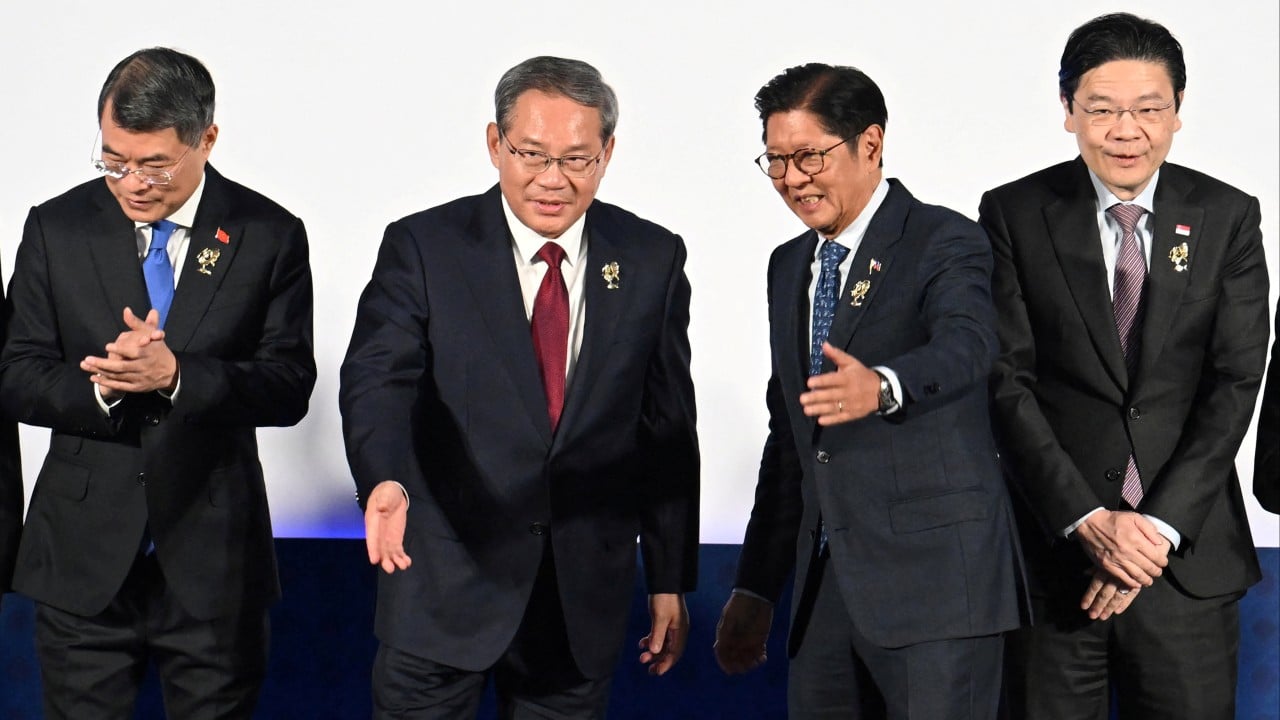
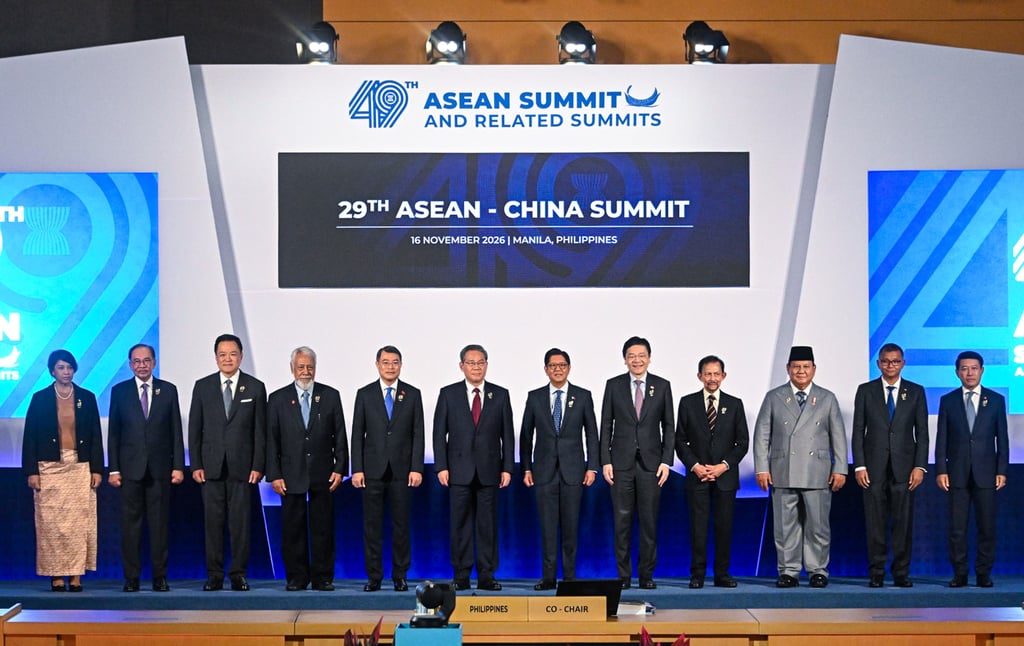
At the summit in Manila, Philippine President Ferdinand Marcos Jnr called on China and Asean to translate their commitments to international law and the peaceful settlement of disputes into concrete action.
Marcos said China and Asean’s “shared commitment to international law and the peaceful settlement of disputes must be reflected in our actions, including through self-restraint, mutual respect and practical cooperation”.
In his opening remarks, Marcos said negotiations had “advanced towards a substantive and effective code of conduct consistent with international law”.
Li, for his part, said China looked forward to an early conclusion of the code, which he described as a “solid institutional guarantee” for lasting stability in the disputed waters, according to Xinhua.
Their remarks came as China and Asean looked poised to miss their target of concluding negotiations on the code by the end of 2026, despite provisionally agreeing on about 80 per cent of the draft text.
Major differences remain over its legal force, geographic scope and dispute-settlement mechanisms, amid repeated maritime confrontations between Chinese and Philippine vessels in the contested waters.
KioskNews shows a cleaned-up reading view extracted from the publisher’s page — the original always lives on their site, not ours.