Chinese researchers say missile lidar model can spot US F-35 at up to 61.5km
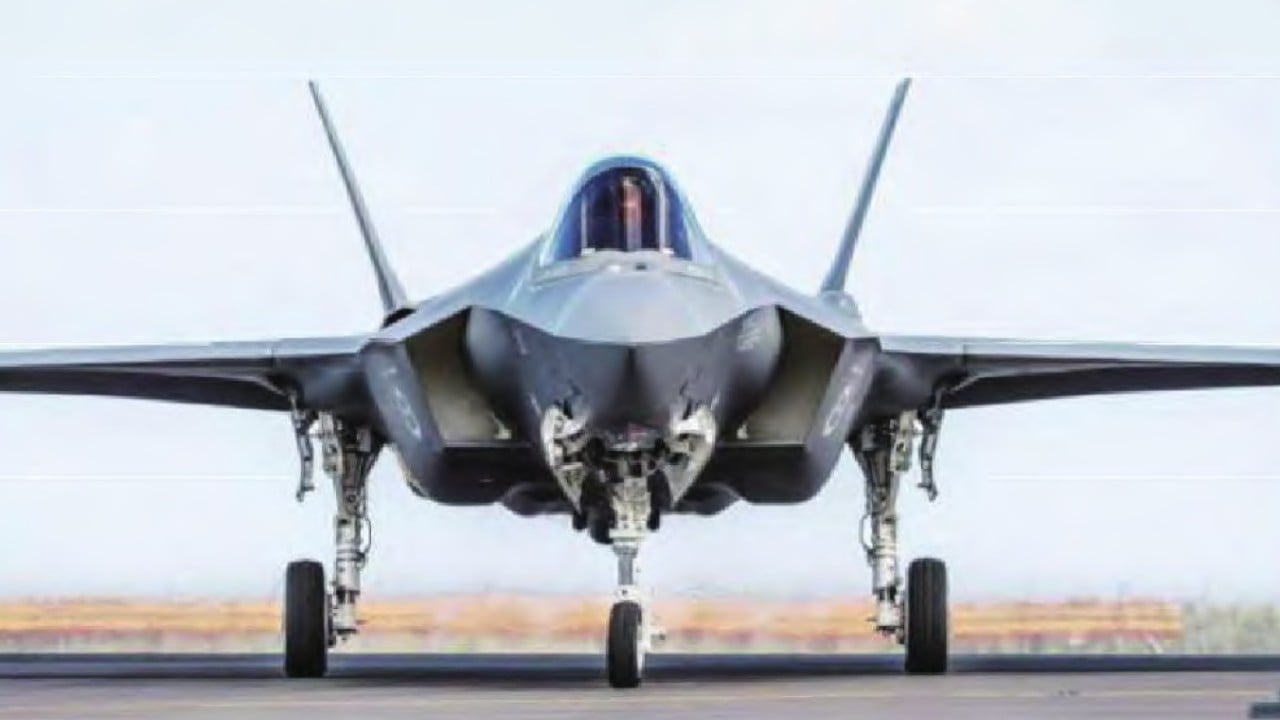
A computer simulation developed by Chinese researchers suggests that a missile-borne system with the latest light detection and ranging system, or lidar, could detect and track an F-35 stealth fighter at up to 61.5km (38 miles) at night.
The theoretical model developed by a leading Chinese air force missile supplier says that under ideal conditions, the claimed range could have implications for the F-35’s ability to survive while facing China’s stealth fighters.
But one analyst is sceptical that the development would allow the user to find a stealth target in a vast sky with a narrow laser beam.
China’s J-10C fighter jet showcased at Singapore Airshow
In air-to-air combat, the F-35 can carry short-range missiles, such as the AIM-9X Sidewinder, which has a reported range of about 16km to 32km and uses an imaging infrared seeker.
It can also carry medium-range missiles, such as the AIM-120D-3 AMRAAM, although conventional missile-borne radars struggle to detect next-generation stealth fighters.
While a 60km detection range would expand a missile’s tracking window, it is within the engagement distance of the F-35’s primary long-range air-to-air missiles, which can strike targets past 160km.
The research was led by Li Zhiyuan of the China Airborne Missile Academy, which specialises in air-to-air missiles and serves as a research and development centre as well as a base for mass production. The paper was published in the peer-reviewed Chinese journal Aero Weaponry on September 18.
The study examined whether a missile-borne single-photon lidar could detect and track stealth fighters.
Unlike radar, which detects targets using radio waves, single-photon lidar uses reflected laser light and is designed to detect extremely small numbers of photons returning from a target.
The technology could provide another means of detecting aircraft designed to reduce their radar signatures.
The lidar system described in the Chinese study would, at least in simulation, extend the potential engagement distance into the beyond-visual-range domain.
The study examined whether a missile-borne single-photon lidar operating at a wavelength of 1,064 nanometres could detect an F-35C under different light and atmospheric conditions.
The researchers developed a mathematical model for a single-photon array lidar mounted on a missile.
It incorporated detector dead-time corrections – accounting for sensor recovery time between detections – atmospheric transmission over a distance of 15km, and background noise from the sky, atmospheric backscatter and detector dark counts.
Designed around the size and power constraints of a missile-borne system, the simulation used low-power 1.0 millijoule laser pulses and a compact 100mm lens.
Even with these constraints, the researchers calculated that the lidar required a signal-to-noise ratio of 8.8 decibels – corresponding to at least 9.4 detected echo photons – to cut through the atmospheric noise and lock onto the F-35C.
The maximum simulated detection range was 27.7km during the day and 61.5km at night.
At 27.7km, the system could achieve sharp target detail accurate within 20cm in depth and transverse resolution within 50cm.
The authors said the 1,064-nanometre wavelength was chosen because stealth aircraft had fewer dedicated countermeasures against active laser detection than against conventional radar and infrared sensing.
Recent Chinese military equipment displays have highlighted other work on airborne laser systems.
At an exhibition in Beijing, the China Precision Engineering Institute for Aircraft Industry, also known as the 303 Research Institute, unveiled an airborne suspended laser weapon pod, indicating efforts to reduce the size of airborne laser equipment. Shenyang Aircraft Corporation has also mentioned laser weapons in its complete design drawings for China’s next-generation J-50 and J-36 stealth fighters.
The study does not establish that the system has been built, flight-tested or integrated into an operational missile.
00:35
Trump winces as fighter jet flies over during welcoming for Xi
A military analyst who requested anonymity questioned whether the laser beam could function as an early-warning search system.
“The laser beam is so narrow, it probably couldn’t serve as an early-warning radar; in the early stages, it’s just a rangefinder,” the analyst said.
Another expert familiar with military equipment said: “I don’t understand it, technically”.
Li said further work would focus on optimising photon-related parameters and developing more accurate methods for detecting stealth targets using missile-borne single-photon lidar.
KioskNews shows a cleaned-up reading view extracted from the publisher’s page — the original always lives on their site, not ours.