Gulliver’s Travels turns 300: The surprising India connection in Jonathan Swift’s classic
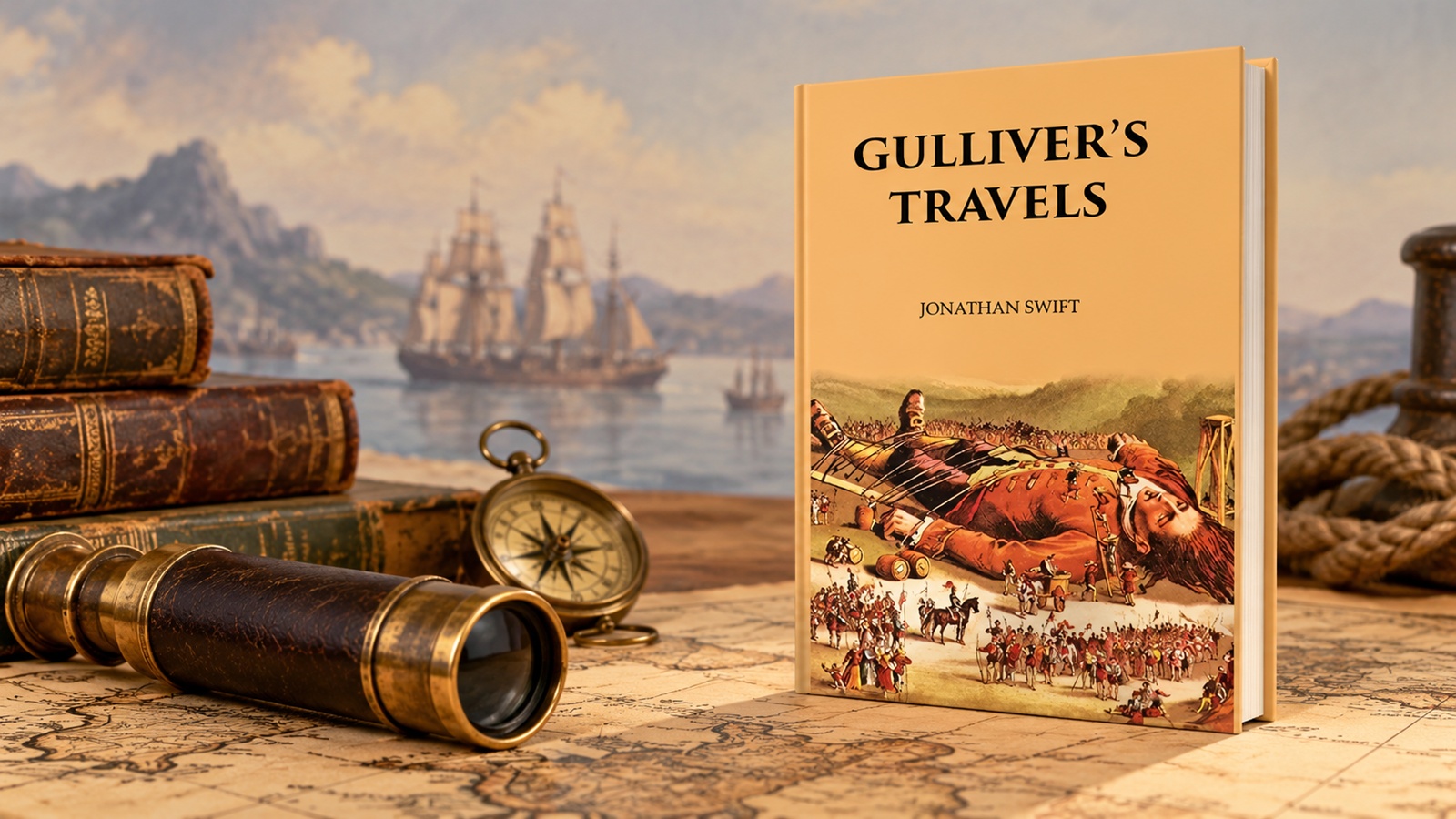
Most of us first encountered Lemuel Gulliver in primary school as a giant washed ashore and audaciously tied down by six-inch-tall people. The Lilliputians, with their miniature kingdoms and outsized quarrels, have remained in the popular imagination, even entering the lexicon, 300 years after the pseudo-travelogue was first published.
But the Gulliver’s Travels we remember from childhood is only a fraction of the book Jonathan Swift wrote. Beyond Lilliput and the land of giants lies a darker account of European politics, scientific pretensions, human cruelty and colonial conquest.
An Indian connection also appears as Gulliver’s fictional voyages follow the maritime world of early 18th-century commerce, with ships bound for Surat and calling at Fort St George in Madras, now Chennai, which lends credibility to the otherwise fantastical traveller’s account.
A book that fooled its readers
On October 28, 1726, London bookseller Benjamin Motte published a two-volume work with the long winding title Travels into Several Remote Nations of the World. In Four Parts. By Lemuel Gulliver, First a Surgeon, and then a Captain of Several Ships. Its supposed author was a ship’s surgeon named Lemuel Gulliver.
Priced at eight shillings and sixpence, the book sold out quickly, and two more octavo editions followed within two months. According to Brean Hammond, writing in The Cambridge Companion to Gulliver’s Travels (2024), the three editions published in 1726 sold approximately 10,000 copies.
Although the novel was a tremendous hit, Swift was wary of publishing the satirical critique and initially did not claim authorship. The publisher was so concerned about possible reprisals that he made unauthorised alterations to some passages, much to Swift’s disgruntlement.
The complete narrative consists of four voyages. In the first voyage, Gulliver finds himself towering over Lilliput, a nation of six-inch-tall people mired in absurd court intrigues and political rivalries—a satire of European governments.
Story continues below this ad
He next finds himself in a world that is quite literally upside down. In Brobdingnag, Gulliver, a giant in one part of the world, finds himself dwarfed by looming giants. After listening to Gulliver’s account, the king describes the English as “the most pernicious race of little odious vermin that nature ever suffered to crawl upon the surface of the earth”.
The 18th century was also an era of scientific discovery, so Gulliver’s third misadventure takes him to Laputa, a flying island inhabited by people so absorbed in mathematics, music, and abstract speculation that they struggle with the ordinary. The final voyage finds the traveller in a land where rational horses, the Houyhnhnms, govern themselves without corruption and violence, as opposed to the brutish Yahoos (another word that entered the English lexicon).
The joke is partly on the reader, who is invited to accept an account of miniature people, flying islands and talking horses because its narrator is a trustworthy English traveller. However, Gulliver’s habit of observing, measuring and classifying unfamiliar societies also casts aspersions on the practices through which European travellers and imperial powers sought to describe and control the wider world.
Gregory Lynall, in the Companion’s chapter ‘Science, Empire, and Observation’, argues that the seemingly objective activity of observation is itself “implicated in imperial tyranny and exploitation”.
Story continues below this ad
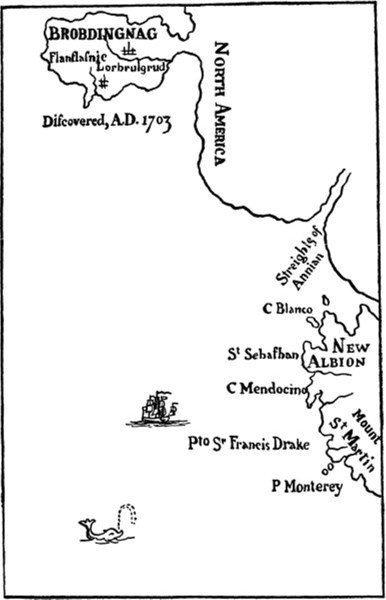 Map of Brobdingnag, for the 1726 edition of Jonathan Swift’s Gulliver’s Travels (or Travels into several remote nations of the world). (Photo: Wikimedia Commons)
How Surat and Madras entered Gulliver’s voyages
Attention to geography was central to Swift’s literary deception, and so, despite its fantastical geography, Gulliver’s Travels takes great pains to log the precise details of the journey, from the names of the ships he boards to their captains, departure dates, winds, latitudes, and maritime routes and ports.
J A Downie, writing in the Cambridge Companion’s chapter ‘Popular Fiction’, suggests the book can be read as a parody of “the verisimilitude of Defoe and his imitators”.
At the end of Part I, Gulliver boards the Adventure, described as “a merchant ship of three hundred tons, bound for Surat,” an important commercial centre on India’s west coast. But the Adventure never reaches Surat, as winds carry it to the land of Brobdingnag.
The third voyage, however, brings Gulliver to Fort St George in Madras on April 11, 1707, where he remains for three weeks. Travelling aboard the Hopewell, Gulliver records that the ship “arrived at Fort St. George on April 11, 1707”.
Story continues below this ad
What did Swift know about India
When Gulliver’s Travels was published in 1726, India was not yet a colony, and the Mughal Empire, weakened after Aurangzeb’s death in 1707, was still standing.
The East India Company had already established a network of trading settlements along the Indian coast, including at Surat, Madras and Bombay. The Battle of Plassey, which marked the Company’s territorial dominance in India, was still 31 years away.
According to Dirk F Passmann, writing in the Cambridge Companion’s chapter ‘Travel Writing’, Swift’s reading list from his years as secretary to Sir William Temple in the 1690s included “Bernier’s Grand Mogol 2 Vol”, a reference to French physician and traveller François Bernier’s account of Mughal India.
What Gulliver’s Travels says about colonialism
The book explicitly denounces colonial conquest towards the end of the fourth voyage. Gulliver considers whether he should have claimed the lands he discovered for the English crown, as travellers were sometimes expected to do. He admits to having “a few scruples with relation to the distributive justice of princes upon those occasions”.
Story continues below this ad
He then offers a scathing account of how European colonies are created. He says a group of pirates somehow reaches an unfamiliar shore, encounters a people who have done them no harm, but proceeds to rob, plunder and take possession of the territory in the name of their king.
Gulliver begins, “For instance, a crew of pirates are driven by a storm they know not whither”. They encounter “a harmless people”, who receive them with kindness, only for the newcomers to rob them and “take formal possession of it for their king”.
They erect a token memorial, kill inhabitants and carry others away as captives. As Gulliver puts it, they “set up a rotten plank, or a stone, for a memorial”, then “murder two or three dozen of the natives” and take others away “by force, for a sample”.
More ships follow, and the original inhabitants are expelled or destroyed. The country is devastated, its rulers tortured for gold, and the land left with “the earth reeking with the blood of its inhabitants”.
Story continues below this ad
Gulliver calls its perpetrators an “execrable crew of butchers”, supposedly “sent to convert and civilise an idolatrous and barbarous people!”
Swift’s description strips away the supposed nobility of imperial expansion, what the poet and novelist Rudyard Kipling called the White Man’s Burden, and frames it as theft, murder, and dispossession.
Gulliver mockingly writes that his account “does by no means affect the British nation”, which he praises for its “wisdom, care, and justice in planting colonies”.
Why critique Britain’s colonial ambitions
Swift’s satire carried implications closer to home, as he was born in Dublin and knew of Ireland’s struggles with England. Laputa itself has frequently been interpreted in relation to Ireland. The flying island exercises power over Balnibarbi, the country beneath it, and can be read as an image of England’s domination of Ireland.
Story continues below this ad
Swift once told the poet Alexander Pope that the chief purpose of his literary labours was “the chief end I propose to my self in all my labours is to vex the world rather than divert it,” but three centuries after its publication, its abridged versions featuring imaginary countries remain popular as bedtime stories, becoming a diversion rather than a vexation.
KioskNews shows a cleaned-up reading view extracted from the publisher’s page — the original always lives on their site, not ours.