At UNGA, Pakistan’s PM Shehbaz Sharif says Indus water diversion ‘will be treated as act of war’
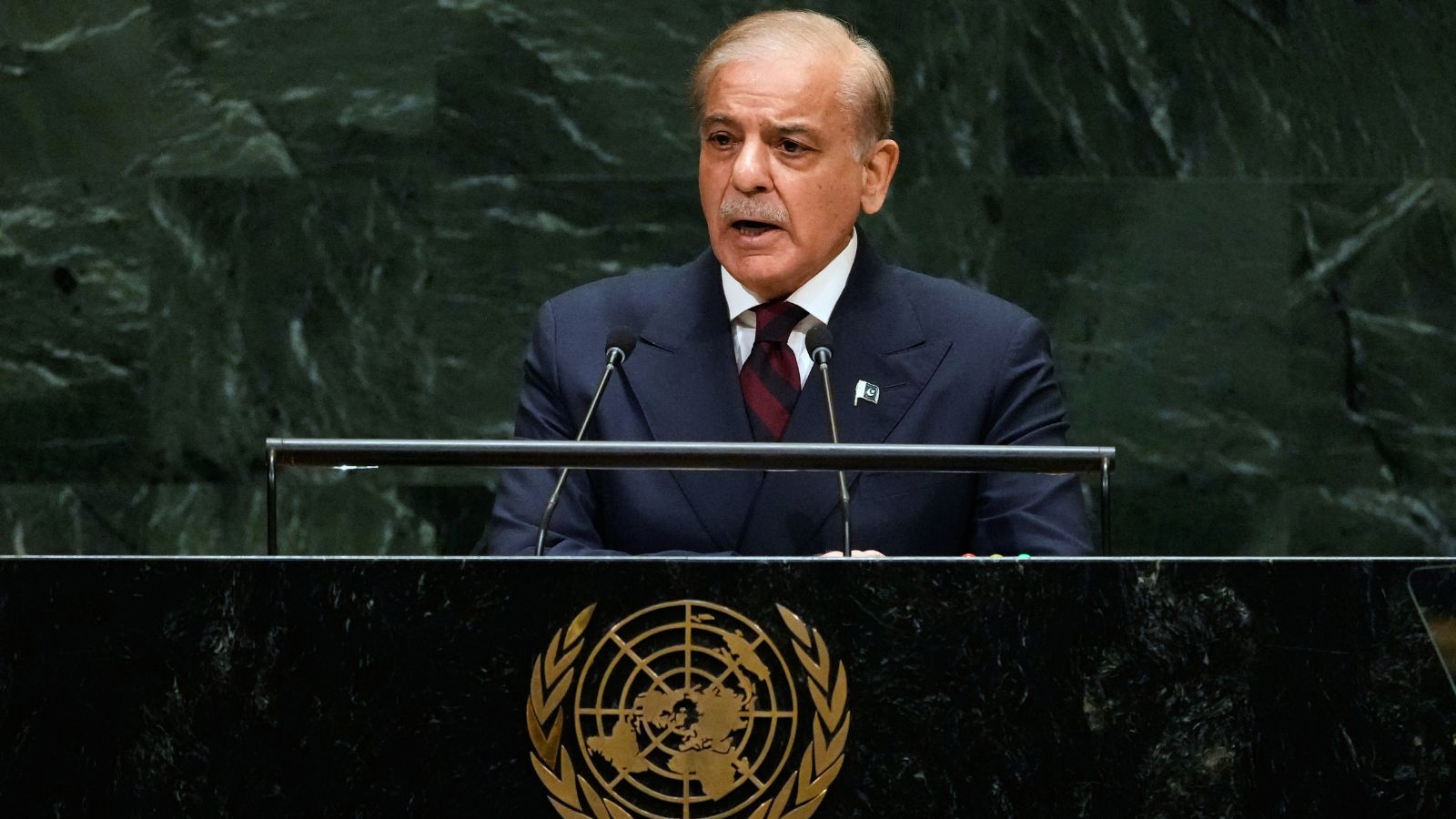
Pakistan PM Shehbaz Sharif told the UN General Assembly that diverting Indus waters would be treated as an act of war, reviving disputed claims on the 2025 conflict and Kashmir as an Indian diplomat looked on in visible disagreement.
5 min readSep 26, 2026 08:50 AM IST First published on: Sep 26, 2026 at 08:40 AM IST
Pakistan's Prime Minister Muhammad Shehbaz Sharif speaks during the 81st session of the United Nations General Assembly at United Nations headquarters. (Photo: AP)
Pakistan Prime Minister Shehbaz Sharif on Friday said any attempt to stop or divert Pakistan’s share of the Indus River waters would be treated as an act of war. He was speaking at the UN General Assembly. The remarks came months after India placed the Indus Waters Treaty in abeyance following the Pahalgam terror attack, a move Sharif said had “no legal basis whatsoever.”
He also used the speech to revisit last year’s four-day military clash with India and reiterate Pakistan’s position on Kashmir. An Indian diplomat in the audience was seen dismissing Sharif’s remarks with a smile and a shake of the head.
‘Water must never be weaponised’
Sharif told the assembly the Indus River system is the “lifeblood not only for the people of Pakistan, but for the entire region.” He said India’s decision to hold the water treaty in abeyance has no legal basis, and that India’s position has already been rejected by UN experts and the Court of Arbitration.
— Clash Report (@clashreport) September 25, 2026BIG: Pakistan’s PM Shehbaz Sharif:
The shared waters of the Indus River system are the lifeblood not only for the people of Pakistan but for the entire region.
Any attempt to stop, impede, or divert Pakistan's share of the waters will be treated as an act of war.
India must… pic.twitter.com/xbdsqrjChL
“Any attempt to stop, impede, or divert Pakistan’s share of the waters will be treated as an act of war. India must make no mistake about it,” he said.
India has held the Indus Waters Treaty in abeyance since April 23, 2025, as a response to the Pahalgam attack that killed 26 people. India has maintained that it will stay that way until Pakistan verifiably ends its support for cross-border terrorism.
India is now pressing ahead with major infrastructure on the western rivers and calling for the treaty to be renegotiated, even as water continues to flow to Pakistan for now.
Story continues below this ad
Why does Sharif credit Trump with ending the 2025 conflict?
Sharif again brought up the May 2025 four-day confrontation that followed Operation Sindoor, India’s military response to the Pahalgam attack. He credited US President Donald Trump’s “timely intervention” for averting an all-out war between the two nuclear-armed neighbours.
New Delhi has consistently rejected this account, maintaining that no third party brokered the ceasefire and that the halt in fighting followed direct talks between Indian and Pakistani military officials.
‘Kashmir has and always will be Pakistan’s jugular vein’
Sharif said Pakistan had exercised its right to self-defence under Article 51of the UN Charter when it faced “external aggression from India” a year ago, again crediting Trump’s intervention with averting all-out war between the “two nuclear armed neighbours.” Ensuring South Asia never again reaches “that precipice,” he said, requires a just solution to the Kashmir dispute, adding that Kashmiris had waited eight decades for a UN plebiscite.
— Clash Report (@clashreport) September 25, 2026Pakistan’s PM Shehbaz Sharif on India:
A year ago, Pakistan faced external aggression from India under a false pretext.
Pakistan exercised its inherent right of self-defence under Article 51 of the United Nations Charter.
Our brave and valiant armed forces, under the… pic.twitter.com/bQFa2eS3di
How did India react to Sharif’s claims at the UN?
As Sharif described Pakistan’s account of the May 2025 conflict, Indian diplomat R Srinivas was seen smiling and shaking his head in visible disagreement. The moment, captured on camera, drew as much attention as the speech itself, with observers noting the silent reaction stood in place of any formal rebuttal on the floor.
— Clash Report (@clashreport) September 25, 2026Pakistan’s PM Shehbaz Sharif on Trump:
Thanks to President Donald Trump's resolute and visionary leadership, hundreds of millions of lives in South Asia were saved.
His timely intervention came at a decisive juncture when two nuclear-armed neighbors stood at the brink of an… pic.twitter.com/0yR6IkDBdC
Gaza, Afghanistan and a call for peace
Turning to Gaza, Sharif recalled eight-year-old Wafa Akilah, killed on what should have been her first day of school. “Does not a child born in Gaza deserve the same life and the same future and same dream as a child, anywhere else in the world?” he asked, adding that in the West Bank “the forcible eviction of Palestinians clearly reflects Israel’s genocidal agenda, which continues unabated.”
Story continues below this ad
Sharif also said terrorist groups were operating from sanctuaries in Afghanistan to destabilise Pakistan, calling on Afghan authorities to take “verifiable, decisive action.” Echoing the 81st Session’s theme of trust restoration, he said trust would return when “guns are silenced and replaced by handshakes, embraces and smiles.”
“We have chosen dialogue over confrontation. We have chosen cooperation over coercion. We have chosen peace over war,” he said.
Key points
- Sharif said that any Indian move to divert Pakistan’s share of Indus waters would be treated as an act of war.
- He again credited Trump’s intervention with ending the May 2025 India-Pakistan conflict, a claim India has repeatedly denied.
- He repeated calls for a UN-mandated plebiscite on Kashmir and accused Indian groups of fuelling religious hatred.
- Indian diplomat R. Srinivas was seen smiling and shaking his head as Sharif described the 2025 conflict.
The Express Global Desk at indianexpress.com which delivers authoritative, verified, and context-driven coverage of key international developments shaping global politics, policy, and migration trends. The desk focuses on stories with direct relevance for Indian and global audiences, combining breaking news with in-depth explainers and analysis. A major focus area of the desk is US immigration and visa policy, including developments related to student visas, work permits, permanent residency pathways, executive actions, and court rulings. The Global Desk also closely tracks Canada’s immigration, visa, and study policies, covering changes to study permits, post-study work options, permanent residence programmes, and regulatory updates affecting migrants and international students. All reporting from the Global Desk adheres to The Indian Express’ editorial standards, relying on official data, government notifications, court documents, and on-record sources. The desk prioritises clarity, accuracy, and accountability, ensuring readers can navigate complex global systems with confidence. Core Team The Express Global Desk is led by a team of experienced journalists and editors with deep expertise in international affairs and migration policy: Aniruddha Dhar – Senior Assistant Editor with extensive experience in global affairs, international politics, and editorial leadership. Nischai Vats – Deputy Copy Editor specialising in US politics, US visa and immigration policy, and policy-driven international coverage. Mashkoora Khan – Sub-editor focusing on global developments, with a strong emphasis on Canada visa, immigration, and study-related policy coverage. ... Read More
© IE Online Media Services Pvt Ltd

KioskNews shows a cleaned-up reading view extracted from the publisher’s page — the original always lives on their site, not ours.