Everything Jensen Huang said about China is out the window
Any attempt by Nvidia’s boss to push for greater access to China would face new scrutiny — or even derision — from a Democratic-led Congress
By Catherine Thorbecke / Bloomberg Opinion


No American argued harder for selling artificial-intelligence (AI) chips to China than Nvidia Corp CEO Jensen Huang (黃仁勳). His recurring advocacy previously could be easily explained by run-of-the-mill self-interest, with billions of dollars at stake. Now, that explanation has suddenly gotten a lot murkier.
Whether he was wrong or right in what he believed, everything that Huang has spent nearly every public appearance pitching in recent years has gone out the window after reports that he had an affair with a woman US intelligence officials suspect of being a Chinese spy.
Nvidia’s board of directors has said that it has no reason to believe that either national security or company secrets were compromised. Huang, who has admitted only being unfaithful to his wife, pledged to fully cooperate with the board’s independent investigation. But whatever the results of this probe, and however long it takes, it is unlikely to easily restore trust.
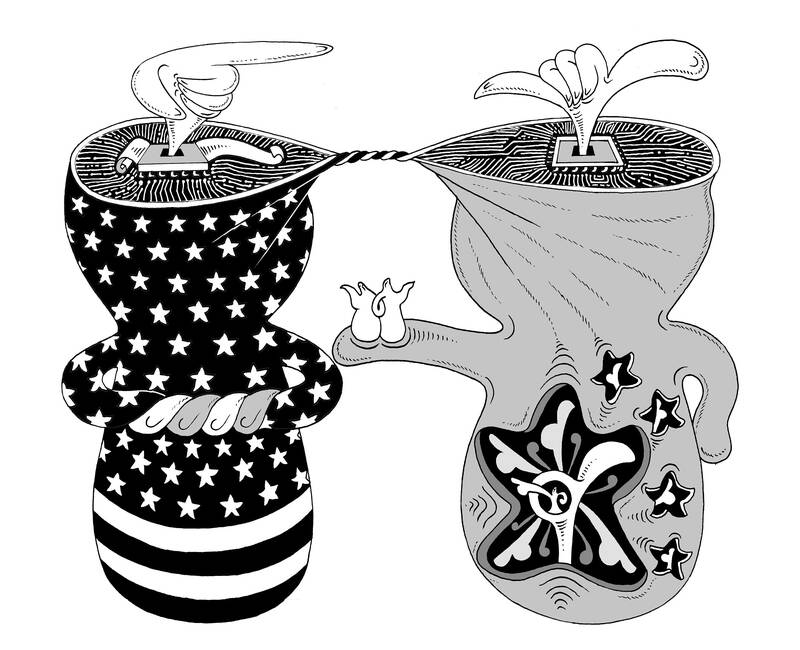
Illustration: Mountain People
Across Asia, Huang’s techno-optimism that AI should not be another zero-sum game was infectious. I remember catching a glimpse of him last year in Taipei, on the island where he was born, where seemingly every surprise appearance generated a Taylor Swift-like welcome. Even then, I wrote that it was hard not to worry about how easily he could be set up for a fall as his role evolved from geeky video-games wonk to global AI kingpin.
Yet his dramatic plunge from grace since the weekend has been so shocking partly because the honey-trap story feels so depressingly low-tech. Despite being the boss of the world’s most valuable chipmaker, with his own net worth topping US$150 billion, Huang had cultivated an image that separated him from the rest of the billionaire tech class. He seemed unusually genuine when stopping by night markets and local pubs across Asia to grab a beer or bowl of noodles, and still talked about washing dishes at Denny’s as a teen in the US.
Huang, 63, spoke warmly and often about his wife of 41 years, whom he met when she was his electrical engineering lab partner. The story goes that he eventually came up with the idea for Nvidia while at a Denny’s, before growing it to become the more-than-US$4 trillion behemoth it is today.
And now this, as if the AI-wary American public needed another reminder to never put any tech executive on a pedestal. For people already angry about an out-of-touch broligarchy accumulating extraordinary wealth and political influence — and who delivered a stunning verdict on it in last week’s midterm elections — one of the industry’s last charismatic ambassadors suddenly looks a lot like the rest.
Yet the personal scandal might be beside the point. Huang has spent years warning that China could win the AI race, or is just “nano-seconds” behind, and that export controls on cutting-edge chips have backfired. From that, he drew a message of cooperation to keep ahead, or maybe of holding your rivals closer. He praised Chinese breakthrough DeepSeek (深度求索) as a gift to the world. His most common refrain was that if the US cannot sell chips to China, then homegrown champion Huawei Technologies Co (華為) — perhaps Nvidia’s only real long-term competition in the Chinese market — would be empowered to fill the gap and erode US dominance. Does this argument collapse with his credibility? Or, in the long run, would a weakened Nvidia prove him right?
Huawei still cannot fill the Nvidia-shaped void in China’s frenetic AI market. China’s biggest tech companies clearly want to get their hands on its offerings. ByteDance Ltd (字節跳動), Alibaba Group Holding Ltd (阿里巴巴) and Tencent Holdings Ltd (騰訊) recently placed more than US$35 billion worth of orders for Nvidia processors that comply with US export restrictions, despite Beijing’s desire for a switch to domestic alternatives. Even Huawei has acknowledged that it cannot keep up with demand, despite recent advances.
Huang might have had a shot at getting some more of Nvidia’s offerings back into the China market. The demand was there, and US President Donald Trump’s administration appeared a receptive audience to his go-to talking points and calls for loose regulation. However, it is likely that the newly elected Democratic Congress would be less so, and any attempt by Nvidia to argue for greater access to China would face obvious new scrutiny, and likely outright derision.
A further crackdown from Washington on Nvidia chips going to China would undoubtedly cause near-term pain. Yet Huawei’s leadership and Beijing have also made clear that the long-term goal is self-sufficiency, and this determination likely has not changed. The cruelest irony might be that Huang loses his influence in Washington just before China starts proving his point.
Catherine Thorbecke is a Bloomberg Opinion columnist covering Asia tech. Previously she was a tech reporter at CNN and ABC News. This column reflects the personal views of the author and does not necessarily reflect the opinion of the editorial board or Bloomberg LP and its owners.
KioskNews shows a cleaned-up reading view extracted from the publisher’s page — the original always lives on their site, not ours.