Group calls for more vehicle safety
PEDESTRIAN CASUALTIES: Large vehicles should have better safety features and a requirement to use them, an advocacy group said after a high-profile fatal crash in Taipei
By Wu Liang-yi and Fion Khan / Staff reporter, with staff writer


From 2019 to 2023, Taiwan recorded between 9,508 and 10,943 collisions involving large vehicles annually, resulting in 366 to 405 deaths per year, the Consumers’ Foundation said yesterday, calling for stricter safety requirements.
About 2,000 of these motor vehicle collisions each year are associated with vehicles turning due to blind spots and off-tracking, causing more than 2,000 casualties annually, the foundation said.
The foundation’s call followed an incident in Taipei’s Wenshan District (文山) in which an elderly woman, surnamed Hsu (徐), died after being hit and run over by a bus on Jingzhong Street shortly after alighting.
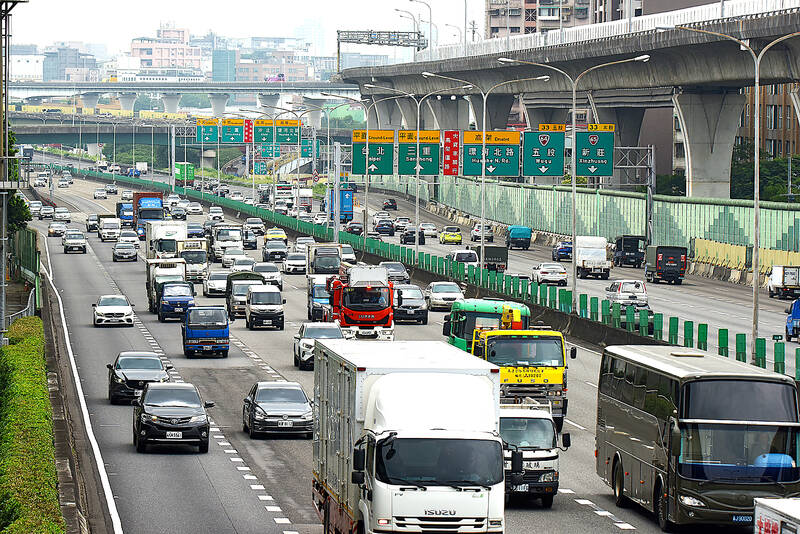
Vehicles travel along a highway in Taipei in an undated photograph.
Photo: Taipei Times
A preliminary police investigation attributed the crash to blind spots that prevented the driver, surnamed Chou (周), from seeing the woman.
The foundation pointed to other fatal motor vehicle collisions, including that of New Taipei City Councilor Chou Sheng-kao’s (周勝考) ex-wife who was hit and killed by a turning bus while using a crosswalk in New Taipei City’s Banciao District (板橋) on June 24.
On July 19 last year, Chou Chia-cheng (周佳正), a surgeon from Taoyuan General Hospital, was fatally struck by a bus while crossing a road in Taipei, the foundation said.
The government has continued to promote the installation of advanced visibility assistance systems for large vehicles in the past few years, with technologies such as side-view cameras, radar alerts and 360-degree surround-view systems being introduced, it said.
However, the key issue is not simply whether safety equipment has been installed, but whether the minimum safety requirements under the regulations are sufficient, it said.
The Ministry of Transportation and Communications launched a research and development program in 2021 to promote active warning and assistance systems for large vehicles, it said.
The systems, which integrate surround-view displays, blind-spot monitoring, forward-collision warnings and lane-departure alerts, have been installed on 800 large vehicles, including 231 trucks and 569 passenger buses, it said.
The foundation urged authorities to review the rule allowing operators to choose just one of three safety devices.
High-risk large vehicles, particularly buses that carry large numbers of passengers every day, should be required to install composite safety systems, which combine video monitoring with active detection and warning technology, it said.
The government should provide subsidies to help operators upgrade equipment that was installed before any regulatory amendments but falls short of improved safety standards or the new requirements, it said.
The subsidies and installation period should be subject to a clear deadline, such as six months or one year, after which no further subsidies would be provided and enforcement under the revised regulations would begin, it said.
The next stage of large-vehicle safety regulations should go beyond checking whether equipment has been installed and instead assess whether it can effectively detect hazards, issue warnings proactively and reduce collisions, it said.
Authorities should ensure that drivers use the systems properly and do not switch off safety assistance functions, it added.
KioskNews shows a cleaned-up reading view extracted from the publisher’s page — the original always lives on their site, not ours.