Built in Singapore and Batam, bound for the North Sea: The massive platforms delivering renewable power to Europe
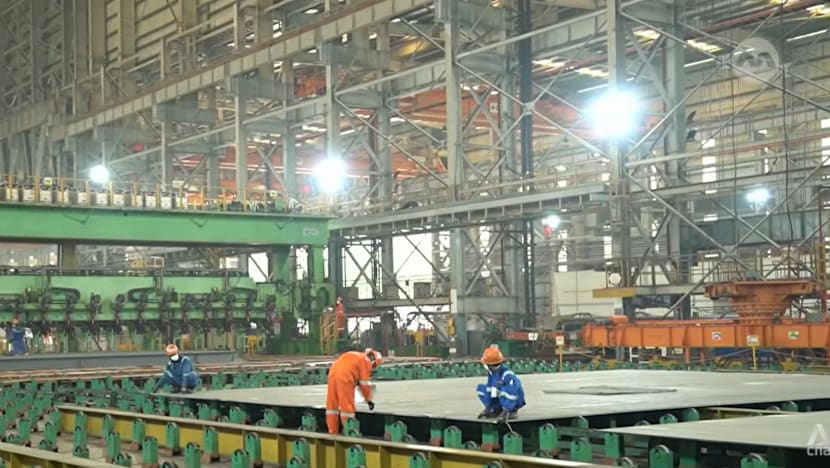
Once installed, each platform will help connect wind farms to Europe's electricity grid, transmitting enough renewable energy to power between 1.5 million and 2 million homes.
New: You can now listen to articles.

This audio is generated by an AI tool.

20 Nov 2026 12:07PM
SINGAPORE: Massive steel structures taking shape in Singapore and Indonesia’s Batam are bound for the North Sea, thousands of kilometres away.
Each weighs about 30,000 tonnes, or roughly the weight of three Eiffel Towers combined.
Once installed, each platform will help connect wind farms to Europe's electricity grid, transmitting enough renewable energy to power around 1.5 million homes.
These high-voltage direct current (HVDC) offshore converter substations are being built for Dutch transmission system operator TenneT, which is investing heavily in expanding infrastructure to support the growing use of offshore wind power.
According to industry group WindEurope, wind power supplies around one-fifth of electricity demand in Europe, with its share expected to grow to 30 per cent by 2030.
“To distribute all this generated wind energy throughout the European continent requires onshore investment,” said TenneT chief operating officer Maarten Abbenhuis.
He added that the state-owned company and the Netherlands are investing €43 billion (US$50 billion) over the next five years to ensure grid expansion keeps pace with the rollout of renewable electricity generation.
Electricity generated by offshore wind farms is collected at these platforms, before being converted and transmitted through subsea cables.
Each platform is designed to transmit up to two gigawatts of electricity, requiring specialised infrastructure to carry such large amounts of power over long distances.
Stefan Hartge, energy firm GE Vernova's global accounts leader for grid systems integration, said the platforms use HVDC technology to move electricity more efficiently over long distances.
“Two-gigawatt platforms are made to really bring very, very large renewable powers onshore,” he added.
Once on land, the electricity is converted from HVDC to alternating current and fed into the continental electricity grid.
SINGAPORE AND BATAM’S ROLE
Seatrium's yards in Singapore and Batam are involved in constructing the offshore platforms, work that requires specialised engineering capabilities, skilled labour and large-scale industrial capacities.
Around 2,000 people are working on the three commissioned substation projects across Singapore and Batam.
TenneT’s Abbenhuis said the availability of skilled workers and the size and quality of the yards were among the factors behind the company’s decision to build the platforms in both places.
“For us, the driver is the technical capability to manage the two-gigawatt standards,” he added.
For Singapore, the projects also draw on expertise via its established offshore and maritime sector.
Seatrium CEO Chris Ong noted that supply chain management is critical to delivering projects of such scale and Singapore provided “certain advantages” in that area.
"The maritime ecosystem, the offshore ecosystem that we have does help us a lot," he said.
While the platforms will help bring more renewable electricity ashore, TenneT’s Abbenhuis said demand for clean power would also need to grow alongside greater electrification of industries, households and transport to support the broader energy transition.
“That momentum is now … for us to be able to distribute all the offshore wind, the industry needs to electrify now,” he added.
KioskNews shows a cleaned-up reading view extracted from the publisher’s page — the original always lives on their site, not ours.