‘We should find our own lexicon’: Nalanda Vice-Chancellor Sachin Chaturvedi on India’s soft power
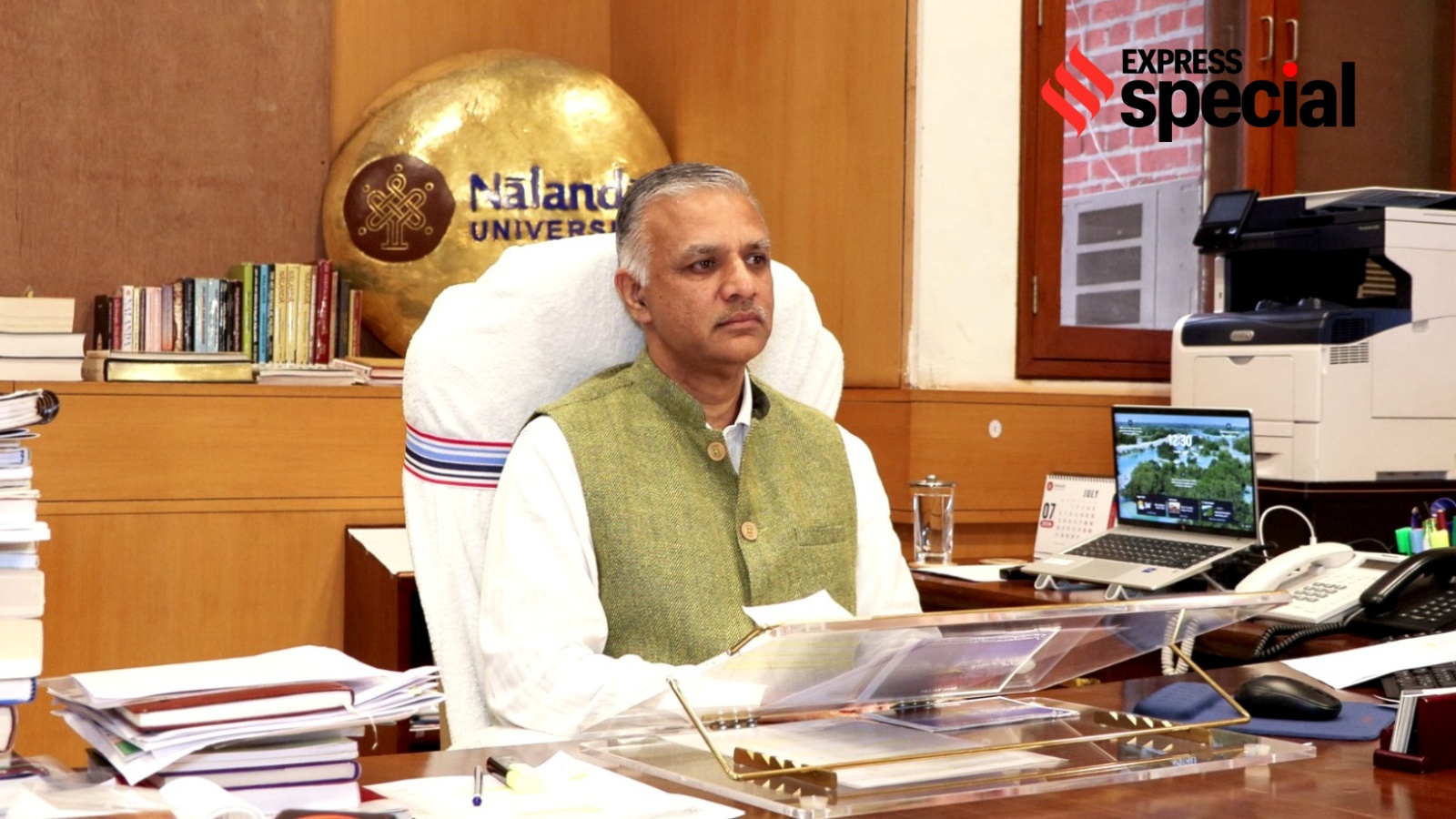
Nalanda University (NU) Vice Chancellor Sachin Chaturvedi speaks to The Indian Express about the university’s planned library, its research on Shastra (weapons) and shaastra (philosophical treatises), the revival of Shaastrartha (debate) and the Nalanda University Press. He also addresses ongoing debates on Sanatan and the saffronisation of education and explains why the international university is taking longer to establish itself than institutions like JNU.
We have planned our library meticulously. The five-storey, stupa-shaped library — with quadrants on each floor — will begin with approximately 3.5 lakh books. The first floor will be devoted to handwritten works such as the Pragya Paramita by Acharya Nagarjuna, one of the foremost among 28 Nalanda masters whose works are being translated into English. We will also have transcriptions of these texts by students, digital analytics and coding of works by experts from IIIT Hyderabad. Since these texts are in Pali, Prakrit, Sanskrit, and other languages, they will first be translated into English. There are about 1,500 to 1,800 volumes of such works. PM Narendra Modi is likely to inaugurate the library in December.
There will also be a floor devoted to complete digitisation — to help avoid the destruction that befell the ancient university. We will have segments on commentators on Nalanda University, physical dissertations from our students and a range of contemporary books across genres.
How does Nalanda University contribute to shaping our foreign policy and international relations in terms of frequent use of soft power, especially in the context of the post-Hormuz world?
Western philosophy talks about the rule of law, but we need to talk about the rule of justice — drawn from Kautilya’s philosophy. The Hormuz crisis and South China Sea crisis are fundamentally cases of rule of law versus rule of justice. We have to revisit the concept of global governance. “Soft power” is a Western concept, we need to find our own lexicon from the ways ancient India practised diplomacy. Soon, we are opening the Gandhi Zayed Centre for Peace, Tolerance and Sustainability, engaging Indian and UAE experts. We are also adding Jain philosophy alongside Buddhist and Hindu philosophy for a comprehensive understanding of statecraft. We have to understand the growing binary in the post-Hormuz world while reading along the works and interpretations of Indian masters of the past.
Could you elaborate on Shastra, Shaastra, and Shaastrartha? PM Modi spoke about Nalanda University introducing Shaastrartha as part of an ancient tradition.
The Hormuz crisis witnessed the use of both shastra and shaastra . We will launch our own publication, the Nalanda University Press on the inauguration day with an edited volume on “Shastra and Shaastra” by eminent scholar Amrita Narlikar, with contributions from 20 leading foreign policy experts. The idea is to amalgamate and differentiate philosophical inquiry and statecraft. Shaastrartha — structured intellectual debate in the tradition of the ancient university — is all the more important in an era of AI overdose.
How do you view the introduction and promotion of courses in Hinduism and Sanatan studies, given the allegations of saffronisation of education?
There is a delicate line to follow — between restraint and ensuring that arguments are placed on the altar of intellectual discussion rather than misinformation. It is important for academics to put facts, history, and wider public understanding together. The fact that Gautam Buddha himself practised several elements of Sanatan Sanskriti (culture) may be contextualised against the differences within Buddhist philosophies. Nalanda University always supported multiple knowledge traditions — Buddhist, Hindu, Jain — from the 7th century onwards. Even now, students from 36 countries are studying here, including religious courses, and we received applications from 72 countries. The response has been strong enough to help us meet our target of 1,000 students.
What does the course on International Relations and Peace Studies cover, and what is the Bay of Bengal studies about?
The idea for a separate peace studies centre came from the former Bihar Chief Minister Nitish Kumar — a mark of pragmatic statecraft. Initially, he held back some portion of the university land to make us fulfill his condition of a separate centre as he was not happy with our formulation of the International Relations and Peace Studies centre, but eventually gave us the land. Yet, we are thankful to him for the idea, which is the mark of statecraft from a pragmatic politician. IRPS has been a big draw for students, alongside archaeology, history, data science and AI. In terms of international relations, data analysis gives us multiple facets of the past, present, and future and we are arriving at computable analysis of our ancient texts.
Story continues below this ad
We will hold a meeting this month bringing together linguists from Northeastern India and Southeast Asia to understand the linguistic dynamics of the region, in line with the Act East policy endorsed by the Prime Minister.
What are the key elements of the Indian Knowledge System which has become a buzzword these days?
Its manifestation is visible in architecture, philosophy and economics. Instead of borrowing from colonial structures, Nalanda University’s architecture reflects ancient design principles — our buildings are oriented so that the purvaiya (easterly) wind flows through them. In terms of economic thinking, our framework is more oriented towards well-being than GDP — an approach emulated by the UN in 2023. We also need to rethink trade metrics: if India has 80% trade with Nepal, 95% with Bhutan and 68% with Sri Lanka, it reflects our trade growth; old metrics depicting it unfavourably have to be changed and viewed through our own indigenous and ancient methodology.
In language, we have incorporated Malayalam, Telugu, Tamil, Kannada and Hindi to revive regional languages and prevent their erosion. Ancient Nalanda did not travel to 200-odd neighbouring villages merely to procure rations — it went there to learn Pali, Prakrit and Sanskrit.
Unlike JNU, which established itself within a decade of opening, why is Nalanda University, a flagship MEA venture, taking longer to arrive?
It is happening, it is just a matter of time. IRPS has been a major preference of students from several states who preferred NU over JNU or DU. In CUET preference rankings, Nalanda University is among the top six or seven institutions. It is difficult to draw students from metro cities to a rural setting. But those who stay here know that the campus ambience is comparable to that of any top university in the world, with significantly better AQI than large metros.
KioskNews shows a cleaned-up reading view extracted from the publisher’s page — the original always lives on their site, not ours.