Is America heading towards a second revolution? A timely and provocative book by Lee Boon Chye — Phar Kim Beng
OCT 16 — The United States has long portrayed itself as the world’s most enduring constitutional democracy.
Yet beneath its impressive economic, military and technological achievements lies a society increasingly divided by inequality, political polarisation and declining confidence in its institutions.
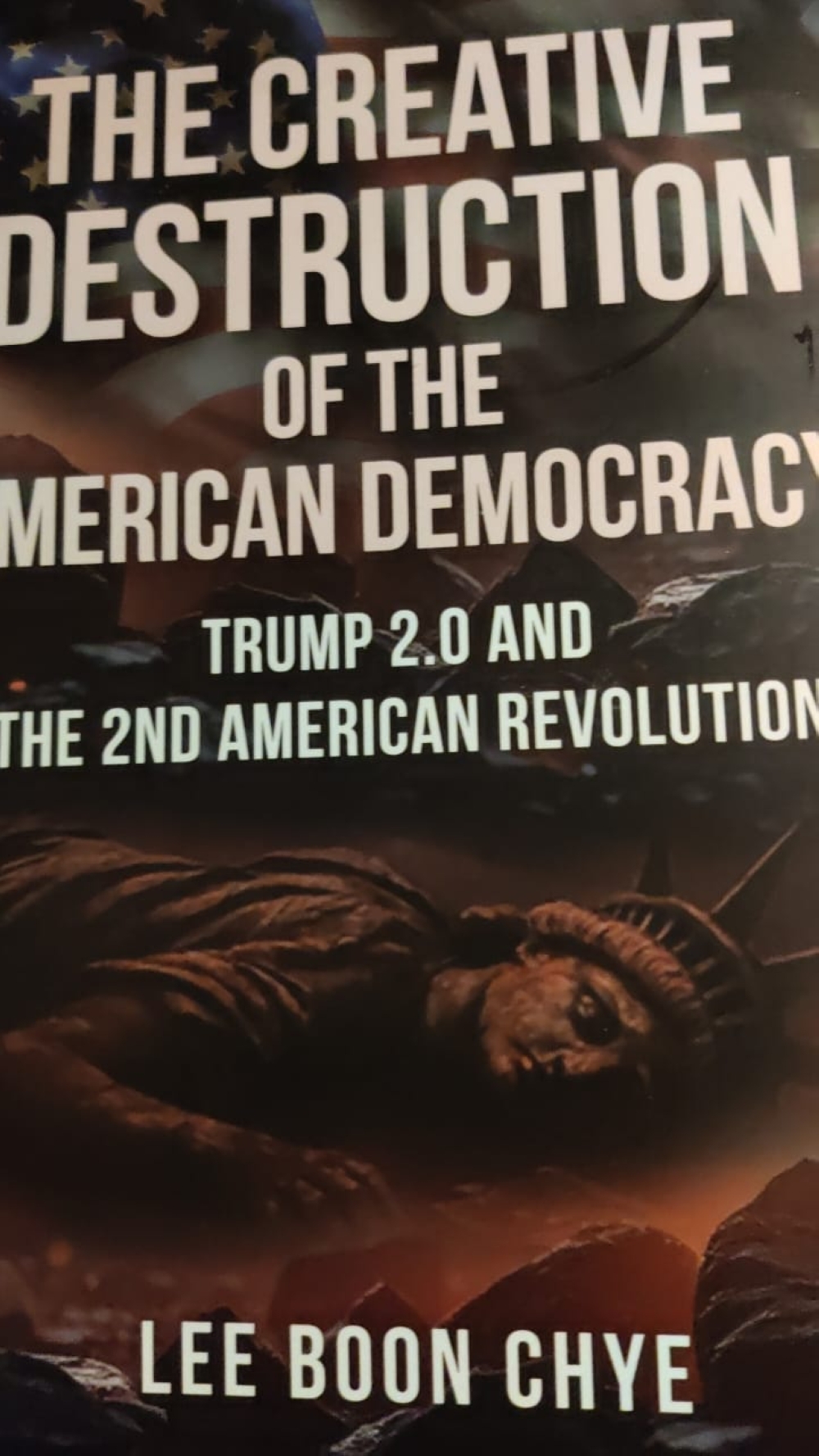
In his ambitious and provocative book on the possibility of a Second American Revolution, Datuk Lee Boon Chye offers a penetrating examination of these contradictions.
The exact title is “The Creative Destruction of The American Democracy: Trump 2.0 and the 2nd American Revolution,” published under the VinLin Press.
Lee’s central argument is that America’s political institutions, once responsible for its extraordinary rise, have become increasingly incapable of correcting their own structural weaknesses.
This is not merely another criticism of President Donald Trump. Indeed, one of the book’s principal strengths is its refusal to treat Trump as the original cause of America’s democratic malaise.
Instead, Lee argues that Trump’s political resurgence reflects decades of accumulated grievances involving stagnant wages, widening wealth inequality, declining social mobility and the growing influence of wealthy elites over public policy.
The distinction is fundamental. Trump did not create these contradictions. He exploited them.
Across 18 chapters, Lee constructs a sweeping argument that connects America’s contemporary political turbulence with the philosophical foundations of its republic.
His examination begins with Trump’s electoral victories in 2016 and 2024, before proceeding to the deeper socioeconomic conditions that made such political upheavals possible.
Lee is particularly persuasive when explaining how economic growth and corporate profitability have increasingly become disconnected from the living standards of ordinary Americans.
While productivity and financial markets have expanded substantially, many working-class households have struggled to experience corresponding improvements in their purchasing power.
This contradiction exposes the limitations of neoliberal capitalism, particularly the assumption that economic prosperity automatically translates into broadly distributed social benefits.
Lee traces these developments to the economic doctrines associated with Ronald Reagan and Milton Friedman, arguing that shareholder primacy, globalisation and declining labour bargaining power have progressively weakened the American middle class.
The book subsequently examines healthcare inequality, opioid addiction, mass incarceration, gun violence, homelessness, suicide and unequal educational opportunities.
These are not treated as isolated social problems. Rather, Lee presents them as interconnected manifestations of an economic and political order increasingly unable to reconcile private prosperity with collective welfare.
His discussion of healthcare is especially revealing.
Despite enormous expenditure, the United States continues to experience serious disparities in medical access and health outcomes.
For Lee, this demonstrates how market mechanisms cannot invariably substitute for effective public governance.
Equally important is his examination of the American criminal justice system, including the controversies surrounding Jeffrey Epstein.
The broader issue is not simply individual wrongdoing but whether wealth and political connections permit influential individuals to enjoy privileges unavailable to ordinary citizens.
Nevertheless, some allegations and interpretations surrounding Epstein would benefit from more rigorous differentiation between established evidence, disputed claims and speculation.
The book becomes intellectually more ambitious when Lee revisits the American Revolution and the philosophical contributions of Thomas Hobbes, John Locke, Jean-Jacques Rousseau and Montesquieu.
Here, he challenges the assumption that America’s founding constitutional arrangements remain universally applicable regardless of changing historical circumstances.
His argument is that constitutional durability can become constitutional rigidity.
The Electoral College, entrenched two-party competition, expensive electoral campaigns and formidable barriers to constitutional amendment have collectively restricted meaningful institutional renewal.
Consequently, American democracy risks becoming procedurally competitive without being substantively responsive.
This is perhaps the book’s most consequential observation.
Democratic legitimacy cannot depend exclusively on periodic elections. It must also rest upon institutions capable of translating public preferences into effective governance.
Lee further examines the contradictions between America’s founding ideals and its historical conduct, particularly slavery, Indigenous dispossession, racial segregation and foreign intervention.
These contradictions deserve serious reflection, although his critique of Enlightenment philosophy occasionally understates the capacity of liberal constitutionalism for gradual reform and self-correction.
The book’s concluding proposition is especially provocative: America may ultimately require a Second Revolution, potentially involving the replacement of its existing Constitution.
This conclusion is intellectually stimulating but remains debatable.
Institutional rigidity does not necessarily make revolutionary rupture inevitable.
Constitutional interpretation, electoral reform, civic mobilisation and political realignment can also generate substantial transformation.
Indeed, the historical resilience of American institutions suggests that the relationship between constitutional continuity and democratic renewal is more complicated than a choice between preservation and revolution.
For readers in Malaysia and Asean, however, Lee’s analysis carries significance beyond American domestic politics.
In his ambitious and provocative book on the possibility of a Second American Revolution, Datuk Lee Boon Chye offers a penetrating examination of these contradictions.
A United States weakened by internal divisions may become more unpredictable internationally, alternating between strategic retrenchment, economic nationalism and assertive demonstrations of military power.
Asean cannot assume that American institutional stability will indefinitely guarantee strategic consistency.
Nor should Southeast Asian countries conclude that China’s rise automatically resolves the uncertainties arising from American political dysfunction.
The region must instead cultivate greater strategic autonomy, strengthen its economic resilience and maintain diplomatic engagement with all major powers.
Lee’s book therefore deserves attention not because its prediction of revolutionary transformation is necessarily correct, but because it identifies the accumulating contradictions that make such a proposition conceivable.
Its breadth occasionally comes at the expense of analytical precision, and several sweeping arguments warrant greater qualification.
Nevertheless, its willingness to connect political economy, constitutional philosophy and social deterioration is commendable.
Ultimately, the book reminds readers that great powers seldom decline solely because of external competitors.
They become vulnerable when their institutions lose the capacity to address the grievances of their own citizens.
Whether America experiences a Second Revolution remains uncertain.
What is increasingly difficult to dismiss is Lee Boon Chye’s underlying warning: a democracy that cannot renew itself risks becoming a prisoner of the very institutions that once made it successful.
* Phar Kim Beng is professor of Asean Studies, and director at the Institute of International and Asean Studies, International Islamic University Malaysia.
** This is the personal opinion of the writer or publication and does not necessarily represent the views of Malay Mail.
KioskNews shows a cleaned-up reading view extracted from the publisher’s page — the original always lives on their site, not ours.