PUB trials rover to pump out flood water in inaccessible spaces ahead of year-end rainy season
SINGAPORE - The next time an underground carpark or a mall basement floods in Singapore, an amphibious yellow rover could come to the rescue.
The new remote-controlled pump vehicle, which is slightly larger than a motorcycle, is one of the new anti-flood measures that national water agency PUB rolled out on Nov 12, at the start of its third annual flood resilience campaign.
During the rainy season, which usually lasts from November to January, flash floods can occur when heavy rain overwhelms Singapore’s drainage system, especially in low-lying areas.
While Singapore has not officially entered this wet phase of the north-east monsoon season, heavy rain in early November had already caused a flash flood at the junction of West Coast Road and West Coast Way on Nov 10.
The campaign highlights the message that flash floods can happen anytime and anywhere, and everyone needs to be flood-ready.
Angela Koh, PUB’s deputy chief executive for flood resilience, said: “Flood resilience is not about being lucky and hoping for the best... it is about being prepared for the unexpected.
“PUB will continue to strengthen our flood monitoring, infrastructure and response capabilities, but building a flood resilient Singapore takes all of us.”
PUB said the new initiatives, such as its remote-controlled pump vehicle as well as new road sensors, will help the agency enhance its flood monitoring and response efforts.
When flash floods are reported, the conventional pumping set-up usually involves contractors using a lorry to transport pumps, a diesel generator, hoses, and other equipment to the affected location. These could take an hour or longer to set up, depending on the situation’s complexity.
But this is challenging to deploy in more confined environments, such as an underground carpark, tunnels, or a basement.
The new 800kg rover that PUB is trialling, however, can be deployed in such cases.
The vehicle can run for at least seven hours, and has a pumping capacity of 500 cubic m per hour, which is equivalent to emptying an Olympic-sized swimming pool in five hours.
As an amphibious vehicle, it can operate in knee-high floodwaters of up to 70 cm deep to draw water into nearby drains. This also reduces the need for personnel to enter tight-spaced areas such as basement carparks where there is a risk of electrical hazards.
The rover is also able to traverse uneven terrain and stairs, as it has tracks instead of wheels.
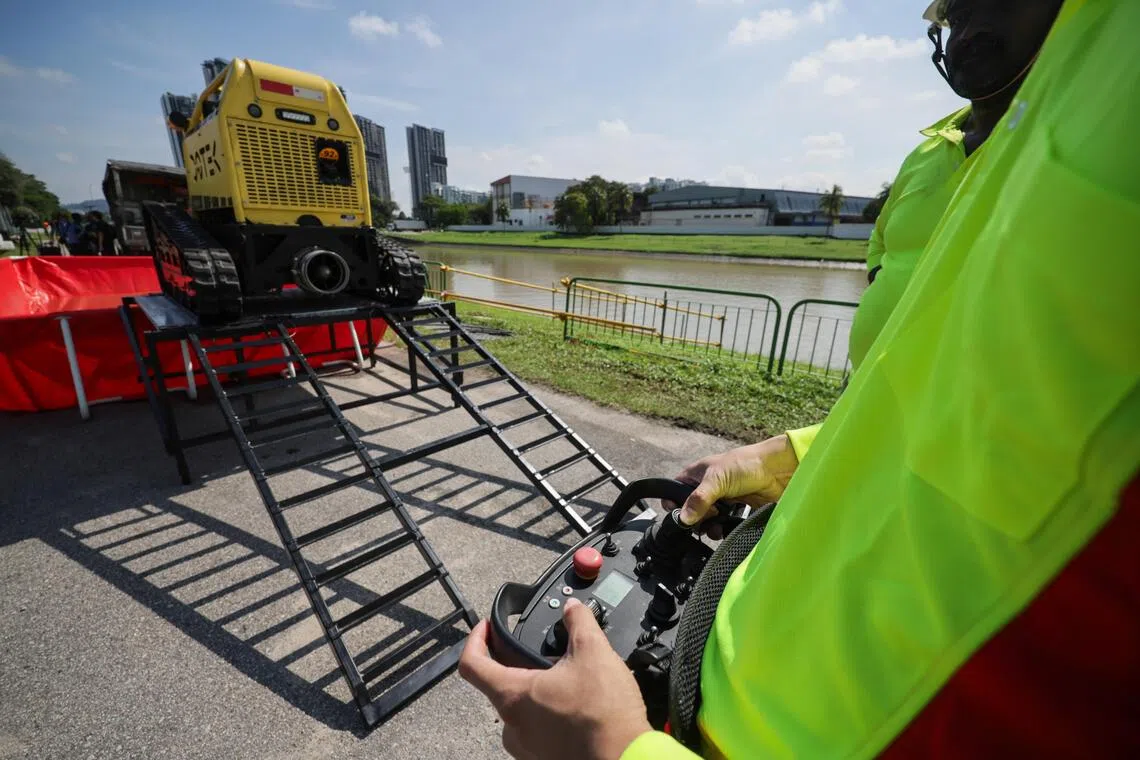
The rover is able to traverse stairs and ramps.
ST PHOTO: GIN TAY
Only one person needs to accompany the rover.
He can manoeuvre it via remote control up to 100m away, and attach a hose to the vehicle before it enters the flooded area. The other end of the hose is then brought to the nearest unflooded drainage outlet to release the water guzzled by the machine.
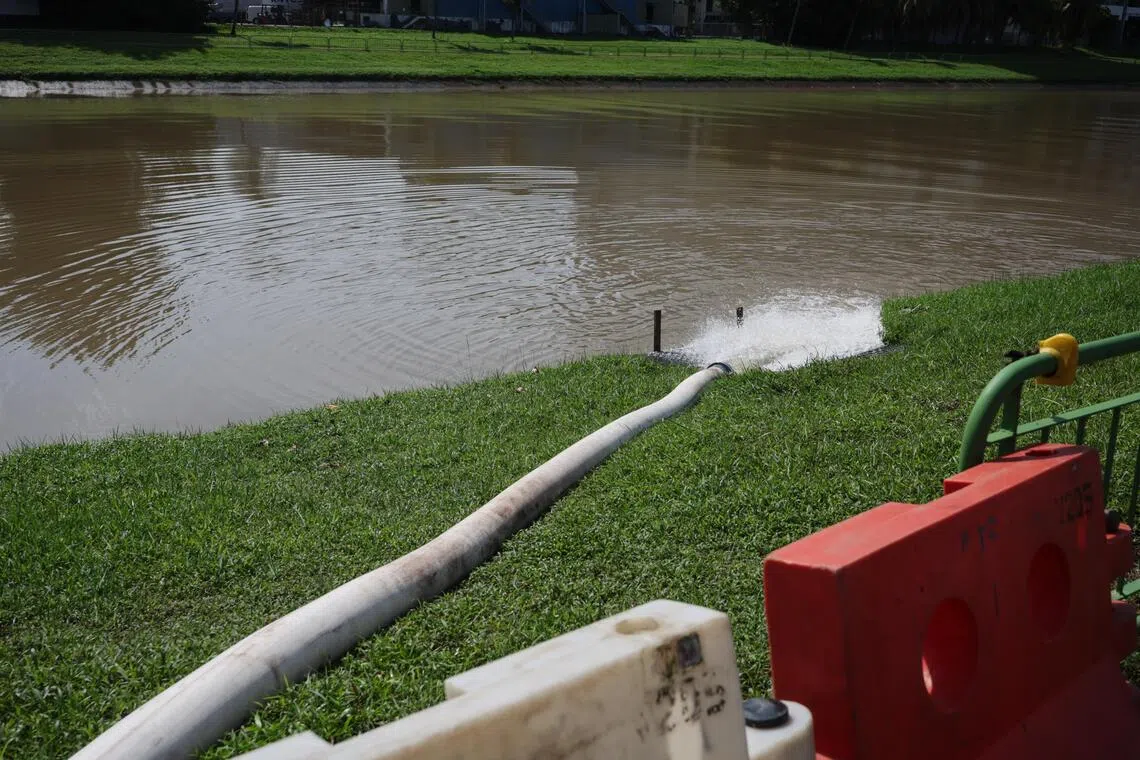
During the demo, the rover pumped out water from the pool into Pandan River.
ST PHOTO: GIN TAY
The new rover has a pumping capacity that is double that of PUB’s largest portable pump in the conventional set-up.
Leased from a vendor, the rover will be trialled in Singapore for a year before PUB decides on deploying more of them.
PUB said the rover can also be used to pump out floodwaters at coastal areas when high tide coincides with heavy rain.
In such situations, coastal tide gates are closed to prevent seawater from flooding inland areas. But this also restricts rainwater from being discharged into the sea.
For example, non-stop rain over Singapore on Jan 10, 2025, coincided with high tides that resulted in flooding in some coastal areas in the low-lying East Coast area. A nearly three-hour flood was recorded in Jalan Seaview in Mountbatten.
PUB also said on Nov 12 that it has installed 30 sensors at flood-prone roads that will trigger alerts to the agency when water starts pooling on the road.
Such road sensors, which are hidden behind drop inlet chambers at road kerbs, are new. Their function is to detect actual flood events.
They join an existing network of over 1,200 water level sensors that PUB has installed in canals and drains. These sensors send automated flood risk warnings to the agency when the water levels of canals reach 90%. In these cases, floods have not occurred yet.
PUB said a six-month trial of the road sensors in places such as King’s Road in Bukit Timah and Craig Road in Tanjong Pagar showed encouraging results, with flood alerts transmitted within one minute.
Currently, flash floods are confirmed by PUB officers who scan footage from CCTV cameras at the agency’s headquarters. Once flooding is seen, they issue flash flood warnings through PUB’s Telegram channel.
The new sensors can automatically transmit alerts to PUB so that its quick response vehicles can also move to the flooded area faster.
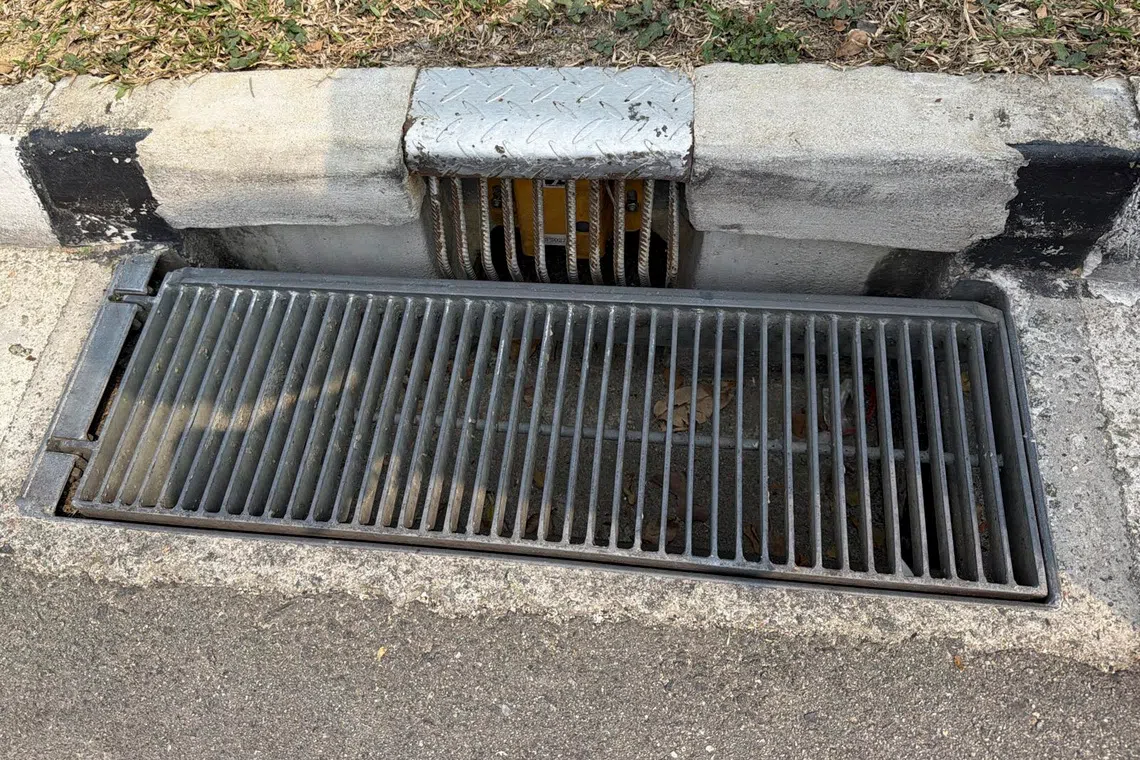
Road flood sensor (in orange) inside the drop inlet chamber at Balmoral Road.
PHOTO: PUB
The quick response vehicles, rolled out since 2021, can drive through floodwaters to close off flooded road sections and divert traffic, and also install portable flood barriers.
The agency said it plans to extend the trial with 15 additional sensors in flood-prone locations and outside residential properties to provide earlier warning for residents to protect their properties and vehicles.
PUB is also looking at integrating the new road sensors with the network of water level sensors in canals and drains, as well as CCTV video analytics, to eventually automate alerts when flash floods are detected.
By end-2028, PUB aims to install about 500 more water level sensors and 200 more CCTVs to expand its flood monitoring efforts.
Motorists are encouraged to follow @PUBFloodAlerts on Telegram and install the myENV app before embarking on their journeys.
Flood alerts are also sent out via the Grab app, Google Maps and the Electronic Road Pricing on-board units.
KioskNews shows a cleaned-up reading view extracted from the publisher’s page — the original always lives on their site, not ours.