Kids awarded for overcoming
By Lin Chih-yi and Fion Khan / Staff reporter, with staff writer


The Noordhoff Craniofacial Foundation yesterday held a scholarship awards ceremony honoring 212 young people across Taiwan with craniofacial conditions who have excelled academically, demonstrated exceptional talents and overcome adversity.
Among the recipients was 14-year-old Chien Chieh (簡婕), who was born with unilateral cleft lip and palate and was diagnosed with mild Asperger’s syndrome in the sixth grade.
Facing challenges in perceiving others’ emotions, she encountered difficulties in social interactions and emotional expression.

Noordhoff Craniofacial Foundation scholarship recipient Chien Chieh, second left, poses for a photograph in Taipei yesterday.
Photo: Lin Chih-yi, Taipei Times
Chien said she was introverted and rarely initiated conversations, but during foundation activities, she bonded with other children who have had similar experiences and overcame her fear of crowds.
After discovering a passion for caring for younger children, she stepped up to serve as a summer camp group leader, guiding younger participants to discover themselves, build self-confidence and remain positive throughout their medical treatment, she said.
She hopes to become a veterinarian and care for more lives, she said.
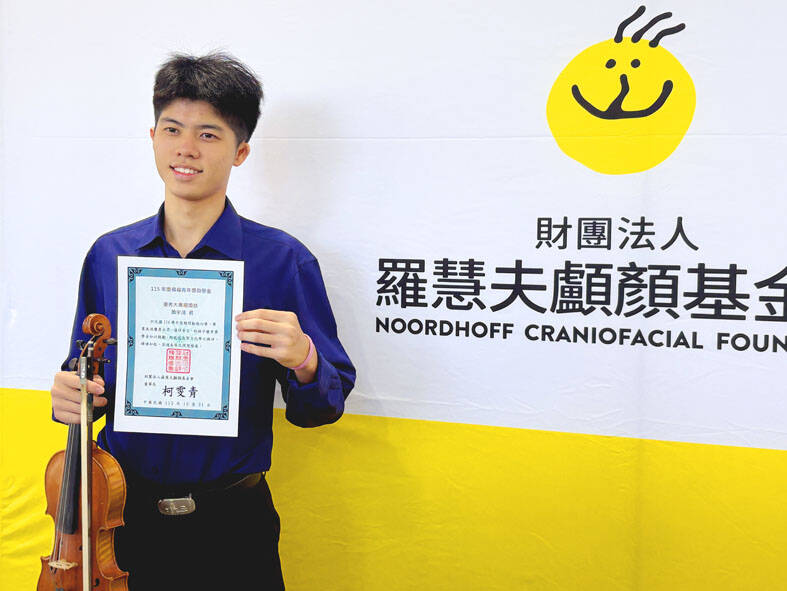
Noordhoff Craniofacial Foundation scholarship recipient Hsiao Yu-hung poses for a photograph in Taipei yesterday.
Photo: Lin Chih-yi, Taipei Times
Another scholarship recipient, Cheng Yu-hsuan (鄭語萱), a first-year student at Taipei National University of the Arts, has unilateral microtia, a congenital condition in which an external ear is underdeveloped.
Cheng, who has loved drawing since childhood, this year won the foundation’s special talent award in recognition of her artistic achievements.
Although her right ear is unusual, with a hearing threshold of about 60 to 70 decibels, she said she still enjoys tying her hair up and does not mind exposing her ear.
Microtia does not define her life, but instead has taught her to understand herself from different perspectives, she said, adding that she plans to continue conveying her observations and feelings through her art.
Another award recipient was 20-year-old Hsiao Yu-hung (蕭宇鴻), a second-year medical student at National Taiwan University, who has microtia in his left ear and a hearing threshold of 50 decibels on that side.
Despite his hearing impairment, he began learning the violin in the second grade, and still practices the violin for at least 30 minutes every day.
Music has taught him to turn life’s imperfections into a source of strength, and he sees his condition as a unique gift, he said.
He said he had experienced discrimination because of the appearance of his ear and had been misunderstood as inattentive in class because of his hearing difficulties.
Although microtia has limited his hearing on the left side, it has made him more determined to experience the world through his right ear, he said.
He said he hopes to become a surgeon and help more people in need.
The proportion of children born with a craniofacial condition in the past few years has dropped to about one in 1,000 from one in every 700, possibly due to improvements in nutrition, said Lo Lun-jou (羅綸洲), a professor in the Department of Plastic and Reconstructive Surgery at Chang Gung Memorial Hospital.
For infants born with a cleft lip and palate, medical institutions educate parents on proper feeding techniques, he said.
Surgical repair for the cleft lip is typically performed at three months of age, followed by cleft palate repair at nine months and an alveolar bone graft at around nine years old, he said.
Although children with cleft lip and palate might still look slightly different after surgery, they can freely pursue their dreams and grow into thriving adults with proper psychological support, he said.
KioskNews shows a cleaned-up reading view extracted from the publisher’s page — the original always lives on their site, not ours.