As drone threat grows, Magos expands commercial security capabilities

Israeli tech company Magos Systems is expanding its capabilities in drone detection, applying its commercial sector experience to the growing challenge posed by unmanned aerial threats.
Founded in 2010 by CEO Aviel Kisliansky and Amit Isseroff, Magos began by developing ground-based radar systems to detect perimeter breaches. While its business remains centered on commercial security, its technology is dual-use and it also serves military and defense applications.
The company’s strategy is built around the concept that security operators should be able to detect suspicious activity across large areas without having to replace their existing infrastructure or depend entirely on camera-based surveillance.
Magos operates in more than 70 countries, providing radar-based surveillance solutions for airports, ports, power stations, data centers, prisons, and other sensitive facilities. As drones become cheaper and more accessible, Magos is extending that approach to defense.
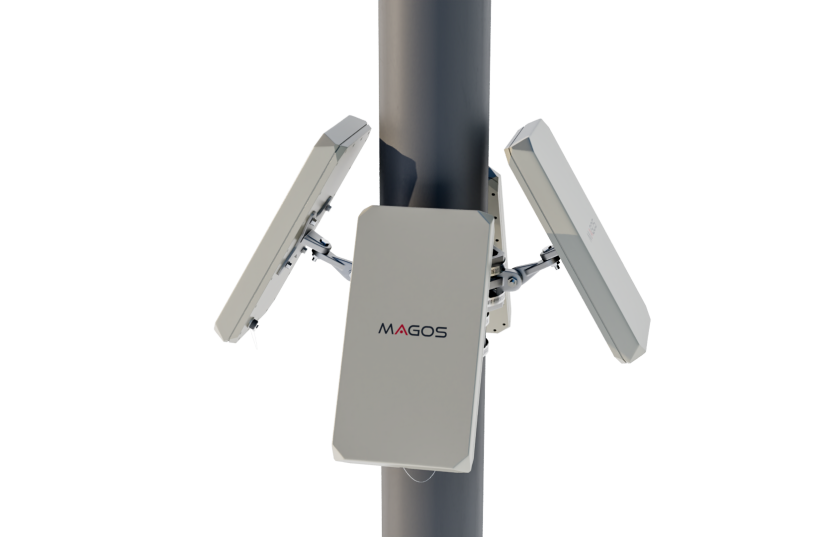
Radar designed for commercial infrastructure
The company’s radar systems are designed to detect and track moving objects and combines radar data with artificial intelligence and machine-learning-based object recognition to help operators identify potential threats and reduce nuisance and false alarms.
Its systems operate in varying weather conditions, and their integration capabilities allow customers to use existing camera equipment rather than commit to a single proprietary surveillance ecosystem. That flexibility is particularly relevant to commercial infrastructure operators, many of which already have extensive security networks and need to improve detection capabilities without undertaking expensive upgrades.
Additionally, MASS (Magos Area Surveillance Software) brings radar-based detection into a broader security-management environment.
The company’s radar portfolio includes several models designed for differing coverage requirements.
Its SR-150 detects people at distances of up to 150 meters and vehicles or boats at similar ranges. The SR-250 extends those distances to 250 m., while the SR-500 can detect people at up to 400 m. and vehicles or boats at up to 600 m.
At the longer end of the range, the SR-1000 is designed to detect people at distances of up to 800 m. and vehicles or boats at up to one kilometer.
The systems provide 100- to 120-degree azimuth coverage and 30-degree elevation coverage, depending on the model, with an accuracy of 0.1 m. across the portfolio, with its longer-range models offering azimuth accuracy of 0.7 degrees.
Extending detection to the drone threat
The same emphasis on detection and integration underpins Magos’ work in drone security.
Small unmanned aerial vehicles (UAV) can approach protected facilities at low altitude, creating challenges for security systems designed primarily to monitor ground-level or high altitude activity. For commercial operators, the first requirement is often to establish that a drone is present, track its movement, and assess whether it poses a threat in time.
Magos’ approach is to combine radar detection with camera-based identification, giving security teams a more complete picture of activity around a facility. And for those who need to protect large or geographically dispersed infrastructure, that flexibility can help them adapt surveillance to the layout and risk profile of each site.
The underlying capabilities of detecting movement, tracking objects, and combining sensor data have applications across both civilian and military environments.
In June, the company secured a NIS 21 million contract to provide hundreds of its radar systems to Israel’s Defense Ministry, which deployed them to the Lebanese border area to improve the detection and identification of Hezbollah’s fiber-optic drones.
As the security industry adapts to the growing use of drones, Magos’ accurate radar detection, integrated cameras, and flexible coverage are essential for both commercial and military uses.
KioskNews shows a cleaned-up reading view extracted from the publisher’s page — the original always lives on their site, not ours.