How a Subang Jaya engineering student turned skyscraper physics into an award-winning wearable for Parkinson’s tremors

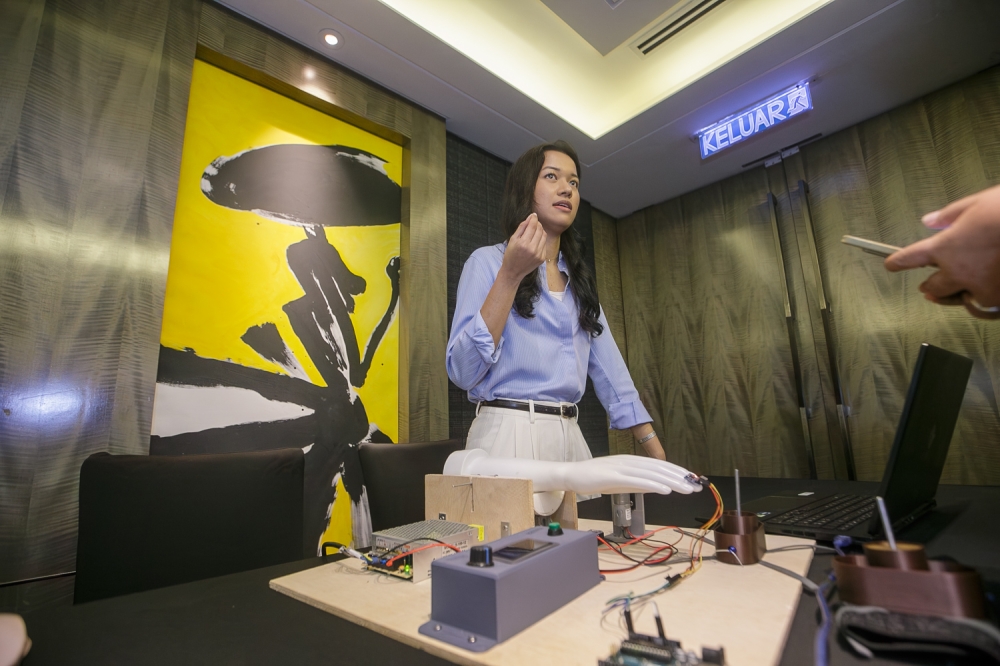
24-year-old Hayley Nea Iauduray has been named as the National Winner for Malaysia in the 2026 James Dyson Award for her ZeMor invention. — Picture by Raymond Manuel
By Arif Zikri
First Published: Thursday, 17 Sep 2026 9:07 AM MYT
KUALA LUMPUR, Sept 17 — Meet the 24-year-old Subang Jaya native Hayley Nea Iauduray who recently came up with a kinetic device designed to alleviate hand tremors associated with Parkinson’s disease.
The Monash University Malaysia graduate was recently named the National Winner for Malaysia in the 2026 James Dyson Awards for her creation, ZeMor (short for ‘Zero Tremor’).
Iauduray is also set to join two other runner-up teams from Malaysia to progress to the next stage of the James Dyson Award, where they will stand a chance to receive RM162,999.
What is ZeMor?
So, what exactly is ZeMor? It is a tunable, battery-free wearable designed to reduce hand tremors caused by Parkinson’s disease.
Interestingly, its design was inspired by Tuned Mass Dampers (TMDs)—the massive engineering systems used to stabilise skyscrapers during severe earthquakes and typhoons such as the one found inside the Taipei 101 building.
How does it work?
Beyond its compact design, ZeMor works like a traditional damper, but with one major edge: unlike fixed-mass passive devices, it can be customised to match individual tremor frequencies by adding or removing weights.
Built using readily available components like slotted weights, steel ball bearings, spring-based dampeners, and other off-the-shelf hardware, alongside a 3D-printed housing, ZeMor was designed to make tremor support more affordable and accessible, supporting broader access across different communities.
Over the course of a year, Iauduray developed and refined multiple prototypes, testing the concept using a custom-built rig that simulated Parkinsonian tremors.
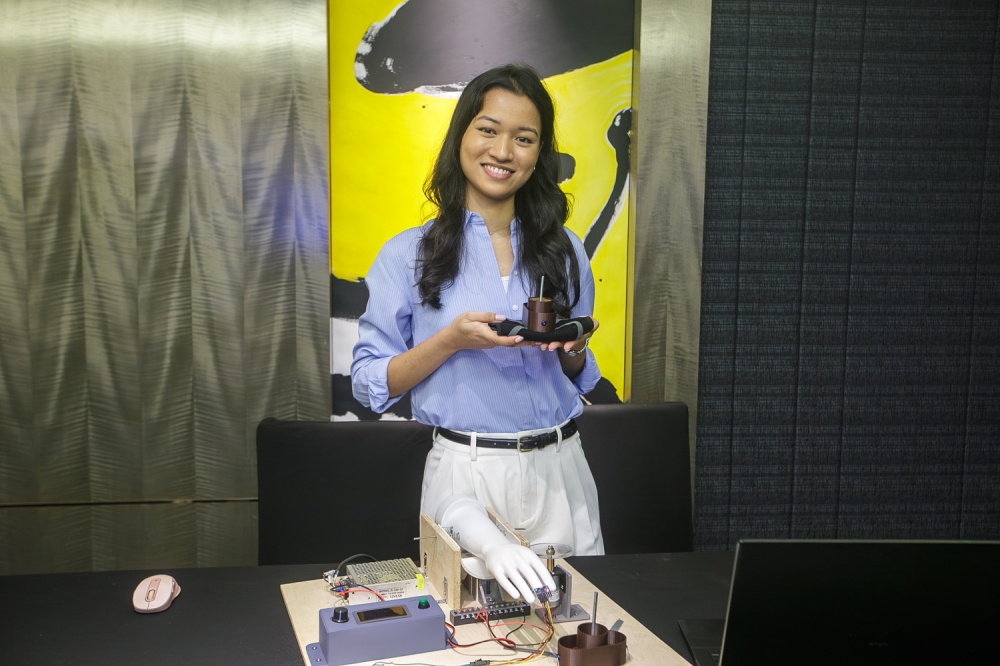
Lauduray said that although she never had any experience with patients with Parkinson’s disease, her research has opened her eyes of on the stark reality of the condition. — Picture by Raymond Manuel
The story behind ZeMor
Lauduray told Malay Mail that ZeMor originated as her Final Year Project and it was her supervisor who encouraged her to join the competition.
While she had no prior experience with Parkinson’s disease, her research exposed the stark reality of the condition.
She learned from World Health Organization (WHO) data that Parkinson’s is among the fastest-growing neurological disorders, with global cases projected to reach 25.2 million by 2050.
Locally, an estimated 20,000 Malaysians live with Parkinson’s—a figure expected to increase fivefold over the next two decades as the population ages.
“I’ve never had experience with any Parkinson’s disease patients before and I didn’t know how bad the situation was after I did my research.
“Hopefully this device could someday help them in the future,” she said.
Iauduray, who found her passion for engineering by playing with Legos while she was in secondary school also shared that she was also inspired by an online video of a boy building a wheelchair for his paralysed pet.
“That’s why for my device, I wanted to move away from electronics because nowadays everyone is using sensors to detect things and some use batteries.
“Are you going to put that amount of batteries on an old person? Old people are already struggling with using their phones and to put something complicated on them is just not ideal and practical.
“Which is why I wanted to make something using simple physics,” she said.
As the National Winner, Iauduray will receive RM27,160 from the James Dyson Foundation and she plans to use the funds to upgrade the current single-axis prototype into a multi-directional system that stabilises tremors from multiple angles.
Aside from that, her next phase will also involve working with medical professionals and research partners to evaluate the device with people living with Parkinson’s disease.
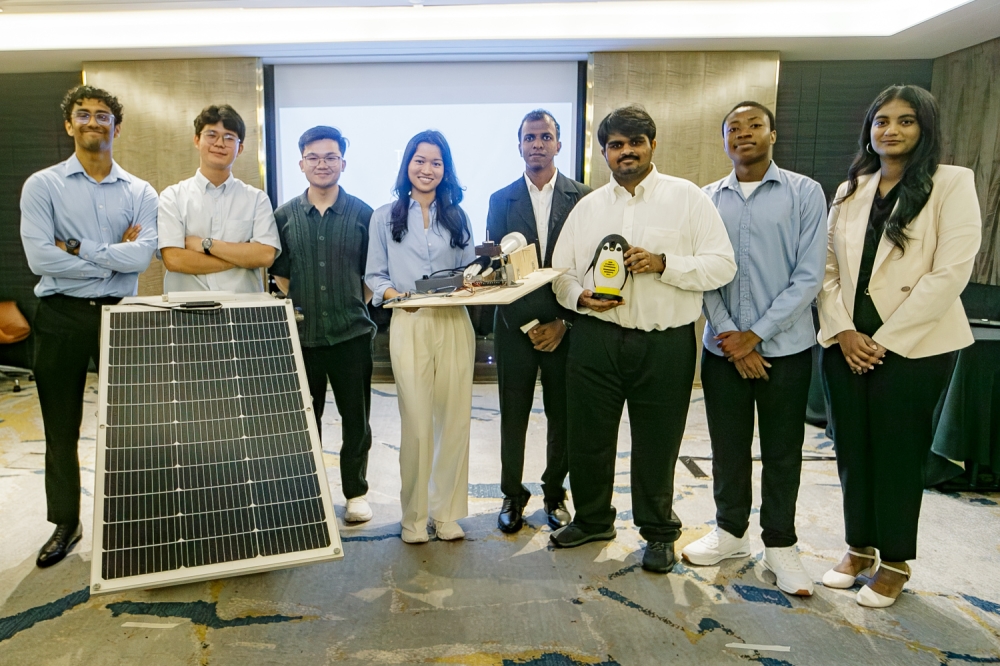
The winnner and runner-ups of the Dyson Malaysia Award 2026. — Picture by Raymond Manuel
The runner ups and next stage
Aside from Iauduray, the Malaysia James Dyson Award also announced two other runner-ups who will be joining Iauduray at the next stage to showcase their inventions.
This includes the Solar Liquid Integration for Communities (SLIC) which is a portable, solar-powered water purification system that aims to improve access to safe drinking water for off-grid communities, developed by students from the University of Nottingham Malaysia in Semenyih.
The other runner-up is Pillay– a child-friendly, contactless screening device that measures vital signs while helping make health checks more comfortable for young children which was developed by students from Asia Pacific University in Kuala Lumpur.
ZeMor, alongside the two runner-ups, SLIC and Pillay will now progress to the next stage of the James Dyson Award, where they will stand a chance to receive RM162,999.
The international Top 20 shortlist will be announced on October 14, selected by a global team of Dyson engineers and the international winners will be announced on November 4, selected by Sir James Dyson himself.
KioskNews shows a cleaned-up reading view extracted from the publisher’s page — the original always lives on their site, not ours.