Inflation generalisation: Why price pressures are spreading, and what it means for interest rates

Household inflation jumped to 5.54% in September from 4.83% in August, data released Monday showed. And one phrase is now on everyone’s lips: price pressures are generalising, or spreading. This is important, as the Reserve Bank of India (RBI) last week admitted that there is “some evidence of elevated inflation expectations and generalisation of inflation”.
The RBI’s admission above marked a U-turn of sorts after it had said as recently as August that there were “little signs of generalisation of price pressures so far” – something a few economists could not digest. For instance, economists from ICICI Securities Primary Dealership (I-SEC PD) said last month the RBI’s “insistence on waiting for generalisation of price pressures and downplaying current bout of inflation as supply shock does not hold up to scrutiny.”
The latest Consumer Price Index (CPI) inflation data for September shows further signs of inflation being generalised, with the RBI’s concession on October 7 giving rise to a consensus of sorts on the subject: yes, price pressures are spreading.
But what exactly is generalisation of inflation and how can it be identified?
Inflation generalisation
In ordinary English, generalisation of inflation is the process when higher prices start to spread across the household consumption basket in a sustained manner. This requires the price rise to span different categories of items and move from ones that are most susceptible to price increases – such as food and fuel – to others, like consumer goods and services.
There are many ways to check if inflation is spreading across the CPI basket. Let us consider the simplest ones first: how many items are seeing above 4% inflation. Why 4%? Because the RBI’s medium-term target is 4%, in a band of 2-6%. So, it stands to reason that if more and more items of the CPI basket are seeing 4%-plus inflation, then price pressures are spreading.
In January, 65 of the 358 items in India’s CPI basket clocked an inflation rate of 4% or more. By September, this number had almost doubled to 129.
Story continues below this ad
Inflation, however, isn’t the best measure of price momentum.
Inflation is the year-on-year change in price – so, inflation in September 2026 is how different prices are, in percentage, compared to September 2025. But this means the inflation rate depends not just on how prices behave in September 2026 but also in September 2025 – if they were unchanged or fell in September 2025 compared to the previous month, it creates an unfavourable base for inflation in September 2026; similarly, a very sharp increase in prices last year would create a favourable base, which would offset sequential price changes in September 2026.
This is why policymakers want to know how prices are moving from one month to another, or month-on-month. This is called the price momentum.
In February, 236 of the 358 items in India’s CPI basket posted saw their price rise compared to the previous month. By September, this number had risen to 319.
Diffusion indices
Story continues below this ad
In many ways, the above two ways to understand if inflation is getting generalised are rather simplistic. Which is why economists have other gauges, such as diffusion indices.
Like the above two simplistic measures, diffusion indices try to see the breadth of price increase across the CPI basket. However, there is one key difference: they take into account the weight each item has in the basket. So, a good that makes up 0.01% of the CPI basket does not get the same importance as one which accounts for 1%.
Going by the RBI’s own diffusion index for the CPI, almost 46% of the CPI basket registered 4%-plus inflation in September, up from 37% in August and 16% in January. Even at 37% in August, the RBI was of the view that this increase “points to a progressive broadening of inflationary pressures”.
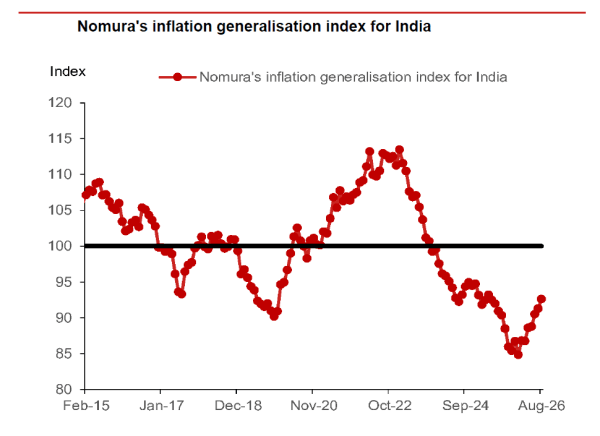
However, not everyone agrees with this assessment. Nomura economists, for instance, think the 37% figure is “low by historical standards”.
Story continues below this ad
As per Nomura’s own inflation generalisation index – which takes into account a variety of indicators beyond the CPI, including household and business inflation expectations and rural and urban wage growth – the “strength of inflation generalisation is currently tracking below average”. But that was in August.
The assessment of Nomura, and others who think price increases are not wide-spread, matters because that determines their prediction of how much the RBI may raise interest rates by in the coming months – broader the pressures, higher the repo rate may end up being. After Monday’s CPI data, the consensus view is leaning towards another 50-75 basis points of rate hikes in the coming 4-6 months.
KioskNews shows a cleaned-up reading view extracted from the publisher’s page — the original always lives on their site, not ours.