When the lepa lights up, Tawi-Tawi tells its story
- Tawi-Tawi, Philippines, is characterized by its untouched beauty and strong maritime culture, with communities closely tied to the sea.
- The Lepa Festival, part of the province's founding anniversary, showcases vibrant boats and traditional dances, emphasizing the cultural heritage of the Sama communities.
- The event highlights the importance of the lepa as a symbol of maritime heritage, with performances and decorations reflecting a living culture rather than a mere spectacle.
This is AI-generated. Read the article for full context. Report any errors.
BONGAO, Philippines — From the plane, Tawi-Tawi first appears in blue.
As the aircraft descends toward Sanga-Sanga Airport, the Sulu Sea fills the window, broken by islands, reefs, and strips of green. For someone coming from the mountains of Northern Luzon, the landscape feels almost like another country.
But what strikes you first is not distance. It is how much of Tawi-Tawi still feels untouched by the kind of tourism that can reshape a place before visitors have learned to understand it.
The sea is everywhere. Boats are everywhere. Communities remain closely tied to the water. You see the beauty, and you hope it stays that way.
On my first evening in the province, I was told there was an event at the port. I went. The masts were the first things I saw.
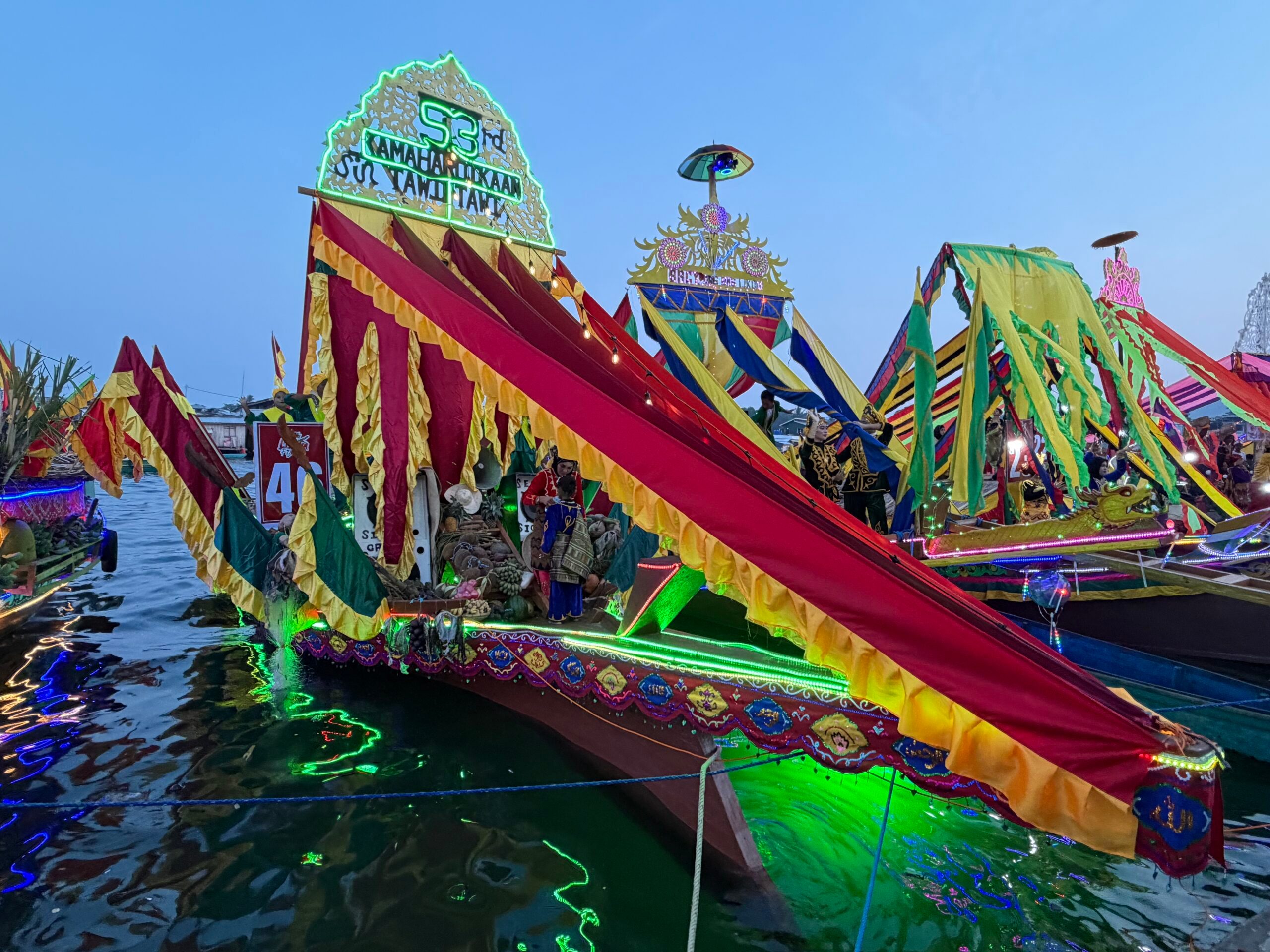
They rose above the crowd in the fading light, ornate wooden forms visible from a distance before the boats themselves came into view. Up close, the waterfront was a burst of color.
Red, yellow, green, pink, blue, and gold streamed from the boats. Cloth stretched from tall masts toward the bows. Flags fluttered above carved hulls. Decorative panels, umbrellas, lights, and patterns made each vessel distinct.
This was the Lepa Festival, part of the Kamahardikaan sin Tawi-Tawi, the province’s founding anniversary celebration. Then the music started.
Almost every boat seemed to have its own sound system. Songs overlapped across the water as dancers moved on narrow decks, surrounded by musicians, children, and performers waiting their turn.
The noise was immense. So was the energy. Amid it all, the dancers held your attention.
Their movements were controlled and fluid, especially in the hands and wrists. Some of the women wore long silver fingernail extensions that gave every gesture more shape and drama. Men and children danced alongside them.
The performances drew from igal, a traditional dance associated with Sama communities, known for expressive movements of the hands, arms, and body.
Even in the din, the dancers moved with remarkable composure. The boats themselves carried another story.

The lepa is more than a festival vessel. Traditionally, it served as home, transport, and livelihood for Sama Dilaut communities whose lives were closely connected to the sea.
Many families later moved into stilt houses along the coast, but the lepa remains one of the strongest symbols of that maritime heritage.
Beneath the lights and decorations were carved hulls, elaborate wooden forms, long sweeps of cloth, and craftsmanship passed down over generations.
There were LED lights and generators, too. This was not an attempt to freeze culture in the past. It was culture being carried into the present.
Nothing about the festival felt like heritage placed neatly on display for outsiders.
People were dancing on the boats. Children were performing. Musicians were playing. Crews checked ropes and lights. Families watched from the shore. Spectators took photos and videos, but the boats still felt like community spaces rather than props.
The pride was unmistakable.

Entries came from different municipalities across Tawi-Tawi, with some supported by local officials.
As darkness settled over Bongao, the crowd thickened along the waterfront, and the tall masts formed a colorful skyline over the port.
Then came the countdown. Generators were switched on. One by one, the lepa lit up!
Green, purple, blue, red, and white lights traced the hulls, masts, carvings, and cloth. Their reflections shimmered across the dark water.
Phones went up. Children pressed closer to the front. The dancers kept moving. For a few minutes, the entire waterfront seemed to glow.
Governor Yshmael “Mang” Sali and Vice Governor Al-Syed Sali were among the provincial officials present, along with mayors, members of the Bangsamoro Parliament, and other local leaders who also served as judges.
But the officials were not the center of the night. The boats were. More importantly, the people who built, decorated, sailed, danced on, and gathered around them were.
Hja. Elmasia Madjilon, Tawi-Tawi commissioner of the Bangsamoro Commission for the Preservation of Cultural Heritage, described the lighting of the lepa as something larger than spectacle.
“We are not just simply lighting a traditional vessel,” she told the crowd. “We are bringing life to a story that has traveled across generations.”
She spoke of the lepa as a vessel carrying knowledge of boatmaking, navigation, art, and a way of life shaped by the waters surrounding the islands.
“Every form, every design, and every meter carries the memory and wisdom of our ancestors,” she said.

Standing beside the boats, that was easy to understand. Heritage here was not confined to a museum. It was in the carved wood, the dancers’ hands, the children learning the movements, and the people who still knew how to build, decorate, and explain the vessels.
Festivals can sometimes reduce culture to spectacle.
There was certainly spectacle in Bongao that night: bright lights, competing sound systems, prizes, judges, and hundreds of phones pointed toward the water. But the celebration never felt hollow.
It felt communal, joyful, and rooted in place. Coming from the Cordillera, I found something familiar in that.
The landscapes could not be more different, but communities in the North also carry traditions while negotiating a rapidly changing world.
In the mountains, identity is often tied to land, ritual, weaving, memory, and place.
In Tawi-Tawi, much of that story is carried by the sea.
And on my first night in the Philippines’ southernmost province, those stories glowed on the water, one lepa after another. – Rappler.com
KioskNews shows a cleaned-up reading view extracted from the publisher’s page — the original always lives on their site, not ours.