‘We’re assuming it’s going to be a lot smellier this year’: Pete the corpse flower prepares to bloom in Geelong

Geelong botanic gardens is preparing for its second corpse flower bloom in two years – a normally rare event that has been dubbed a “smelly sequel”.
The flower, which broke through soil at the end of September, has been rapidly gaining height, heating up and turning purple, all signs of an impending bloom. It’s expected to unfurl as early as Sunday, releasing its signature scent of rotting flesh – and, when it does, it will bloom for just 24 to 48 hours.
At 178cm tall, this year’s plant, known as “Pete”, is nearly double the size of “Betsy”, which bloomed at the gardens in 2024. Pungent Pete, which is 13 years old, already towers above Tracie Abel, a horticulturist at the gardens.
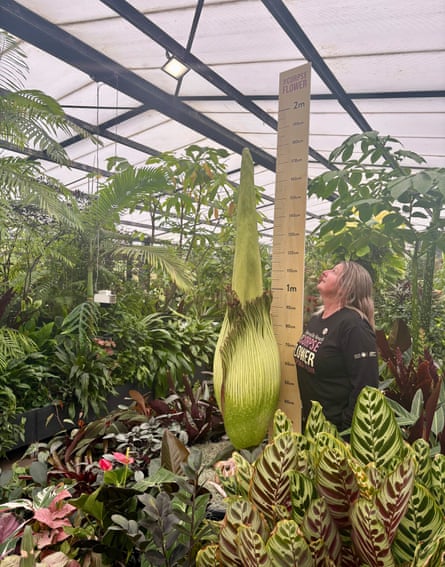
“It’s pretty impressive,” she says. “We’re assuming that it’s going to be a lot smellier this year, because it’s a bigger plant, bigger flower.”
Titan arums are commonly called corpse flowers due to their putrid stench, variously described as being reminiscent of decaying possum, old sweaty socks or the “rich stench of a public bin on a 40-degree day”.
Both of Geelong’s plants hail from Australia’s corpse flower “mothership”, the Botanic Gardens of South Australia, which has one of the biggest collections in the world. Its senior horticulture curator, Matt Coulter, who propagated the two plants from cuttings and tended to them for about eight years before donating them, says he feels “proud” to see them flower, especially given the excitement this generates. “I don’t know any other plant that draws the attention of people like this,” he says.
The putrid smell mimics a dead animal to attract pollinators, he says. A corpse flower can take a decade to form and then it only has one night to get pollinated.
“The big bit in the middle, the spadix, acts like a chimney,” Coulter says. “It actually draws the smell up … and then out into the forest to try to bring the insects to help with the pollination.”
The frilly leaf, the part that opens, is called the spathe. “That will start to open anytime between 12 and 2 o’clock on the day,” he says. “You can actually almost see it move. By the night-time it’ll be fully extended.”
after newsletter promotion
The notoriously unpredictable and stinky specimens are native to Sumatra, in Indonesia, where they are considered endangered. Australia is now one of the top three places for the number of corpse flowers blooming.
John Siemon, the director of horticulture at the Botanic Gardens of Sydney, where three flowers bloomed last year – Putricia, Baby Stink and Stinkerella – says: “People are enamoured with this ginormous stinky flower.” Flowering events attract huge crowds, all wanting to experience the odour, which Siemon describes as akin to “the tampon receptacle at the back of a public toilet” or “possum urine”.
They are an “iconic plant”, which creates an opportunity to talk about the importance of plants and why plant conservation is important, he says.
Visitors making the trip to see – and sniff – Pete, will also be able to check out the garden’s 167-year-old Ginkgo biloba, Victoria’s tree of the year. Out-of-towners can follow the action on a 24-hour live stream of Pete.
KioskNews shows a cleaned-up reading view extracted from the publisher’s page — the original always lives on their site, not ours.