Steve Bracks is on board: Ben Carroll finds a believer as most write off Labor’s Victorian election chances
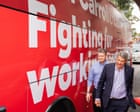
With Victorian Labor sliding in the polls and the prospect of the premier losing his own seat, the party has turned to a figure from its past for a much-needed morale boost. Climbing aboard Labor’s big red campaign bus on Friday morning was Steve Bracks, the former premier who led the party to three consecutive election victories, including the shock 1999 win that toppled Jeff Kennett’s Coalition government.
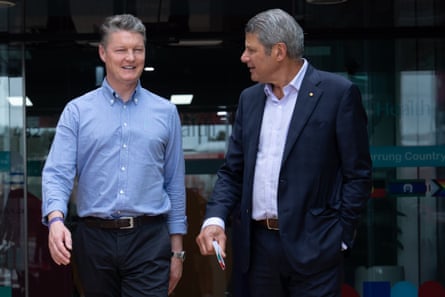
“At this stage in 1999, no one gave me a chance to be premier. Kennett looked like he was a shoo-in for that election,” Bracks told reporters at Sunshine hospital.
“There’s still a week to go. It won’t take that much more improvement in our primary vote for us to go very well this election, and that’s the path required.”
But the polls paint a less optimistic picture. Most suggest Labor is facing its worst result in decades, with its primary vote possibly headed for the lowest of any sitting government in Australia since the second world war.
If the party’s primary vote falls as much as is expected, Ben Carroll could become the first Victorian premier to lose his own seat. He holds Niddrie, covering parts of Melbourne’s inner north-west, on a margin of 6.7%. But Carroll this week batted away the idea, arguing that he had strengthened his margin since winning the seat at a 2012 byelection.
Niddrie was among several seats in the region to record significant primary swings against Labor in 2022, although none were lost. Pollsters are now questioning whether the rise of One Nation, polling at about 20% statewide, could change that.
Bracks acknowledged “nothing is safe” in a “three cornered contest election”. But he dismissed suggestions that Labor’s so-called red wall in Melbourne’s west was about to crumble.
“This narrative that somehow Labor is neglecting the west, it’s just totally untrue. Just look at what’s been developed in Melbourne’s west. It’s been revolutionary,” he says, pointing to Sunshine hospital’s new emergency department, the adjacent Joan Kirner Women’s and Children’s hospital and the West Gate tunnel, which opened last year.
“That will hold us in good stead coming to this election, as well. You’re going to be quite surprised and you will see that we will go very well in Melbourne’s west.”
Carroll, who regards Bracks as a mentor, nodded in agreement. Speaking to Guardian Australia, Carroll concedes that after 12 years in government, voters may have begun to take Labor’s achievements for granted.
“We have had to remind them,” he says.
He points to legislated improvements in nurse-to-patient ratios, and cost-of-living measures such as a 20% car registration rebate earlier this year. Then there’s the free kinder funding program for kindergarten children, the Smile Squad dental program for children and a school breakfast program, which has been running since 2016. There’s also support for LGBTQI+ communities, with the deputy premier on Saturday expected to announce $7.5m to continue Victoria’s Pride street party for another four years.
“These are the things that go very quickly from a Liberal government. They get in, and they will look at what they can cut. They’ve done it before,” Carroll says.
The premier says the Coalition has run a small-target campaign, “an empty vessel”, leaving voters with little sense of what the party would actually do in government. He says to achieve a promised cash surplus in 2032, a Coalition government would have to make “significant cuts”.
“I’ve got to make sure that Victorians realise what’s at risk,” Carroll says.
Opposition leader Jess Wilson has previously dismissed the claims as a “desperate scare campaign”, insisting she has no plans to cut frontline services or programs such as the Smile Squad.
Carroll’s response: “You know who also said that? Tony Abbott. And what did he do in his first budget?”
Despite the 2022 swings, Labor picked up an additional seat at the election. At the time, it was seen as a vindication of the government’s response to the Covid pandemic, when Melbourne endured some of the world’s longest lockdowns. But with the benefit of hindsight, Carroll says Labor should have done more to address the “trauma” Victorians suffered during the lockdown.
The state should have “really ramped up” its response to the recommendations of the mental health royal commission, he says, and provided more support for people returning to work and children struggling at school.
He argues the state needs investment in education, health and workers, rather than the infrastructure program pursued by his predecessors.
Unapologetic
It’s been an unforgiving campaign for Carroll. A week before it had even begun, several unions turned their back on Labor, including the Electrical Trades Union. Last election it spent $1.6m on an advertising campaign supporting Labor but this time it said it had to divert its funds to supporting members who could be called before the Big Build royal commission and preparing for an “oncoming attack” from a “majority Coalition government”.
But Carroll is unapologetic about calling the royal commission. It was his first act as premier and he has made it a feature of his election campaign, even putting it on how-to-vote cards.
“I love the trade union movement and I love the Labor party, but I love the state of Victoria even more,” he says. “That was why I called the royal commission.”
The royal commission has held public hearings through the campaign, with Carroll acknowledging some of the evidence has been “uncomfortable”. But he says it is important to “shine a light” on alleged wrongdoing by both unions and contractors.
“I think it might actually help save the labour movement,” Carroll says.
He speaks passionately about the inquiry, as he did during Tuesday’s leaders debate. During that debate, when asked about his predecessors Daniel Andrews’ and Jacinta Allan, Carroll did not refer to them by name, with Wilson taunting him and saying they were “not Voldemort”.
By Friday, Carroll was repeatedly referring to both leaders by name in interviews. Bracks, too, was willing to acknowledge Andrews’ and Allan’s achievements but said their mistakes were “self-evident”.
“There is more work to be done, and Ben’s going to take this up,” he says. “He’s identified where the deficiencies are and what he wants to improve.”
Whether voters are prepared to give Carroll that chance will be clear on 28 November.
KioskNews shows a cleaned-up reading view extracted from the publisher’s page — the original always lives on their site, not ours.