He was imprisoned and tortured by the Houthis. He’s counselling diplomacy, not war
The Houthis are back on the front page after a week of strikes on Saudi airports, including the main terminal in Riyadh, and the question everyone is asking is how to contain them.
Sign In or Create an Account
The same problem runs through the Bab al-Mandeb, the narrow strait at the bottom of the Red Sea. The Houthis don’t have to sink every vessel or seal the waterway. A few missile hits, or a credible threat of one, are enough to make insurers treat the route as a war zone, jack up premiums, and push some captains the long way around Africa. Oil and freight get more expensive either way.
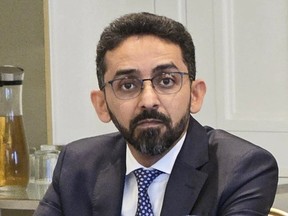
I called someone I have known since the late 1990s. Hisham Al-Omeisy, 47, was born in Sana’a and was among the first of about 100 students chosen, on merit, for a Nexen scholarship program I helped design. He studied at the University of Calgary, went home, worked for the U.S. State Department in Yemen, and stayed after the Houthis seized the institutions of government in 2015. In August 2017 the Houthis picked him up and held him for five months. He was released in January 2018 and got out of the country. He is now a senior adviser at the European Institute of Peace in Washington, which is a polite way of saying he spends his time trying to get people who would rather shoot each other into the same room.

Columnist Jesse Kline keeps you up to date with what’s happening in Israel and the effects of antisemitism on life here in Canada. Friday mornings.
By signing up you consent to receive the above newsletter from Postmedia Network Inc.
A welcome email is on its way. If you don't see it, please check your junk folder.
The next issue of Channel Israel will soon be in your inbox.
We encountered an issue signing you up. Please try again
“A lot of my colleagues from the State Department left, and so did a lot of foreigners, when the Houthis came crashing through Sana’a’s gates,” he told me. “I chose to stay, to focus on humanitarian issues.” The Houthis turned on him when he started saying their leadership was “living lavishly inside the country while everyone else was suffering.” Between torture sessions, he says, they put him and the other prisoners into dark, dungeon-like cells “to stimulate the feeling you’re being buried alive. It’s meant to break your spirit.” He counts himself lucky; dozens of people he knows are still inside these Houthi prisons, and some of them are very sick.
When we talk, he has just landed back in Washington from Nairobi, where he had been working back-channel talks. “Unfortunately,” he says, the Houthis were not at the table “because of their FTO designation,” the U.S. foreign-terrorist-organization listing Washington restored in 2025.
Ask him about a bombing campaign and he does not pause. “There is no winning this battle militarily.” A lot of people, he says, think they can fix it with “a couple bombs here, a couple of strikes there,” but what you get is levelled cities, and “ultimately, it’s the average Yemeni who’s gonna be paying the price — mothers, kids, children, elderly. I’ve seen that first-hand.”
He says the Houthis are not simply an Iranian proxy. Their roots in northern Yemen are old, and although Iran trains them, arms them and has folded them into the Axis of Resistance, “the Houthis have their own ambitions, their own religious dogma, and their beliefs are not necessarily aligned with the Iranians. It’s a bit of a marriage of convenience.”
The Gaza strikes, he says, were a launchpad more than a rescue mission. “Everyone kept dismissing the Houthis as a fringe, crazy group, and now they have missiles that can reach all the way to Tel Aviv.” Their leader, he adds, talks as if he has a divine claim on the Muslim world. Yemen, in that telling, is a recruiting ground, not a country to be rebuilt.
“The only thing these Houthis respond to is force.” Then the caveat: they have to believe there is a force on the other side, “and unfortunately the Yemeni government is still not there yet.” The Presidential Leadership Council sits over a patchwork of forces and factions, and Riyadh and Abu Dhabi spent a decade backing different pieces of that puzzle. That is why, he says, so much of the Houthis’ fire is aimed at Saudi Arabia rather than at Yemeni units.
“We need to humble the Houthis a bit, enough to force them back to the negotiating table,” he says, but he has little faith in a half-hearted measures. The 2022 ceasefire with the Saudis paused the shooting but left the reason for it untouched. That truce broke this summer; in August and September the Houthis pushed down the western coast of Yemen, and Saudi jets answered. Government forces have since claimed ground back; the Houthis dispute it.
The International Organization for Migration counted over 200,000 people newly displaced by early October. More than 3,700 had already crossed by boat to Djibouti, a poor country absorbing someone else’s war.
Hisham’s own numbers are bleak: about 40 per cent of Yemenis are without clean water, roughly 45 per cent of hospitals out of commission, three families in four unsure of the next meal, and four to five million already displaced, close to a fifth of the country. “People are literally eating tree leaves in some areas,” he says. No water, no food, camps: “disease can just rummage through.”
He is watching the Mecca Joint Defence Agreement, signed in Mecca on Aug. 7 by Saudi Arabia, Turkey and Pakistan: an attack on one is an attack on all. After Houthi strikes on the Kingdom, including near holy sites, the three countries activated the pact on Oct. 5 and promised forces and kit. Pakistan already has troops and air defence in Saudi Arabia. Islamabad describes the new role as support and reconnaissance, with the Saudis doing the fighting.
If the Pakistanis stay on the Saudi side of the border, “well and dandy,” he says. “It will serve its purpose; they could create that buffer zone, protect the southern border for the Saudis, protect Aramco and all the oil there.” If Riyadh gets more ambitious, “thinking they can use these Pakistanis for assistance — they are already paying them — and launch an incursion toward Yemeni soil, that would backfire.” Yemenis, he says, are not fans of foreign boots. “As much as I don’t like the Houthis, this is not going to be about the Houthis. This is going to be about Yemenis fighting a foreign invasion. That’s how the Houthis will pitch it,” and the tribes will be invited in.
The 2022 ceasefire is his cautionary tale. It paused the shooting, but it did not touch the reason for the shooting. He wants the Houthis humbled enough to negotiate, not bombed into oblivion. Ships now paying a toll to pass through the Bab al-Mandeb strait, he warns, are writing “a new set of rules that are really troubling,” short-sighted money paid to a terrorist organization.
“There’s no military solution here,” he reiterates. “Yes, there’s going to be a campaign to humble one side or the other, but inevitably — are you going to kill 300,000 Houthis, or their supporters, who I think number about two million? On the other side, Houthis, are you going to kill all the government officials? Are you going to wipe out the South? You can’t.”
So talks are essential, he says. “Let’s not prolong the bloodbath, because ultimately it’s civilians who are paying the price.”
Our website is the place for the latest breaking news, exclusive scoops, longreads and provocative commentary. Please bookmark nationalpost.com and sign up for our newsletters here.
Join the Conversation
This website uses cookies to personalize your content (including ads), and allows us to analyze our traffic. Read more about cookies here. By continuing to use our site, you agree to our Terms of Use and Privacy Policy.
KioskNews shows a cleaned-up reading view extracted from the publisher’s page — the original always lives on their site, not ours.