The Cosmere Explained: Everything To Know About Brandon Sanderson’s Shared Fantasy Universe

Sign in to your Collider account
Fantasy literature is more popular than ever, and the medium is always changing. Previously, it was considered "for nerds" and was a fairly niche community. In the 21st Century, however, things have opened up quite a bit, and fantasy literature has become much more mainstream and celebrated, and rightfully so, likely because it provides a method of escapism, free from the mundanity of everyday life.
While fantasy novels are a dime a dozen nowadays, some of them have made a larger mark on history than their peers. Among these historical feats is a massive undertaking that is still ongoing and will likely not conclude anytime soon. This ambitious, sprawling, and one-of-a-kind project is known as the Cosmere, which has been going strong with yearly releases for 20 years now. The name has been popular lately thanks to the creator scoring an adaptation deal with Apple TV. But what exactly is the Cosmere?
What Is the Cosmere?
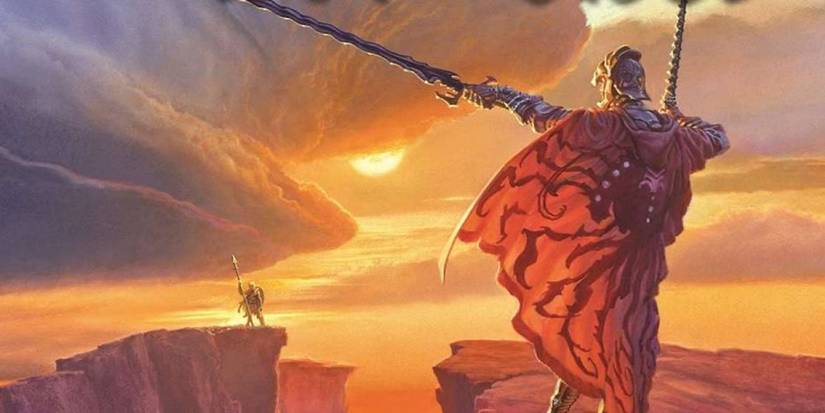
The Cosmere is a shared literary universe created by author Brandon Sanderson, beginning with his debut novel, Elantris, in 2005. The basic premise is that thousands of years ago, a god named Adonalsium was mysteriously shattered into 16 pieces called Shards. These Shards were scattered across the galaxy, each coming to rest within a particular solar system. Each stand-alone story or series takes place on its own planet within the same galaxy. Due to the influence of the Shards, many of these planets have developed unique magic systems, each of which is layered and complex. However, some stories also take place on worlds where no Shards are present. Moreover, while all Shards are known thanks to Sanderson's own words, what is not known is where they all are or what influence they have on their worlds — in fact, only a select few are currently accounted for. While there are still aspects of magic here, there are no complex systems available.
Not only is each planet different in regard to magic, but also in regard to geography. Some planets, like Sel from Elantris, are pretty similar to Earth. Others, however, like Taldain of the White Sand graphic novels, are completely different. Taldain is tidally locked, meaning it is permanently day on one side of the planet and permanently night on the other. There's also the barren, windswept world of Roshar, the burning world of Canticle, and the extremely alien planet Lumar, which doesn't technically defy physics but doesn't resemble any real planets that we know of.
|
System |
Shard(s) |
|
Nalthis |
Endowment |
|
Roshar |
Cultivation, Honour, Odium |
|
Scadrial |
Preservation, Ruin |
|
Sel |
Devotion, Dominion |
|
Taldain |
Autonomy |
The Cosmere isn't strictly relegated to one particular sub-genre of fantasy, either. Elantris is more of a Medieval fantasy, but others fit firmly into the categories of steampunk, romantasy, space fantasy, urban fantasy, and epic fantasy. The universe isn't relegated to one specific format either, as it consists of many short stories, novellas, novels, graphic novels, and even children's picture books. There are over 30 of these entries, with many more planned to come. Recently, the universe has even expanded to include tabletop role-playing games. Their status as canon is debated, but they do add a new level of interaction with the universe that fans love so much.
How Are the Cosmere Stories Connected?

The primary way in which the broader Cosmere is connected is via a mysterious character named Hoid (that's one of his names, anyway). No matter which story you read, you're almost guaranteed to find him lurking somewhere. Sometimes, he plays a major role, aiding the protagonists on their quests, whilst other times he is nothing more than a brief glimpse in the background. No one yet knows who Hoid truly is or what he wants, but he seems capable of performing all types of magic, regardless of the system. Hoid describes himself as a Worldsinger, meaning he is a sort of magical bard who tells stories, plays a flute, and inspires others. He has also taken up other professions, though, such as carriage driver, pirate, and even a coat hanger (yes, really).
Hoid isn't the only Worldhopper, though he is the most prolific. Other Worldhoppers (that is to say, characters who can jump to other worlds) are present. There are also many shadowy organizations working behind the scenes, which seem to have a motive that spans the entire galaxy, though what these motives are have yet to make themselves clear. It's here that the Cosmere excels the most: keeping the reader invested (pardon the pun, for those who are already fans). Not only are there secrets to be revealed over the span of numerous series, but each world is meticulously designed and more singular and different than any other work of fantasy out there.
Collider Exclusive · 8 Questions · 2 Minutes What Fantasy World Do You Belong To? Middle-earth · Grand Line · The Continent · Camp Half-Blood
Pick your magic, your crew, where you want to wake up and who you would rather be fighting, and we will tell you which world you actually belong in. Four are open to you: an ancient kingdom living through its last good age, an endless sea full of pirates, a continent that pays people to kill monsters, and a summer camp where the Greek gods are extremely real and mostly a nuisance.
💍Middle-earth(Rings of Power)
👒Grand Line(One Piece)
🐺The Continent(The Witcher)
🔱Camp Half-Blood(Percy Jackson)
01
What kind of power do you want? Every one of these worlds runs on a completely different sort of magic.
02
Who is travelling with you? Nobody gets through any of these stories entirely on their own.
03
Where do you want to wake up tomorrow? The best fantasy is usually just somewhere you would genuinely like to live.
04
How are you making a living out there? Even in fantasy somebody has to pay for the horse.
05
There is something in the woods. What do you do about it? All four of these worlds keep something unpleasant out there in the dark.
06
Who is the villain of your story? The enemy tells you far more about a world than the hero ever does.
07
What do you actually believe in out there? Every world hands its heroes one rule and asks them to hold onto it.
08
A thousand years from now, how are you remembered? Eight questions in, this is the one that decides your world.
The Map Is Drawn Your World Is…
Four worlds and four completely different ideas of what a good life looks like. This is where you belong, what it would ask of you, and what you would get back in return.
Middle-earth
You belong somewhere old enough that the mountains have names and somebody can still tell you who gave them. Middle-earth is for people who think the right thing is worth doing even when it will not be finished in their lifetime.
- This is the only world on the list where doing good is understood as a very long defeat, fought anyway, by people who will never see how it ends.
- You are drawn to grandeur, to white cities and deep forges and the sense that almost everything you touch is older than your entire family line.
- The Rings of Power is set in the last good age before it all goes wrong, which gives every quiet scene in it a slightly unbearable weight.
- You would take the hard road, and you would take it on foot.
The Grand Line
You want the sea, a crew, and absolutely nobody telling you where you are allowed to go. The Grand Line is the world for people whose main ambition in life is finding out what is over there.
- One Piece has run for decades on one very simple engine, which is a group of people who each want something impossible and have decided to go and get it together.
- You collect people. Your ideal crew is a set of misfits who were each written off somewhere else before you turned up and offered them a better idea.
- The world is enormous and deliberately ridiculous, and the emotional gut punches land harder because of that rather than in spite of it.
- You would set sail knowing the map runs out, which is more or less the entire point of it.
The Continent
You would rather be feared and useful than liked and useless. The Continent is a world where the monsters are the straightforward part of the job and the people are where it all gets complicated.
- Witchers get paid to do what nobody else will and resented for existing at all, which is a trade most people would refuse and you would probably accept.
- You have no real illusions about which side is the good one, largely because on the Continent that question tends to have a disappointing answer.
- The best of these stories are not about the fighting. They are about somebody with a rigid code being repeatedly cornered into caring about people.
- You would take the coin, finish the job properly, and be out of town before the story got told wrong.
Camp Half-Blood
You want the myths to be real and loose in the actual world, and you want to find out at about thirteen that you were never anywhere near as ordinary as everybody kept telling you.
- Percy Jackson takes the oldest stories we have and drops them into car parks and diners, which makes the gods considerably funnier and a great deal worse.
- You would be the kid every school gave up on, who turns out to have been built for something nobody thought to test for.
- The series is genuinely about friendship rather than destiny, and it says so out loud every time a prophecy tries to get in the way.
- Camp Half-Blood is the real fantasy here: a place where the thing that made you difficult everywhere else is the thing that makes you belong.
What Makes the Cosmere so Enticing?

One of the main reasons fans are constantly drawn to the Cosmere goes beyond its immersive worlds and varied settings. As any fan will tell you, there is some profound moral wisdom within the pages. Characters often give sage advice to others, which is also applicable to real life. Many of these tidbits are about perseverance, trauma, love, politics, and war. They show how Sanderson thinks and feels, and how he, like many of the greatest fantasy authors, believes there is good to be found, even amongst turmoil.
Another reason fans are drawn to the Cosmere is its diversity. The Stormlight Archive series, for example, mostly consists of People of Color, to the point that white people are rare. Other stories, like Mistborn, feature primarily white people, but still have their fair share of POCs. The stories also include numerous queer, neurodivergent, disabled, and gender non-conforming characters, and feature both women and men in leading roles. Within each race, various nationalities are represented as well, often bearing similarities to real-world cultures. This approach makes the story vastly accessible, to the point that no one feels alienated or left out. Everyone can see a little bit of themselves in at least one character.
Lastly, there's the "Sanderlanche," which occurs in pretty much every book. This term refers to a deluge of plot twists that happens all at once near the end, exposing Sanderson's outside-the-box thinking and pre-planning. None of these twists feel like deus ex machinae, either, and all make sense within their contexts.
The Cosmere May Rival J. R. R. Tolkien
The Cosmere has not ended, not by a mile. In fact, it has been said that we are only about halfway through everything, if not a little less than that, with more works planned for release over Sanderson's lifetime. Other authors, such as Sanderson's friend Dan Wells, are planning to collaborate on the project, too, meaning this prospect will likely end up turning into a five-decade affair, if not more. With each new series or stand-alone entry, the lore thickens, and new histories are introduced. Magic systems emerge, and the stories influence the whole Cosmere in unimaginable ways. Already, the Cosmere is one of the most comprehensive and expansive universes in all of fantasy, yet it still has a long way to go.
By the time it has concluded, the Cosmere might very well rival the legendarium of J. R. R. Tolkien, who penned an enormous mythology surrounding his beloved The Lord of the Rings trilogy. Tolkien's world is widely considered the most complex mythology ever written, with more and more of his work being revealed even today, decades after his death. While the histories of each planet in the Cosmere may not come close to Tolkien, the lore behind the universe as a whole might just. This lore isn't revealed through history books, but rather by natural revelation, as part of the narrative (supplemented by a few short appendices). It's enough that readers have even been able to piece together a distinct chronology, placing each story in an organized timeline. There is no doubt that this shared universe will eventually go down in literary history as a masterclass in writing — heck, it pretty much already has.
KioskNews shows a cleaned-up reading view extracted from the publisher’s page — the original always lives on their site, not ours.