‘Not about preventing AI misuse’: S’pore universities move from grading essays to assessing thinking
SINGAPORE – In a seminar room at the Singapore Management University (SMU), a professor is assessing a student as he delivers a live pitch to the class about an app he developed that guides users through a healthy grieving process.
After the student’s five-minute presentation, he has to tackle queries lobbed at him from fellow students and the professor during a question-and-answer segment.
A peer asks him if the app caters to a user’s unique emotional needs. He explains how the app asks users about what they are feeling each day, before determining the support they need.
This session makes up 30 per cent of the final grade for the management communication module. Other components include weekly reflections, and essays done either in class or online with a lockdown browser that prevents students from visiting other websites.
The professor at the session is evaluating the students’ understanding of concepts and their ability to spontaneously respond to questions without relying on a prepared script.
In previous years, the professor had graded students based on essays and projects submitted at the end of the term.
Elsewhere in SMU, another professor, Michelle Lee, is watching over students in her sustainable marketing class, as they write their essays in 15 minutes, without any materials to refer to.
They were given the essay question two weeks earlier, and were allowed to use AI to do research and formulate their answers.
But by having students write the essays in class, Lee said she is able to see whether students can put together a well-formed essay based on their research and understanding of the essay question, instead of using AI as a shortcut.
Tertiary educators have been moving away from traditional assessments like essay submissions to come up with creative ways to evaluate students.
This is a shift that is increasingly necessary as AI use becomes more common and even encouraged in universities.
“We have to be more creative in thinking up less straightforward ways to test students. Like a problem scenario where there are no easy answers, and AI will not be able to tackle it or answer in a perfect way,” said Lee.
This issue was thrust into the spotlight in 2025, when three public policy and global affairs students at the Nanyang Technological University (NTU) were penalised for misusing AI, resulting in false and inaccurate citations in their submitted essays.
NTU and the Singapore University of Social Sciences (SUSS) said in August that they will stop deploying detection tools to flag for AI misuse in students’ work.
The National University of Singapore (NUS), Singapore Institute of Technology (SIT) and Singapore University of Technology and Design (SUTD) also told The Straits Times they do not use such tools.
SMU said deploying detection tools is just one of the ways it detects AI misuse.
Christian Wolfrum, NTU’s deputy president and provost, said AI-detection tools served a reasonable purpose when universities were navigating AI’s uncharted territory, after OpenAI released ChatGPT in November 2022 and students began experimenting with it.
Over time, the detection tools have become obsolete, he elaborated, and research has shown that they produce unreliable results.
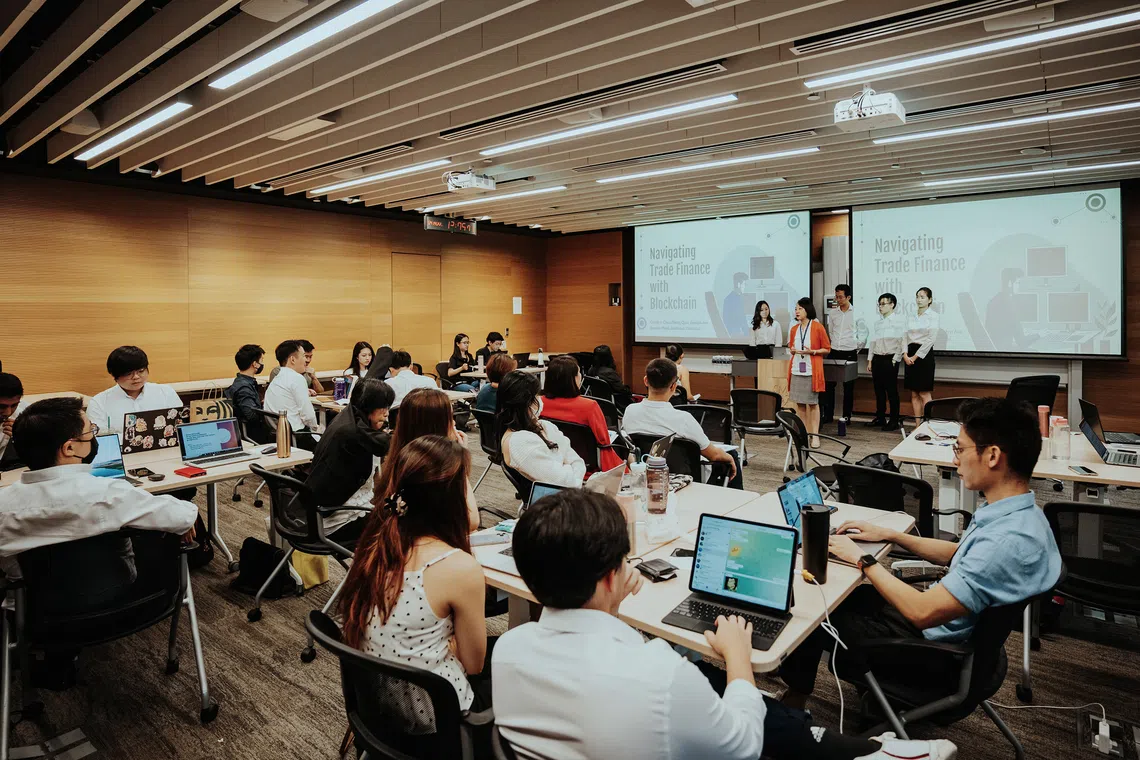
Tertiary educators have been moving away from traditional assessments like essay submissions to come up with creative ways to evaluate students.
PHOTO: SMU
For example, SUSS had used AI detectors from Turnitin, a software used to check assignments for plagiarism.
The tool is based on statistical guesswork instead of concrete proof. According to research, it raises false flags for structured human writing, and unfairly targets non-native English speakers who write simply.
With NTU teaching students AI literacy and responsible use from April 2026, as well as offering them free access to a suite of premium Google AI tools, Wolfrum said that it was timely to retire AI-detection tools.
Other universities also offer students access to AI tools, such as ChatGPT Edu and Microsoft Copilot. Some use custom AI bots to assist with daily studying, coding and even oral exams.
“NTU’s approach to assessment is moving in a direction where faculty can evaluate what a student actually knows and understands, not just what they submitted,” said Wolfrum.
Grading understanding as students learn with AI
The local universities said their students are told explicitly when AI use is allowed, forbidden or is a must. For example, some courses require students to brainstorm with AI to develop a project, while others prohibit students from using AI when answering a quiz.
As more universities here phase out grading work submitted each term, they seek to evaluate the process of learning, or assess students’ thinking and understanding at progressive checkpoints.
Lee, SMU’s associate provost for undergraduate education, said the university implemented new assessment design guidelines for faculty to follow in the age of AI. One criterion mentioned is designing assessments where AI offers no meaningful advantage.
Across the six autonomous universities here, assessments come in various forms. These include:
Invigilated examinations that prohibit the use of AI
In-person oral presentations
Gallery presentations, which require students to set up visual displays of their work around a room and interact with professors viewing the displays
Staged submissions, such as drafts or outlines showing students’ reasoning at each point
Reflective journals done in class without the use of AI
Oral defences that require students to explain their decisions
In some instances, such as in SMU’s writing and reasoning course, instructors assign higher-order tasks where students are graded on their ability to evaluate AI outputs.
Students first use AI to generate summaries of readings. Then, they evaluate them for accuracy, bias and hallucinations by comparing the AI-generated material with published sources.
Designing such tasks takes time and involves rigorous testing before they are used. But SMU’s Lee said this is necessary and useful at a time when students have to learn with AI.
“We have no choice. We have to change how we are teaching and testing students to make sure they are learning,” she said.
Alvin Teo, 24, a third-year engineering student at SUTD, said while traditional exams or essay writing can be stressful for him, oral presentations require him to think fast on his feet and understand concepts in such depth that he can argue them convincingly in person.
Said Teo: “With oral defence, I cannot just memorise the final result. I have to be prepared for someone to ask, ‘Why did you choose this geometry? Why do you expect it to perform better?’
“If there is a gap in my understanding, I have to work through it and respond in real time.”
Xavier Goh, 21, a second-year economics undergraduate at SMU, said AI usage remains high among university students regardless of the assessment format.
“Shifting from written final exams to live presentations changes how we use AI rather than reduce our reliance on it,” he said.
While AI serves as an interactive tutor when he is preparing for traditional exams, Goh said its use for live presentations and oral examinations is limited to background research and script refinement. The technology cannot help him during in-person Q&A sessions.
Ashraf Kassim, SUTD’s associate provost of education and innovation, said assessment methods like oral presentations at different checkpoints keep students engaged throughout the course and help them develop a deeper understanding of the material.
“They can’t put off learning to the end and wait for the high-stakes exam paper,” he said, adding that this approach enhances students’ employability as it prepares them better for real-world problem-solving.
May Lim, SIT’s assistant provost for applied learning, said assessments should not focus only on whether AI was used, but also whether students can demonstrate the knowledge, competence and professional judgment expected of a graduate.
This, she said, is increasingly important in AI-enabled workplaces, where employers will expect graduates to combine disciplinary expertise with AI skills.
“Assessing is not just about preventing the misuse of AI. It is to ensure that AI does not replace the learning, thinking and capabilities that students are expected to develop,” said Lim.
KioskNews shows a cleaned-up reading view extracted from the publisher’s page — the original always lives on their site, not ours.