‘I can’t afford to lose £3,000’: the ‘gameshow’ that made contestants gamble their own money

In late October, some canny viewers began to wonder whether there was something strange about Channel 4’s latest gameshow. Bradley Walsh’s Million Pound Shot had been billed as a new big-money contest with a twist, but information about its pilot episode was strangely minimal. Television and radio producer Chuck Thomas wondered on X whether it could be a Derren Brown-style psychological experiment; a Ghostwatch-esque stunt; or even a dark TV comedy in the vein of the genre-bending series Inside No 9. Indeed, the timing – one day after Halloween – also seemed to point viewers towards some kind of parody or one-off drama.
As more information was revealed about the show – including that its players would stake their own money, in a UK television first – Thomas considered whether this was in fact “an elaborate anti-gambling stunt”. It was an opinion shared by journalist Alistair Ryder, who posted that it was “more likely to be a stealth anti-gambling drama disguised as a gameshow than a modern Ghostwatch”, adding that the programme “could make for uncomfortable viewing in a completely different way”.
Both were right: Bradley Walsh’s Million Pound Shot was a fake, designed to highlight the manipulative tactics used by the gambling industry. And even for those who watched the programme live tonight (Channel 4 provided press screeners a few days beforehand), the ruse was likely fairly apparent from the outset. One contestant, Mark, declared that he would stake all of the money he had to his name – £1,000 – while another, Reece, intended to use money borrowed from friends and even credit cards and loans for a chance to win the show’s titular top prize. Said Walsh, in a departure from the usually upbeat language of TV quizzes: “There could be a lot to win … but there could also be a lot to lose.” Either this was the biggest recession indicator ever, or there was something more afoot.
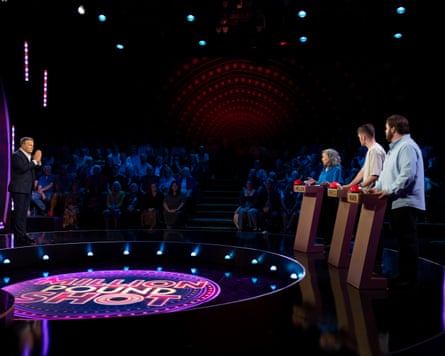
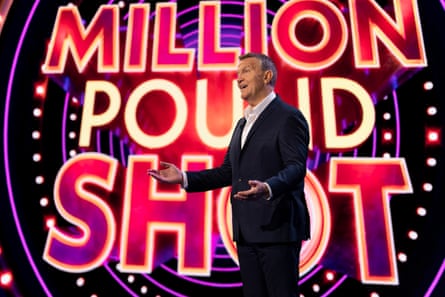
Walsh compered the show in the usual breezy style he displays on ITV’s The Chase (when Reece made his first bet – using a chip-and-pin machine mounted in his lectern – Walsh asked: “Did you leave a tip for me?”). But what followed was markedly different from what we usually see in these sorts of shiny-floor productions. Reece began to lose badly, betting more than he could afford on trivia rounds and ending up £2,400 in the red. At a critical moment where he could have cashed out of the game, he was offered a bonus ball – a free bet – for the “million pound shot” roulette game. “I can’t really afford to lose £3,000,” said Reece, a teacher on an annual salary of £30,000. “But then, if you have another free £3,000 … ” He played on, losing catastrophically. But, said Walsh, he could always buy another ball with his own money …
It was here that Million Pound Shot’s artifice would have begun to truly give way for anyone watching live. A heckler in the crowd asked whether there was “no one else that thinks that this is wrong?!” The woman was an actor – as was Reece, Mark, another contestant Helen and even the floor manager. But – as both viewers at home and press watching in advance would have then realised – the audience were totally unaware. Pity the people who thought they had signed up for a fun outing, only to find themselves at the centre of a downbeat TV experiment.
But, depressing as it may be, Million Pound Shot had an important message. Psychologist Dr Steve Sharman explained to the studio audience that the game’s “bet balls” echoed the way the gambling industry makes money feel abstract, encouraging people to spend far beyond their means. Losses, he explained, are often disguised as wins, using an example of similar-sounding winning and losing notifications from the Ladbrokes app which “messes with the reward circuitry in our brain”. (Entain, which owns Coral and Ladbrokes, say customers only receive promotional offers if they have opted in to marketing, and that it blocks marketing where it identifies safer gambling concerns, even if a customer has opted in. It strongly rejects any suggestion that Coral deliberately targets customers showing signs of gambling harm with free bets. They say all games on Ladbrokes are certified to the regulator’s technical standards, which ban games from celebrating a return less than or equal to the stake.)
Pressing a buzzer gave Reece the illusion of control, in the same vein as fixed-odd betting terminals and online games, while the free bet hooked him back in just as he should have quit, echoing tactics used by the likes of , William Hill. (Evoke, owners of William Hill, say they strongly reject any suggestion that they disregard consumer protections to keep customers playing regardless of the potential risks. They say their approach to restricting marketing and take-up of new bonus offers is informed by the Gambling Commission’s requirements and their own assessment of indicators of gambling harm. They say they have invested in specialist teams to identify potential signs of gambling harm and take appropriate action, including stopping customers from gambling.) Gambling reform campaigner Will Prochaska told Walsh that problem gamblers were nine times more likely than others to be offered a free bet, with half of the sector’s profits coming from just 5% of its customers.
Elsewhere, according to Prochaska, at least £1bn a year is spent by the industry on advertising in the UK – to replace customers who quit, turn to crime to fund their gambling, or even take their own lives. Walsh’s language, we learn, had been lifted directly from those adverts, such as Sky Bet. (Flutter UKI, which owns Paddy Power & Sky Bet, say they operate in a legal, licensed and highly regulated market and they take their obligations incredibly seriously. They say advertising is a benefit of being part of a regulated market. They say that like any other business, their brands offer promotions to attract customers and free bets are part of that offer.)
The most impactful aspect of Million Pound Shot was arguably an interview with the man who inspired the character of Reece, Patrick Foster, who struggled with gambling addiction for 13 years, racking up estimated debts of around £250,000. He began gambling in betting shops at university, before turning to the internet: “Suddenly I had a betting shop and a casino in my pocket, and I could do it any time, any place, at the click of a button.” At one stage, Foster had 76 accounts with different online platforms. Like Reece, he was also a teacher. So severe was his addiction that he lied to his students’ parents and borrowed money from them, too. A high-risk attempt to get the money back led him to contemplate suicide. His wife Charlotte says: “The gambling industry has an awful lot to answer for.”
Foster’s story has been highly publicised before. And many of the gambling industry’s dirty tricks have long been dissected by journalists like the Guardian’s Rob Davies, who wrote in his 2022 book Jackpot that such companies “have an incentive to ensure you don’t twig that you’re steadily haemorrhaging cash”. Million Pound Shot might also feel too heavy-handed – a clearly signposted experiment that lays everything on extra thick.
And yet, it highlights an extremely dangerous problem that’s all too often trivialised. A closing ident tells us that £17.5bn was lost by Britons to gambling in 2025, with one in every 14 suicides linked to gambling. Reform is surely long overdue. “It’s serious, it’s real and it’s happening now,” says Walsh of the events dramatised in Million Pound Shot. If it makes even one person think differently about how they gamble, this brash and blatant hoax will surely have been worth it.
A Betting and Gaming Council spokesperson said: “Our members operate in one of the most tightly regulated gambling markets in the world, with strict rules on advertising, customer protection, promotional offers and game design. These protections have been strengthened significantly in recent years. Practices such as losses disguised as wins have been banned for years, while operators are required to stop marketing to customers where strong signs of harm are identified.”
-
In the UK and Ireland, Samaritans can be contacted on freephone 116 123, or email jo@samaritans.org or jo@samaritans.ie. In the US, you can call or text the 988 Suicide & Crisis Lifeline at 988 or chat at 988lifeline.org. In Australia, the crisis support service Lifeline is 13 11 14. Other international helplines can be found at befrienders.org.
-
In the UK, support for problem gambling can be found via the NHS National Problem Gambling Clinic on 020 7381 7722, or GamCare on 0808 8020 133. In the US, call the National Council on Problem Gambling on 1-800-MY-RESET. In Australia, Gambling Help Online is available on 1800 858 858 and the National Debt Helpline is at 1800 007 007
KioskNews shows a cleaned-up reading view extracted from the publisher’s page — the original always lives on their site, not ours.