Professor honored for his heartbeat radar work
By Jonathan Chin / Staff writer, with CNA


The Ministry of Education yesterday awarded a researcher for developing self-injection-locked (SIL) radar for monitoring human vital signs without physical contact, among other achievements.
National Sun Yat-sen University (NSYSU) electronic engineering professor Horng Tzyy-sheng (洪子聖) won the ministry’s Academic Award in the engineering and applied sciences category, the university said in a news release.
The ministry awarded Horng in recognition of his “pioneering” work on SIL radar, also known as “4D Sensing,” which integrates sensors with Wi-Fi, artificial intelligence (AI) and next-generation telecommunications, it said.
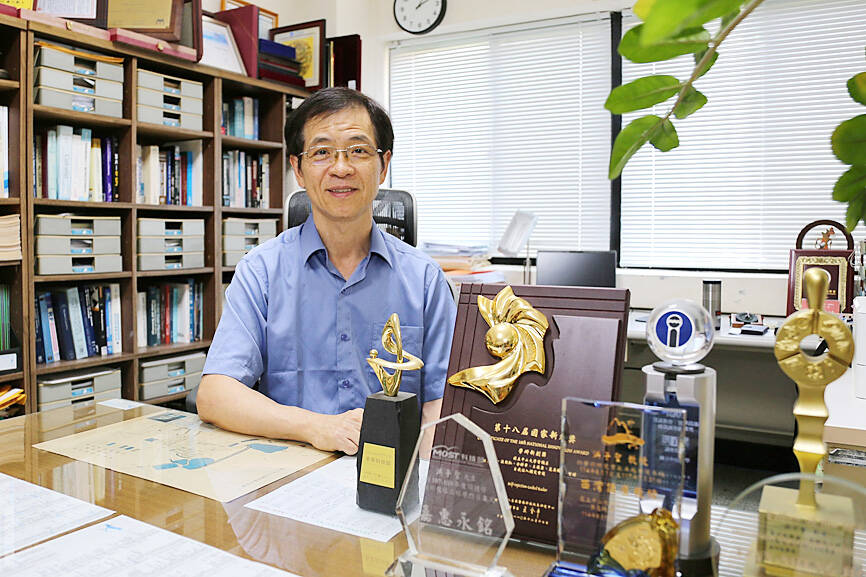
National Sun Yat-sen University electronic engineering professor Horng Tzyy-sheng poses at his desk in an undated photograph.
Photo courtesy of National Sun Yat-sen University
The contributions are being applied to the medical field, livestock management and advanced mobile networks, it said.
SIL technology detects movement without requiring the subject to wear equipment or skin contact, improving a caregiver’s ability to monitor the health of their dependents, it said.
SIL radars have been used to remotely monitor quarantined people during the COVID-19 pandemic, which reduced infection risks for medical personnel, it added.
The technology, which holds more than 80 patents globally, is available for use by authorized users, including US farms and ranches that obtained a US$2 million use-permit package, the university said.
Horng’s team built Taiwan’s first-ever integrated sensing and communication (ISAC) system prototype, combining telecommunications and radar-like sensory capabilities, it said.
ISAC technology is capable of simultaneously transmitting data and sensing the position, bearing and speed of objects in its network, with applications in smart homes, healthcare and environmental perception, it said.
Horng is also involved in research on the transmission characteristics of semiconductors, packaging and motherboards, which led to the development of technology utilized by ASE Technology Holding Co (日月光投控) and other chipmakers, the university said.
In 2016, he became an Institute of Electrical and Electronics Engineers fellow and was twice the recipient of the National Science and Technology Council’s Outstanding Research Award, it said.
The news release cited Horng as saying that he thanks the university for its long-time support of his work and that the award is a storied and highly regarded distinction among researchers.
He urged the nation to create more prizes and career opportunities to retain talent in research fields, it said.
KioskNews shows a cleaned-up reading view extracted from the publisher’s page — the original always lives on their site, not ours.